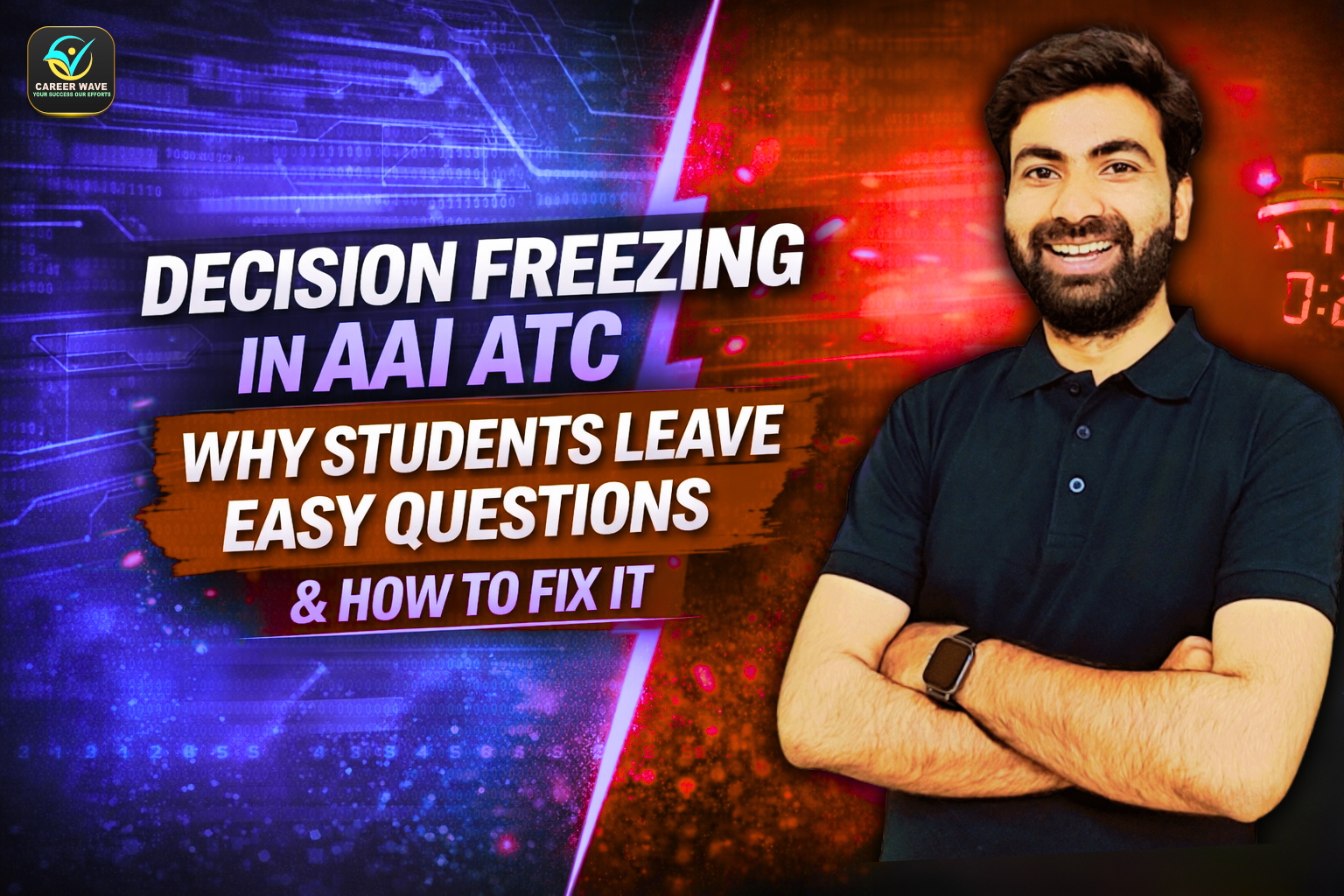
Decision Freezing: The Hidden Reason Students Leave Easy Questions
You prepared for months.
You solved PYQs.
You gave mock tests.
But inside the AAI ATC exam hall, something strange happens.
You read an easy question.
You know the concept.
Still… you don’t mark it.
Later outside the hall, you realize —
"That was 100% correct."
This silent mistake is called Decision Freezing — and it is one of the biggest hidden score killers in competitive exams.
At Career Wave, we’ve analyzed mock data of hundreds of AAI ATC aspirants, and this pattern appears again and again:
Students don’t fail because of lack of knowledge.
They fail because of hesitation at the moment of decision.
Let’s understand this deeply.
1) What Exactly is Decision Freezing?
Decision Freezing is a psychological reaction under pressure where:
• The brain delays commitment
• Confidence drops temporarily
• Fear of being wrong overrides logic
• You postpone marking the answer
It is not confusion.
It is not ignorance.
It is hesitation under stress.
And in a time-bound exam like AAI ATC, hesitation = marks lost.
2) The Psychology Behind Decision Freezing
Let’s break down what actually happens inside your brain.
2.1 Fear Response Activation
When you see a doubtful option, your brain triggers risk-avoidance mode.
It thinks: “Better safe than sorry.”
So instead of attempting with 80% confidence, you skip.
2.2 Cognitive Overload
During the exam, your brain is handling:
• Time pressure
• Question analysis
• OMR/online marking
• Cutoff anxiety
• Self-doubt
When too much information is processed, decision speed drops.
2.3 Perfectionism Trap
Many serious aspirants think:
“I will only attempt when I am 100% sure.”
But competitive exams reward probability-based decisions, not perfection.
2.4 Negative Marking Trauma
Even if negative marking is minimal, past experiences make students overly cautious.
One wrong attempt in mock test → emotional memory → hesitation in real exam.
3) Why Decision Freezing is Dangerous in AAI ATC
AAI ATC is a precision-based exam.
Cutoffs are usually tight.
Difference between selection and rejection can be 3–6 marks.
Now imagine:
• You left 8 easy questions
• 6 of them were correct
• You lost 6 marks
Those 6 marks might be your final rank difference.
At Career Wave, when we analyze mock reports, students are often shocked to see how many “known but unattempted” questions they left.
4) Real Example Scenario
Suppose paper difficulty is moderate.
Total questions: 120
You attempt: 85
Out of remaining 35, at least 10 were known but skipped.
If you had attempted those 10 with 80% accuracy:
Correct: 8
Wrong: 2
Even with negative marking, net gain is positive.
But fear made you leave them all.
This is how Decision Freezing silently reduces your score.
5) How Toppers Control Decision Freezing
Through detailed observation at Career Wave, we’ve identified patterns among high scorers.
They are not emotionless.
They are trained decision-makers.
5.1 They Trust First Logical Instinct
Research and exam behavior show that first analytical instinct is often correct.
Toppers:
• Read
• Analyze
• Decide
• Move
They don’t re-evaluate 3 times unless truly confused.
5.2 They Follow Structured Attempt Strategy
Instead of randomly solving, they follow:
🔵 Round 1 – Direct & Easy (Fast scoring)
🟡 Round 2 – Moderate questions
🔴 Round 3 – Risk-managed attempts
This reduces panic and hesitation.
At Career Wave, we actively train students in structured attempt flow inside full-length mocks.
5.3 They Use the Confidence Scale Method
During mocks, rate each attempt:
• 100% sure
• 80% sure
• 60% unsure
Later analyze:
How many 80% answers were actually correct?
This builds statistical confidence.
5.4 They Practice Decision Speed, Not Just Syllabus
Many students’ complete syllabus but never train decision timing.
We emphasize:
• Timed sectional tests
• Rapid decision drills
• Limited-thinking practice
• Pressure simulation
Because AAI ATC is a decision-making exam.
6) Signs You Are Suffering from Decision Freezing
Be honest with yourself:
✔️ You review same question multiple times
✔️ You change answers frequently
✔️ You leave questions despite knowing concept
✔️ You feel mentally blocked in middle of paper
✔️ You regret more unattempted than wrong answers
If 3 or more match, you need strategy correction.
7) How to Fix Decision Freezing (Practical Plan)
Here’s a structured plan you can start immediately:
Step 1: The 10-Second Rule
If you understand the question and recall concept within 10 seconds → attempt.
If not → mark for review and move.
No emotional thinking.
Step 2: Set Attempt Target Before Exam
Example:
Paper moderate → Target 95–105 attempts
Paper tough → Target 85–95 attempts
Having a range reduces panic.
Step 3: Mock Reflection Journal
After every mock, write:
• How many known questions left?
• Why left? (fear / time / confusion)
• Was decision logical?
Within 5 mocks, pattern becomes clear.
Step 4: Reduce Emotional Attachment
Never think:
“This question is from my favorite topic, I must solve.”
Solve strategically, not emotionally.
8) Important Truth Most Students Don’t Realize
Leaving easy questions does not feel painful in exam hall.
But result day hurts.
And that pain is preventable.
Decision clarity is trainable.
At Career Wave, we focus heavily on exam psychology along with syllabus because we know — marks are lost inside the mind, not the book.
9) Final Takeaway
You don’t need more chapters.
You don’t need 500 extra questions.
You need:
• Controlled thinking
• Structured attempt strategy
• Confidence calibration
• Timed decision practice
Fix Decision Freezing → Your score jumps without extra study hours.
That’s smart preparation.
FAQs –
Q1. Is hesitation normal during competitive exams?
Yes. But controlled hesitation is healthy. Repeated freezing is harmful.
Q2. Should I attempt when 70–80% sure?
In most cases, yes — if elimination logic supports your choice.
Q3. How can mocks reduce Decision Freezing?
Mocks simulate pressure. Repeated exposure trains your brain to decide faster.
Q4. Is Decision Freezing a confidence issue?
Partly. It is a mix of confidence, strategy, and pressure management.
Q5. Can this be improved within 1–2 months?
Yes. With structured mock analysis and strategy correction, visible improvement is possible.
Related blogs-
Accuracy vs Speed: The Exact Balance That Clears AAI ATC Cutoff
The ‘Safe Attempt Zone’ Concept Used by AAI ATC Toppers
Score vs Rank Analysis: How to Predict Your Selection (Human, Real Insight)