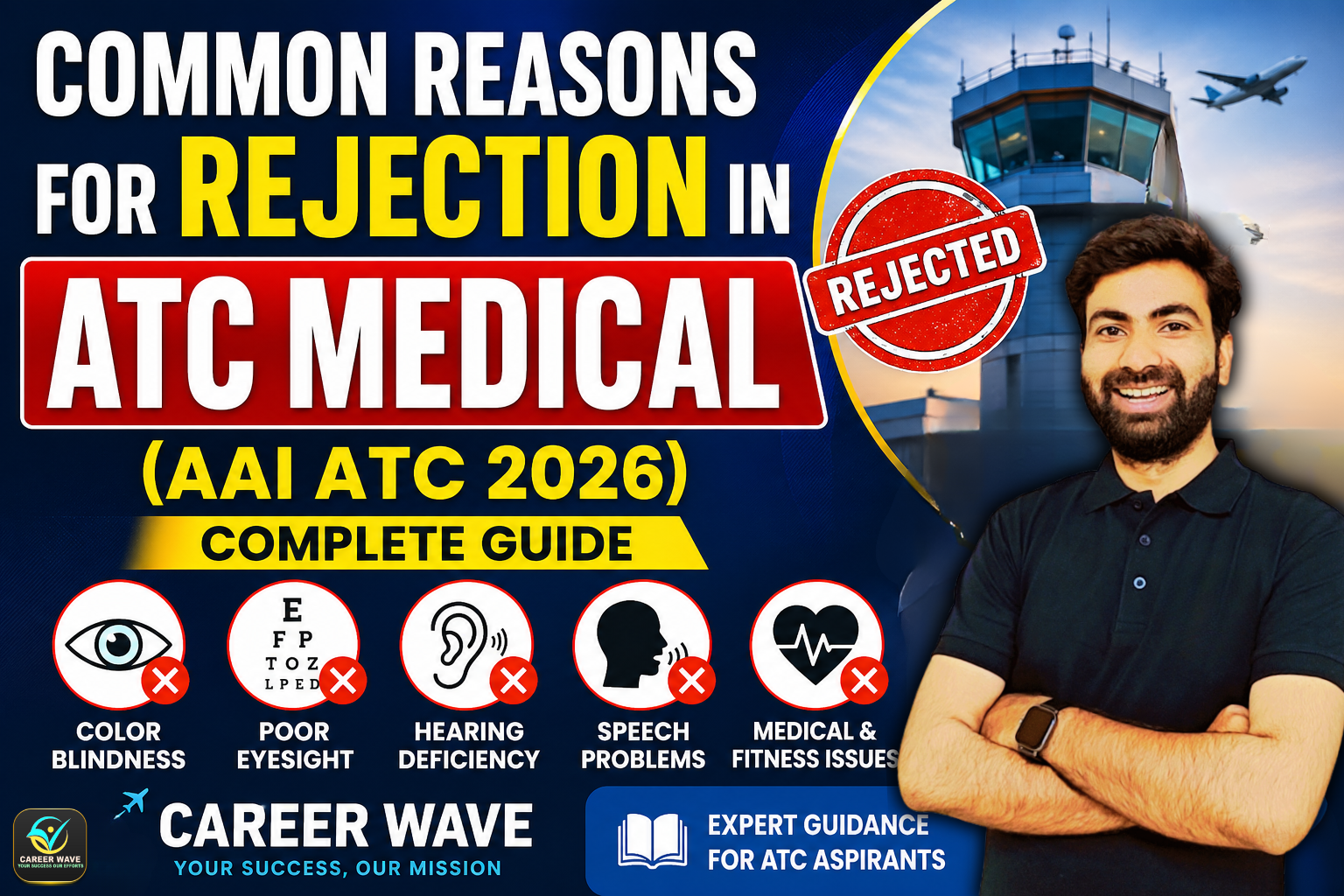
Common Reasons for Rejection in ATC Medical (AAI ATC)
Most AAI ATC aspirants focus heavily on clearing the CBT—and rightly so. But a critical reality often gets ignored:
Selection is not complete until you clear the medical examination.
Every year, a significant number of candidates with strong scores are rejected at the final stage. Not because they lacked preparation, but because they were not medically fit as per ATC standards.
ATC is a safety-critical profession. One wrong decision can impact hundreds of lives. That is why AAI follows strict, non-negotiable medical criteria.
1) What is ATC Medical?
The ATC Medical Examination is a specialized aviation fitness assessment conducted to verify whether a candidate is capable of handling:
• Continuous attention
• High-pressure decision-making
• Real-time communication with pilots
It evaluates:
• Vision (including color vision)
• Hearing ability
• Speech clarity
• Overall physical and mental fitness
The result is strictly:
Pass / Fail
There are no marks, no relaxation, and no second chances if you fail.
2) Why Medical Rejection Happens (Ground Reality)
Medical rejection usually does not happen suddenly. It happens because:
• Candidates are unaware of standards
• Issues are ignored during preparation
• No early verification is done
Result:
Months of preparation → good score → final rejection
3) Common Reasons for Rejection in ATC Medical
3.1 Color Blindness (Most Critical Reason)
This is the number one reason for rejection.
Requirement:
• CP-I vision (perfect color vision)
Even a slight deficiency can lead to rejection.
Why it matters:
ATC officers constantly interpret:
• Radar displays
• Signal lights
• Aviation indicators
A small error in color interpretation can lead to serious consequences.
3.2 Eyesight Not Meeting Standards
Required vision:
• Distance: 6/6 or 6/9 (with or without correction)
• Near: N5
Common issues:
• High refractive error
• Improper correction
• Fluctuating vision
Spectacles are allowed, but only if vision falls within acceptable limits.
3.3 Hearing Deficiency
ATC is communication-driven.
Controllers must:
• Listen clearly to pilots
• Respond instantly without confusion
Rejection may occur if:
• Hearing is not sharp
• Difficulty in understanding voice instructions
3.4 Speech & Communication Issues
Clear and confident communication is essential.
Possible reasons for rejection:
• Stammering
• Unclear pronunciation
• Speech disorders
Even minor communication issues can create operational risk.
3.5 Medical Conditions Affecting Alertness
ATC requires continuous mental focus and quick decision-making.
Rejection may happen due to:
• Neurological disorders
• Severe anxiety or instability
• Chronic conditions affecting alertness
The job demands consistent cognitive performance, not occasional efficiency.
3.6 General Physical Unfitness
Although ATC is not physically intensive, it requires:
• Long hours of mental concentration
• Stable health condition
Issues like:
• Frequent fatigue
• Poor stamina
may raise concerns during medical evaluation.
3.7 Late Awareness of Medical Criteria
This is one of the most avoidable mistakes.
Many aspirants:
• Focus only on CBT
• Ignore medical standards
• Check eligibility only after result
By then, it is too late to fix major issues.
4) Key Insight
Medical stage is:
• Qualifying in nature
• But final and decisive
You can:
• Clear CBT with high marks
• Still lose selection due to medical rejection
Preparation without medical awareness is incomplete preparation
5) Career Wave Guidance
At Career Wave, preparation is not limited to clearing CBT. The focus is on complete selection readiness.
Students are guided for:
• Understanding ATC medical standards early
• Vision and color test awareness
• Voice clarity and communication improvement
• End-to-end preparation strategy
This ensures that students do not face last-stage rejection after months of effort.
6) How to Avoid Medical Rejection (Practical Approach)
• Get complete eye check-up (including color vision) before preparation
• Test hearing ability if doubtful
• Work on speech clarity
• Maintain basic health and fitness
• Consult a doctor early if any issue exists
Most importantly:
Do not assume eligibility—verify it
7) Final Conclusion
AAI ATC selection is not just about scoring high.
It is about clearing every stage without failure.
Medical is not a formality—it is a strict elimination filter.
Smart aspirants:
• Prepare for CBT
• But also prepare for final eligibility
8) FAQs
1. Can I get selected if I fail the ATC medical?
No. Medical is a qualifying stage. Failure leads to final rejection.
2. Is color blindness allowed in ATC?
No. CP-I level vision (perfect color vision) is mandatory.
3. Can I wear spectacles in ATC?
Yes, but your vision must meet the required standards.
4. Is hearing tested strictly?
Yes. Clear hearing is essential for communication with pilots.
5. What speech issues can lead to rejection?
Stammering, unclear speech, or any disorder affecting communication clarity.
6. When should I check my medical eligibility?
Before starting serious preparation. Early awareness prevents future rejection.
7. How does Career Wave help in medical preparation?
Career Wave provides:
• Medical standards awareness
• Voice and communication guidance
• Complete selection-focused mentorship
9) Final Line
High marks can get you shortlisted
Only medical fitness can get you selected
Related Blogs -
AAI ATC JE Job Profile – Duties, Shifts & Work Pressure (2026)
How Structured Courses Improve Selection Chances in AAI ATC
Medical Test Requirements for ATC (Vision, Hearing, Fitness)