FCI Category 2 vs Category 3 Posts Explained – Complete Detailed Comparison for FCI Recruitment Aspirants
Food Corporation of India (FCI) recruitment is considered one of the most attractive government job opportunities for graduates across India. Every year, lakhs of aspirants preparing for SSC, Banking, Railways, Insurance, and other competitive exams also target FCI vacancies because of:
• good salary,
• central government status,
• job security,
• promotion opportunities,
• nationwide vacancies,
• and stable career growth.
Whenever FCI recruitment discussions begin, one of the most common doubts among aspirants is:
1) What is the difference between FCI Category 2 and Category 3 posts?
Many students become confused regarding:
• salary difference,
• eligibility,
• exam pattern,
• selection process,
• work profile,
• promotion opportunities,
• difficulty level,
• and long-term career growth.
This confusion is completely normal because both categories are important and both attract a huge number of applicants.
However, understanding the difference properly is extremely important before starting preparation because:
• preparation strategy changes,
• post preference changes,
• competition level changes,
• and career growth also changes significantly.
This article explains the complete detailed difference between FCI Category II and Category III posts in the simplest possible way.
2) Understanding FCI Recruitment Categories
The Food Corporation of India divides recruitment into multiple categories:
Category | Nature |
Category I | Senior management level |
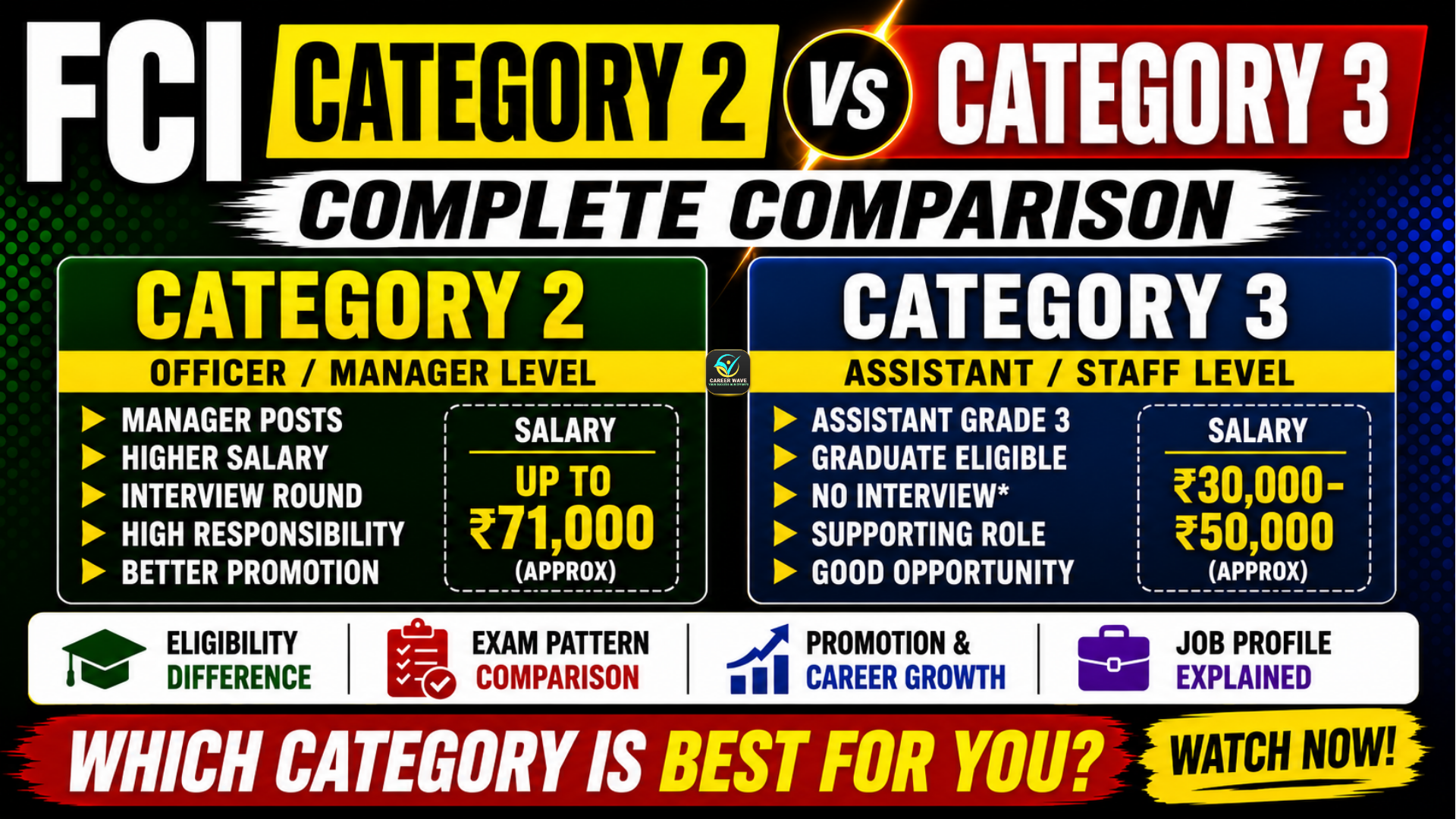
Category II | Officer/Manager level |
Category III | Assistant/Staff level |
Category IV | Watchman/Support staff |
Among all these categories, the most popular are:
Category II
and
Category III
because:
• they usually contain the largest vacancies,
• attract the highest number of aspirants,
• and provide strong career opportunities.
3) What Is FCI Category II?
FCI Category II mainly includes:
Officer-Level or Manager-Level Posts
These are supervisory and administrative positions inside the Food Corporation of India.
Employees in Category II generally manage:
• operations,
• logistics,
• depot systems,
• administration,
• technical activities,
• accounts,
• movement of food grains,
• and departmental coordination.
These posts are considered higher-level positions compared to Category III.
4) Major Posts Under FCI Category II
The following posts are usually included under Category II recruitment.
Post | Main Responsibility |
Manager (General) | Administrative management |
Manager (Depot) | Depot handling & storage management |
Manager (Movement) | Transportation & logistics |
Manager (Accounts) | Financial operations |
Manager (Technical) | Food quality & technical supervision |
Manager (Hindi) | Official language implementation |
These posts are officer-grade jobs and involve decision-making responsibilities.
5) Nature of Work in Category II
The work profile of Category II employees is more management-oriented.
Responsibilities may include:
• supervising staff,
• managing warehouses,
• handling transportation logistics,
• maintaining records,
• coordinating food supply systems,
• monitoring technical standards,
• preparing reports,
• and ensuring smooth operations.
Category II officers generally handle more responsibility compared to Category III employees.
6) Educational Qualification for Category II
The educational qualifications are more specialized.
Manager (General/Depot/Movement)
Expected qualification:
• Graduation from recognized university
Manager (Technical)
Expected qualification may include:
• B.Sc Agriculture
• Food Science
• Agricultural Engineering
• Biotechnology
• Food Technology
Manager (Accounts)
Expected qualification:
• CA
• ICWA
• CS
• MBA Finance
Manager (Hindi)
Expected qualification:
• Master’s degree in Hindi or English with translation-related expertise
7) Age Limit for Category II
Expected age limit based on previous trends:
Post | Expected Maximum Age |
Most Manager Posts | 28 Years |
Manager (Hindi) | 35 Years |
Age relaxation:
• OBC → 3 years
• SC/ST → 5 years
• PwD → additional relaxation
8) Selection Process for Category II
The selection process is generally tougher and more competitive.
Phase 1 Examination
Common online CBT including:
• English Language
• Reasoning Ability
• Quantitative Aptitude
• General Studies
This stage is qualifying in nature in many cases.
Phase 2 Examination
This stage is post-specific and much more technical.
Questions depend on:
• specialization,
• professional qualification,
• and selected post.
Interview Stage
Many Category II posts also include:
Interview Round
This makes the recruitment process more competitive compared to Category III.
Final Stage
• Document Verification
• Medical examination (if applicable)
9) Salary Structure of Category II
One of the biggest reasons students prefer Category II is the salary package.
Expected salary:
• Basic Pay during training → Around ₹40,000
• Gross Salary → Up to ₹71,000/month
Additional benefits:
• Dearness Allowance (DA)
• House Rent Allowance (HRA)
• Medical benefits
• Transport allowance
• Leave benefits
• Promotion increments
These jobs are considered premium officer-level government jobs.
10) Promotion & Career Growth in Category II
Promotion opportunities are considered very good.
Employees can rise through higher managerial positions over time depending on:
• performance,
• seniority,
• departmental exams,
• and experience.
Long-term career growth is one of the biggest advantages of Category II posts.
11) What Is FCI Category III?
FCI Category III mainly includes:
Assistant-Level and Operational Posts
These posts are more execution-based rather than management-based.
Category III employees generally assist in:
• office operations,
• clerical work,
• technical support,
• typing work,
• documentation,
• field-level tasks,
• and administrative assistance.
These posts usually attract the highest number of applicants because eligibility is comparatively simpler.
12) Major Posts Under Category III
Expected Category III posts include:
Post | Main Responsibility |
Assistant Grade III | Clerical & office work |
Junior Engineer | Technical operations |
Typist | Typing & document work |
Stenographer | Official shorthand & documentation |
Technical Assistant | Technical support |
13) Nature of Work in Category III
The work profile is generally operational and support-oriented.
Responsibilities may include:
• maintaining files,
• office assistance,
• data entry,
• typing,
• supporting depot activities,
• handling documentation,
• assisting officers,
• and maintaining records.
Compared to Category II, decision-making responsibility is lower.
14) Educational Qualification for Category III
The eligibility is generally broader and simpler.
Assistant Grade III
Expected qualification:
• Graduation from recognized university
Typist
Expected qualification:
• Graduation
• Typing skill requirement
Junior Engineer
Expected qualification:
• Engineering diploma or degree
Because many posts require only graduation, the competition becomes extremely high.
Age Limit for Category III
Expected age limit:
• Around 27 years in many posts
Relaxation:
• OBC → 3 years
• SC/ST → 5 years
• PwD → additional relaxation
15) Selection Process for Category III
The recruitment process is comparatively simpler.
Online CBT
Common subjects generally include:
• English
• Reasoning
• Quantitative Aptitude
• General Studies
Skill/Typing Test
Depending on the post:
• Typing Test
• Skill Test
• Technical Test
• may be conducted.
Final Stage
• Document Verification
Most Category III posts generally do not include interviews, which makes the process comparatively easier than Category II.
16) Salary Structure of Category III
Although lower than Category II, the salary is still considered attractive.
Expected gross salary:
• ₹30,000 to ₹50,000/month
Additional benefits:
• DA
• HRA
• Medical facilities
• Government allowances
For fresh graduates, these jobs are considered financially strong opportunities.
17) Promotion & Career Growth in Category III
Promotion opportunities are available, but generally slower compared to Category II.
Employees may gradually move to higher administrative positions through:
• departmental promotions,
• experience,
• internal exams.
Biggest Differences Between Category II & Category III
Feature | Category II | Category III |
Job Level | Officer/Manager | Assistant/Staff |
Responsibility | High | Moderate |
Salary | Higher | Moderate |
Qualification | Specialized | General |
Interview | Usually Yes | Mostly No |
Competition Type | Quality-based | Quantity-based |
Work Nature | Administrative | Operational |
Promotion Growth | Faster | Slower |
Difficulty Level | Higher | Moderate |
18) Which Category Is Better?
There is no universal answer.
The better category depends on:
• qualification,
• confidence,
• preparation level,
• career goals,
• and long-term plans.
Category II Is Better For:
Students who:
• want officer-level jobs,
• prefer higher salary,
• have specialized qualifications,
• are confident academically,
• want faster promotion growth.
Category III Is Better For:
Students who:
• are general graduates,
• want wider eligibility,
• prefer simpler recruitment process,
• are beginners in government exam preparation,
• want stable government jobs quickly.
19) Which Category Has More Competition?
Category III Competition
Category III generally attracts:
Massive Crowd Competition
because:
• graduation is enough,
• eligibility is broad,
• and posts are more accessible.
Lakhs of candidates apply.
Category II Competition
Category II competition is:
More Quality-Oriented
because:
• qualifications are specialized,
• interview exists,
• technical knowledge matters more.
Can Students Prepare for Both Together?
Yes.
This is one of the biggest advantages.
The Phase 1 syllabus for both categories overlaps heavily.
Students can prepare:
• Quantitative Aptitude
• Reasoning
• English
• General Studies
simultaneously.
Later they can prepare post-specific subjects separately.
20) Important Preparation Strategy for FCI Aspirants
Students should focus heavily on:
• mock tests,
• speed,
• accuracy,
• revision,
• current affairs,
• and consistency.
Most students fail because:
• they underestimate competition,
• ignore revision,
• avoid mock tests,
• or depend only on vacancy excitement.
21) Final Conclusion
Both FCI Category II and Category III offer excellent government career opportunities, but they are designed for different types of aspirants.
Category II
Best for:
• officer-level ambitions,
• higher salary goals,
• specialized candidates,
• long-term managerial career growth.
Category III
Best for:
• graduates,
• beginners,
• broader eligibility,
• faster entry-level government jobs.
The smartest strategy for aspirants is:
• understand the structure early,
• choose the category according to qualification and goals,
• start preparation before notification,
• and build strong fundamentals consistently.
When the official FCI Recruitment notification arrives, students who prepared early and understood the recruitment system properly will automatically have a major advantage over others.