How to Build a Personal Error Book for AAI ATC
Most AAI ATC aspirants spend months solving questions, giving mocks, revising formulas, and studying theory.
But despite all this effort, many students still repeat the same mistakes again and again.
Examples:
• same formula mistake
• same sign error
• same reading mistake
• same confusion in concepts
• same time-management problem
And because these mistakes are never tracked properly, mock scores remain unstable.
At Career Wave, we strongly believe:
Your mistakes are your biggest teachers — but only if you record and analyze them properly.
This is why toppers often maintain one extremely powerful tool during preparation:
A Personal Error Book
An error book is not just a notebook of wrong answers.
It is:
✔ a mistake tracker
✔ a revision shortcut
✔ an accuracy-improvement system
✔ a weak-area detector
✔ a score-stabilization tool
In this blog, Career Wave explains in detail:
• what an error book is
• why it is extremely important for AAI ATC
• how to build it correctly
• what mistakes to include
• how to revise it properly
• how toppers use it to improve rank
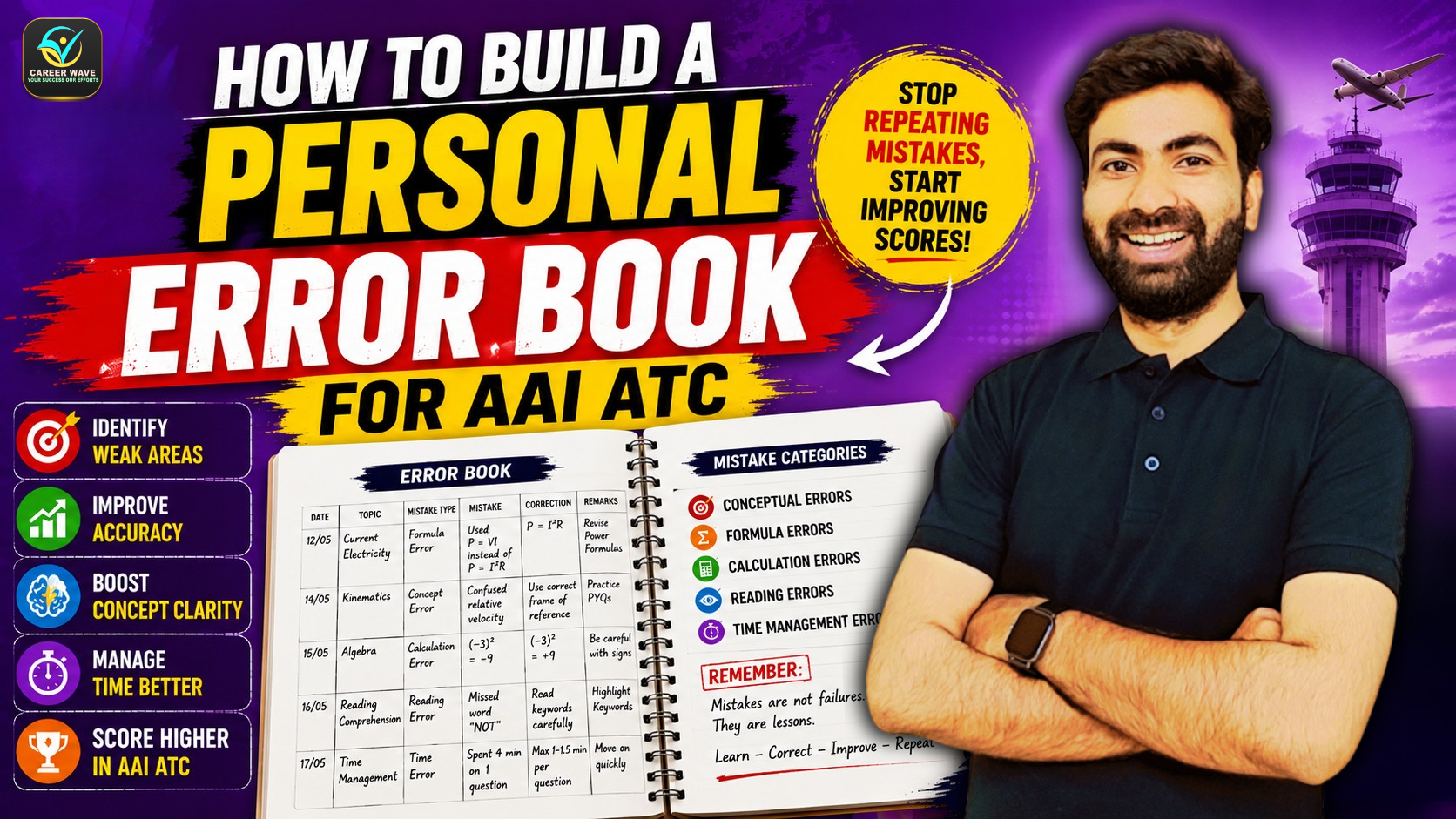
1. What Is a Personal Error Book?
A personal error book is a dedicated notebook or digital file where you record:
• mistakes from mocks
• repeated formula errors
• conceptual confusion
• calculation mistakes
• reading errors
• time-management problems
• wrong assumptions made during solving
The purpose is very simple:
Never repeat the same mistake twice.
At Career Wave, we consider the error book one of the most important tools during the mock-test phase of AAI ATC preparation.
2. Why Most Students Fail Without an Error Book
Most students solve hundreds of questions every week.
But after making mistakes, they simply move ahead.
This creates a dangerous cycle:
Mistake → Forget → Repeat → Lose Marks Again
Without proper mistake tracking:
• weak concepts remain weak
• silly mistakes continue
• accuracy remains unstable
• mock scores fluctuate
• confidence drops before exam day
Career Wave repeatedly observes that students without error tracking improve much slower than students maintaining structured error books.

3. Why Error Books Are Extremely Powerful in AAI ATC
AAI ATC is not only about solving questions.
It is about:
✔ avoiding repeated mistakes
✔ improving accuracy
✔ maintaining consistency
✔ reducing pressure errors
✔ improving revision quality
Even small repeated mistakes can reduce rank significantly.
Example
Suppose a student repeats:
• 5 formula mistakes
• 3 reading mistakes
• 2 calculation errors
in every mock.
That alone may reduce:
8–15 marks consistently.
Now imagine correcting those mistakes permanently.
This is why Career Wave says:
Improving score is often about removing mistakes, not adding new knowledge.
4. The Biggest Misunderstanding About Error Books
Many students think error books should contain:
❌ full chapter notes
❌ long derivations
❌ copied textbook solutions
❌ detailed theory explanations
Wrong approach.
Your error book should contain only:
✔ the mistake
✔ why it happened
✔ the correction
✔ how to avoid it next time
Keep it:
• short
• practical
• revision-friendly
• highly personal
5. Types of Mistakes You MUST Record
This is the most important part.
At Career Wave, mistakes are usually divided into 5 major categories.
A) Conceptual Errors
These happen when:
• the concept itself is weak
• theory understanding is incomplete
• wrong formula application happens
Example
Applying incorrect direction in magnetic force.
What to Write
✔ Correct concept
✔ Key formula
✔ One-line reminder
Sample Entry
“Magnetic force direction → use Fleming’s left-hand rule carefully.”
B) Formula Errors
These happen when:
• formulas are forgotten
• similar formulas mix up
• variables get confused
Example
Using:
P = VI
instead of:
P = I²R
What to Write
✔ Correct formula
✔ Common confusion point
✔ Short example
Career Wave Observation
Formula confusion is one of the biggest causes of avoidable negative marking.
C) Calculation Mistakes
Very common in Physics and Maths.
Examples:
• sign mistakes (+/–)
• decimal errors
• multiplication mistakes
• incorrect simplification
• unit conversion errors
Example
Wrongly simplifying:
(−2)² = −4
instead of:
(−2)² = 4
What to Write
✔ Exact mistake pattern
✔ Faster solving tip
✔ Reminder for caution
Career Wave has seen students lose 10+ marks only due to repeated calculation carelessness.
D) Reading Errors
These are extremely dangerous in CBT exams.
Students:
• miss keywords
• rush reading
• assume answers early
• misunderstand statements
Common Keywords Missed
• NOT
• EXCEPT
• INCORRECT
• MOST APPROPRIATE
Example
Question asks:
“Which is NOT correct?”
Student solves:
“Which is correct?”
What to Write
✔ Missed keyword
✔ Why it happened
✔ Reading reminder
Career Wave strongly trains students on reading discipline because one missed word can destroy the entire answer.
E) Time-Management Errors
These happen when:
• too much time is spent on one question
• difficult questions create panic
• easy questions get rushed later
Example
Spent 4 minutes on one difficult probability question.
What to Write
✔ Time wasted
✔ Why you got stuck
✔ Better strategy for next time
Career Wave Insight
Many students do not lose marks because of lack of knowledge.
They lose marks because of poor time control.
6. Ideal Error Book Format (Career Wave Model)
Keep the format clean and structured.
Date | Subject | Topic | Mistake Type | Mistake | Correction |
12 May | Physics | Current Electricity | Formula Error | Used wrong power formula | Revise P = VI, P = I²R |
14 May | Maths | Probability | Concept Error | Confused independent events | Revise multiplication rule |
15 May | English | Reading Error | Missed “NOT” | Slow down while reading |
This format allows extremely fast revision before mocks and final exam.
7. When Should You Update the Error Book?
Career Wave recommends updating it:
✔ immediately after mocks
✔ after sectional tests
✔ after difficult PYQs
✔ whenever repeated mistakes appear
Do not delay mistake recording.
Because once the emotional impact disappears, the brain stops treating the mistake seriously.
8. Biggest Mistake Students Make While Maintaining Error Books
Students often turn the error book into another theory notebook.
Wrong approach.
Your error book should NOT become:
❌ a textbook
❌ a lecture notebook
❌ a formula dictionary
The purpose is not content collection.
The purpose is:
✔ mistake elimination
✔ quick revision
✔ accuracy improvement
9. How Often Should You Revise the Error Book?
Career Wave recommends a 3-level revision system.
Daily Quick Revision
10–15 minutes.
Focus on:
• fresh mistakes
• recent mock errors
Weekly Deep Revision
Before full mocks.
Focus on:
• repeated patterns
• formula confusion
• weak topics
Final Revision Phase
During last 30–45 days:
✔ revise error book repeatedly
✔ prioritize high-frequency mistakes
✔ strengthen accuracy
This creates powerful mistake awareness before actual CBT.
10. Why Error Books Improve Accuracy Very Fast
Most students think score improvement requires:
• learning more chapters
• solving more questions
• studying longer hours
But often:
10 repeated mistakes
10–15 marks lost repeatedly.
Once these mistakes are corrected:
✔ accuracy rises quickly
✔ confidence improves
✔ mock scores stabilize
✔ panic reduces
Career Wave has observed major score jumps in students who seriously maintain error books.
11. Error Books Reduce Exam Fear
One major hidden benefit:
Students become mentally calmer.
Why?
Because they already know:
• their weak areas
• their dangerous patterns
• their repeated mistakes
• their pressure points
Instead of thinking:
“I hope I don’t make mistakes…”
they begin thinking:
“I already corrected this mistake before.”
This creates strong exam confidence.
12. Error Books Are More Valuable Than New Material
Many students continuously search for:
• new PDFs
• new books
• new mock platforms
• new strategy videos
But ignore their old mistakes.
Career Wave strongly believes:
Correcting known mistakes gives more marks than adding random new content.
13. Digital vs Handwritten Error Book
Both methods work.
Handwritten Error Book Advantages
✔ better memory retention
✔ emotional seriousness
✔ faster revision recall
Digital Error Book Advantages
✔ searchable
✔ easier organization
✔ faster editing
Career Wave Recommendation
For most aspirants, handwritten error books work better because the brain remembers written corrections more deeply.
14. Career Wave Error-Book Strategy
At Career Wave, students are trained to use structured mistake analysis through:
✔ mock analysis sessions
✔ error categorization
✔ weak-topic tracking
✔ formula revision systems
✔ reading-error correction
✔ time-management analysis
The goal is simple:
Reduce repeated mistakes before the actual CBT.
15. What Top Rankers Do Differently
Top rankers are not students who never make mistakes.
They are students who:
✔ identify mistakes quickly
✔ track them seriously
✔ revise them repeatedly
✔ avoid repeating them in the exam
This is one of the biggest hidden differences between average preparation and rank-oriented preparation.
Final Takeaway
AAI ATC selection is not only about:
• learning more
• solving more questions
• studying longer hours
It is also about:
✔ correcting mistakes
✔ improving accuracy
✔ strengthening weak areas
✔ building consistency
✔ reducing repeated errors
A personal error book transforms mistakes into score improvement tools.
At Career Wave, we strongly believe:
One corrected mistake can be worth multiple marks in the final exam.
Because in competitive exams:
Selection often depends less on what you know and more on what mistakes you stop making.
FAQs
Q1. What is a personal error book in AAI ATC preparation?
A personal error book is a notebook or digital file where students record mistakes from mocks, PYQs, and practice tests along with corrections and reminders.
Q2. Why is an error book important for AAI ATC?
It helps reduce repeated mistakes, improve accuracy, strengthen weak areas, and stabilize mock performance.
Q3. What types of mistakes should be recorded?
Students should record conceptual errors, formula mistakes, calculation mistakes, reading errors, and time-management issues.
Q4. Should I write complete solutions in the error book?
No. Keep entries short and focused only on the mistake, correction, and prevention strategy.
Q5. How often should I revise my error book?
Quick revision daily and deeper revision before mocks is ideal. During the final phase, revise it repeatedly.
Related Blogs -
The Truth About AAI ATC Selection: It Is Not About Hard Work Alone
How to Know Your AAI ATC Preparation Is Going in the Wrong Direction
Why Most Students Fail Without Proper Guidance in ATC
Reasoning Section Strategy: 100% Accuracy Plan (AAI ATC)
Category-Wise Strategy to Clear AAI ATC Exam – Complete Guide by Career Wave