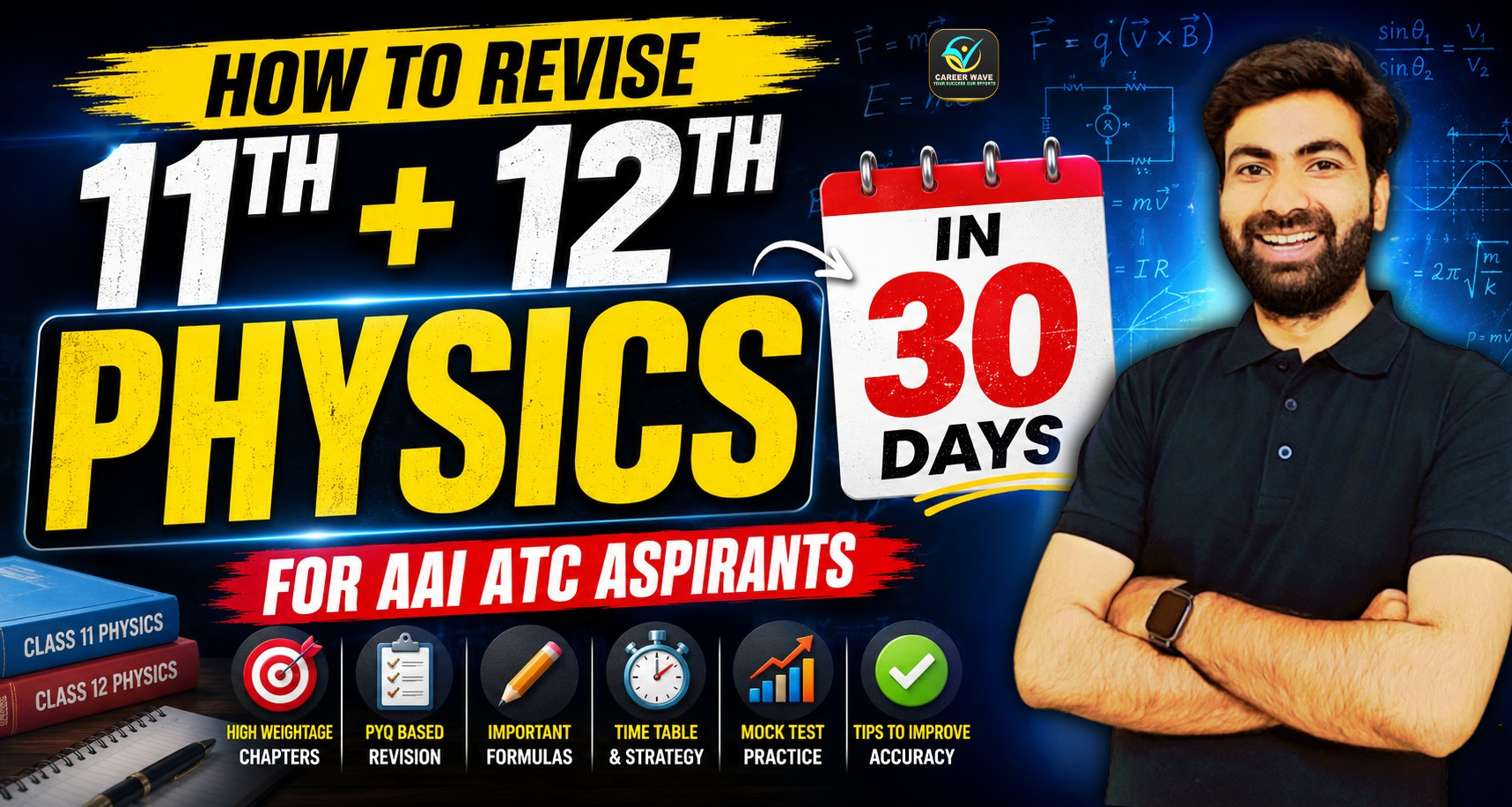
How to Revise 11th + 12th Physics in 30 Days
A Complete Strategy for AAI ATC Aspirants by Career Wave
Physics is one of the most important subjects in AAI ATC preparation. Many aspirants study Class 11 and Class 12 Physics throughout the year, but when the exam comes near, they struggle with one big question:
How should I revise the complete 11th + 12th Physics syllabus in just 30 days?
The answer is simple: do not revise Physics like a school exam. Revise it like a competitive exam.
In AAI ATC, Physics revision should be:
• Formula-based
• PYQ-based
• Concept-focused
• Mock-linked
• Error-driven
• Time-bound
Career Wave always advises students that the last 30 days should not be used for restarting the syllabus. This phase should be used to revise, test, analyze, and improve accuracy.

Why 30-Day Physics Revision Needs a Different Strategy
Class 11 and Class 12 Physics together cover a wide syllabus. If you try to revise every chapter line by line, you will waste time and lose confidence.
In 30 days, your aim should be:
• To revise all important formulas
• To strengthen high-weightage chapters
• To solve PYQs
• To improve numerical accuracy
• To reduce silly mistakes
• To revise weak topics repeatedly
• To build exam confidence
AAI ATC Physics does not require random deep theory in the final phase. It requires quick recall, correct formula application, and strong question practice.
30-Day Physics Revision Plan Overview
Phase | Days | Focus |
Phase 1 | Day 1–10 | Class 11 Physics revision |
Phase 2 | Day 11–20 | Class 12 Physics revision |
Phase 3 | Day 21–26 | PYQs + mixed practice |
Phase 4 | Day 27–30 | Formula revision + mock analysis |
Phase 1: Day 1–10
Revise Class 11 Physics
Class 11 Physics builds the foundation for mechanics, heat, waves, and basic physical concepts. These chapters need formula clarity and numerical practice.
Day 1: Units, Dimensions and Error Analysis
Focus Areas
• Dimensional formula
• Dimensional analysis
• Significant figures
• Errors
• Accuracy and precision
• Unit conversion
Revision Method
This chapter should be revised through formulas and quick questions. Do not spend too much time on theory.
Target
• Revise all dimensional formulas
• Solve 30–40 questions
• Practice PYQs
• Make a list of repeated mistakes
Day 2: Motion in Straight Line + Motion in Plane
Focus Areas
• Equations of motion
• Relative velocity
• Projectile motion
• Uniform circular motion
• Vector addition
• Components of vectors
Revision Method
First revise formulas, then solve direct numerical questions. Projectile motion should be practiced properly because it is formula-based and scoring.
Target
• 20 questions from kinematics
• 20 questions from projectile motion
• 10 questions from vectors
Day 3: Laws of Motion + Friction
Focus Areas
• Newton’s laws
• Free body diagram
• Tension
• Normal reaction
• Friction
• Circular motion with force
Revision Method
This chapter needs concept clarity. Do not just memorize formulas. Practice FBD-based questions.
Target
• Revise basic force cases
• Solve 40–50 questions
• Practice PYQs
• Note common errors in FBD
Day 4: Work, Energy and Power
Focus Areas
• Work done by force
• Kinetic energy
• Work-energy theorem
• Potential energy
• Power
• Conservation of mechanical energy
Revision Method
This chapter is highly scoring if concepts are clear. Focus on energy conservation and work-energy theorem.
Target
• Revise formulas
• Solve 35–40 questions
• Practice numerical questions from conservation of energy
Day 5: System of Particles and Rotational Motion
Focus Areas
• Centre of mass
• Moment of inertia
• Torque
• Angular momentum
• Rolling motion
• Rotational kinetic energy
Revision Method
This is a concept-heavy chapter. Revise only exam-relevant formulas and common cases.
Target
• Revise standard moment of inertia formulas
• Solve PYQs
• Practice torque and angular momentum questions
• Avoid unnecessary advanced derivations
Day 6: Gravitation
Focus Areas
• Newton’s law of gravitation
• Acceleration due to gravity
• Variation of g
• Gravitational potential
• Escape velocity
• Orbital velocity
• Satellite motion
Revision Method
This chapter is formula-based. Make one-page formula notes and revise repeatedly.
Target
• Revise all formulas
• Solve 30–40 questions
• Practice satellite-based questions
Day 7: Properties of Matter
Focus Areas
• Elasticity
• Stress and strain
• Young’s modulus
• Fluid pressure
• Buoyancy
• Viscosity
• Surface tension
• Bernoulli’s theorem
Revision Method
Focus on formulas and conceptual definitions. This chapter often has direct formula-based questions.
Target
• Revise key definitions
• Solve 30 questions
• Practice formula-based PYQs
Day 8: Thermodynamics
Focus Areas
• Zeroth law
• First law of thermodynamics
• Work done
• Heat and internal energy
• Isothermal process
• Adiabatic process
• Carnot engine
• Efficiency
Revision Method
Revise processes through a comparison table. Focus on sign convention and formula application.
Target
• Prepare process-wise formula table
• Solve 35 questions
• Practice PYQs
Day 9: Kinetic Theory of Gases
Focus Areas
• RMS speed
• Average speed
• Most probable speed
• Pressure of gas
• Degrees of freedom
• Specific heat
• Mean free path
Revision Method
This chapter is short and scoring. Revise formulas properly and solve direct questions.
Target
• Revise all speed formulas
• Solve 25–30 questions
• Practice heat capacity questions
Day 10: Oscillations and Waves
Focus Areas
• SHM
• Time period
• Frequency
• Spring-mass system
• Simple pendulum
• Wave speed
• Sound waves
• Doppler effect
Revision Method
SHM and waves are formula-heavy. Focus on standard formulas and graph-based understanding.
Target
• Revise SHM formulas
• Solve 40 questions
• Practice wave speed and Doppler effect questions
Phase 2: Day 11–20
Revise Class 12 Physics
Class 12 Physics is very important for AAI ATC. It includes electricity, magnetism, optics, modern physics, and electronics. These chapters are generally more scoring if formulas are revised properly.
Day 11: Electric Charges and Fields
Focus Areas
• Coulomb’s law
• Electric field
• Electric dipole
• Electric flux
• Gauss’s law
• Applications of Gauss’s law
Revision Method
Focus on formulas and standard cases of Gauss’s law.
Target
• Revise field due to point charge and dipole
• Practice Gauss’s law cases
• Solve 35–40 questions
Day 12: Electrostatic Potential and Capacitance
Focus Areas
• Electric potential
• Potential energy
• Equipotential surface
• Capacitance
• Series and parallel combination
• Energy stored in capacitor
• Dielectric effect
Revision Method
This chapter is numerical-based and very scoring. Revise capacitor formulas carefully.
Target
• Solve capacitor combination questions
• Practice energy-based questions
• Revise dielectric cases
Day 13: Current Electricity
Focus Areas
• Electric current
• Ohm’s law
• Resistance
• Resistivity
• Kirchhoff’s laws
• Wheatstone bridge
• Meter bridge
• Potentiometer
• Cells in series and parallel
Revision Method
This chapter should be revised with circuit practice. Focus on formula application and PYQs.
Target
• Revise all circuit formulas
• Solve 50 questions
• Practice previous year patterns
Day 14: Moving Charges and Magnetism
Focus Areas
• Lorentz force
• Motion of charged particle in magnetic field
• Biot-Savart law
• Ampere’s circuital law
• Force between current-carrying wires
• Torque on current loop
Revision Method
Focus on direction rules and formula-based questions.
Target
• Revise right-hand rules
• Solve magnetic force questions
• Practice circular motion in magnetic field
Day 15: Magnetism and Matter
Focus Areas
• Bar magnet
• Magnetic dipole moment
• Earth’s magnetism
• Magnetic materials
• Dia, para, and ferromagnetic substances
Revision Method
This chapter is mostly theory + formula based. Revise definitions and comparison tables.
Target
• Prepare magnetic material comparison table
• Revise formulas
• Solve PYQs
Day 16: Electromagnetic Induction and Alternating Current
Focus Areas
• Faraday’s law
• Lenz’s law
• Motional emf
• Self and mutual induction
• AC voltage and current
• Reactance
• Impedance
• Resonance
• Transformer
Revision Method
EMI and AC should be revised together because both are linked. Focus on formulas and graphs.
Target
• Revise EMI formulas
• Solve AC circuit questions
• Practice transformer numericals
Day 17: Electromagnetic Waves
Focus Areas
• Displacement current
• EM wave properties
• EM spectrum
• Uses of EM waves
• Relation between electric and magnetic fields
Revision Method
This is a short and important chapter. Revise NCERT-based facts and spectrum order.
Target
• Memorize EM spectrum order
• Revise applications
• Practice direct questions
Day 18: Ray Optics and Optical Instruments
Focus Areas
• Reflection
• Refraction
• Lens formula
• Mirror formula
• Magnification
• Prism
• Total internal reflection
• Microscope
• Telescope
Revision Method
This is a high-priority chapter. Revise formulas and sign convention carefully.
Target
• Solve mirror and lens questions
• Practice prism questions
• Revise optical instrument formulas
Day 19: Wave Optics
Focus Areas
• Huygens principle
• Interference
• Young’s double slit experiment
• Diffraction
• Polarization
Revision Method
Focus on formula-based revision and conceptual definitions.
Target
• Revise YDSE formulas
• Solve fringe width questions
• Practice conceptual PYQs
Day 20: Dual Nature, Atoms, Nuclei and Semiconductor
Focus Areas
• Photoelectric effect
• de Broglie wavelength
• Bohr model
• Energy levels
• Radioactivity
• Half-life
• Nuclear binding energy
• Logic gates
• Diode
• Transistor basics
Revision Method
This is a scoring cluster. Revise formulas, graphs, and standard facts.
Target
• Revise all modern physics formulas
• Solve 50 mixed questions
• Practice logic gate questions
Phase 3: Day 21–26
PYQ-Based Mixed Revision
In this phase, do not revise chapter-wise theory again. Focus on question practice and PYQ pattern recognition.
Day 21: Class 11 Physics PYQs
Revise all Class 11 PYQs topic-wise. Mark repeated chapters and formula patterns.
Target
• 80–100 questions
• 2-hour timed practice
• Error analysis
Day 22: Class 12 Physics PYQs
Solve Class 12 PYQs in timed mode.
Target
• 80–100 questions
• Identify repeated patterns
• Revise formulas from mistakes
Day 23: Mechanics + Heat Mixed Practice
Topics
• Kinematics
• Laws of Motion
• Work Energy Power
• Rotational Motion
• Gravitation
• Thermodynamics
• KTG
Target
• 100 mixed questions
• Time-bound practice
• Mistake notebook update
Day 24: Electricity + Magnetism Mixed Practice
Topics
• Electrostatics
• Capacitance
• Current Electricity
• Magnetism
• EMI
• AC
Target
• 100 mixed questions
• Formula revision
• Circuit practice
Day 25: Optics + Modern Physics Practice
Topics
• Ray Optics
• Wave Optics
• Dual Nature
• Atoms
• Nuclei
• Semiconductor
Target
• 100 mixed questions
• PYQ comparison
• Error correction
Day 26: Full Physics Sectional Test
Take one full Physics sectional test in exam-like conditions.
After Test Analysis
Check:
• Accuracy
• Time per question
• Wrong concepts
• Silly mistakes
• Formula errors
• Guessing mistakes
Do not ignore analysis. This day is more about correction than score.
Phase 4: Day 27–30
Final Revision and Exam Polishing
Day 27: Formula Marathon
Revise the full Physics formula notebook.
Divide formulas into:
• Mechanics
• Heat
• Waves
• Electricity
• Magnetism
• Optics
• Modern Physics
• Semiconductor
Target
• Revise all formulas twice
• Mark weak formulas
• Solve 5–10 questions from each weak formula group
Day 28: Mistake Notebook Revision
Revise all mistakes made during mocks, PYQs, and practice.
Focus On:
• Repeated wrong questions
• Formula confusion
• Unit mistakes
• Sign convention errors
• Calculation mistakes
• Overthinking questions
This day can improve your score more than studying a new chapter.
Day 29: Full Mock + Physics Analysis
Attempt one full-length AAI ATC mock test.
Physics Analysis
Check:
• Which Physics questions were direct?
• Which were time-consuming?
• Which formulas were forgotten?
• Which questions should have been skipped?
• Which chapters need last revision?
Day 30: Light Revision Only
Do not overload your mind on the last day.
Revise:
• Formula notebook
• Important PYQs
• Short notes
• Mistake notebook
• High-weightage chapters
Avoid:
• New chapters
• New books
• Random videos
• Heavy numerical sessions
• Overthinking
High-Priority Physics Chapters for AAI ATC
Class | High-Priority Chapters |
Class 11 | Laws of Motion, Work Energy Power, Rotational Motion, Gravitation, Thermodynamics, Oscillations, Waves |
Class 12 | Electrostatics, Capacitance, Current Electricity, Magnetism, EMI, AC, EM Waves, Ray Optics, Modern Physics, Semiconductor |
Daily Revision Structure
Each day should follow this pattern:
Time | Task |
30 min | Formula revision |
60–90 min | Concept revision |
90 min | Question practice |
30 min | PYQs |
30 min | Mistake analysis |
For working aspirants, this can be divided into morning and evening slots.
Best Method to Revise Physics
1. Formula First
Before solving questions, revise formulas. Physics questions become faster when formula recall is strong.
2. PYQ Priority
Always check how the topic was asked in previous exams. PYQs give the real exam direction.
3. Practice in Timed Mode
Do not solve every question casually. Use a timer to improve speed.
4. Maintain a Mistake Notebook
Write:
• Wrong formula used
• Calculation error
• Concept confusion
• Unit mistake
• Sign convention error
5. Revise Weak Topics Repeatedly
Weak topics improve only through repeated exposure, not through one-time reading.
Common Mistakes to Avoid
• Restarting the entire syllabus from zero
• Watching random YouTube videos
• Ignoring PYQs
• Solving questions without time limit
• Not revising formulas daily
• Avoiding weak chapters
• Giving mocks without analysis
• Studying theory more than questions
• Learning new topics in the last week
Career Wave’s Advice for Physics Revision
Career Wave recommends that AAI ATC aspirants should revise Physics with a performance-oriented approach.
Your 30-day revision should focus on:
• Formula mastery
• PYQ familiarity
• Topic-wise question practice
• Mock analysis
• Weak-area correction
• Time management
• Accuracy improvement
Physics becomes scoring when you stop reading randomly and start revising strategically.
Conclusion
Revising Class 11 and Class 12 Physics in 30 days is possible if you follow a structured plan. Do not try to read everything again from the beginning. Instead, revise formulas, solve PYQs, practice high-weightage chapters, analyze mocks, and correct repeated mistakes.
The correct 30-day Physics revision strategy is:
10 days Class 11 + 10 days Class 12 + 6 days PYQ practice + 4 days final revision.
With the right structure and discipline, AAI ATC aspirants can revise Physics effectively and improve their exam performance.
Career Wave helps students prepare Physics in a focused, exam-oriented way so that revision turns into marks.
Related Blogs -
Best Daily Routine for Working + ATC Aspirants
How to Make a 60-Day ATC Crash Plan
The Truth About AAI ATC Selection: It Is Not About Hard Work Alone
AAI ATC Preparation Audit: How to Check If You Are Exam-Ready