SSC CGL 2026 Complete Guide: Posts, Salary, Eligibility and Selection Process
SSC CGL 2026 is one of the most important government job examinations for graduates in India. The Staff Selection Commission conducts the Combined Graduate Level Examination to recruit candidates for various Group B and Group C posts in central government ministries, departments, constitutional bodies, statutory bodies and tribunals.
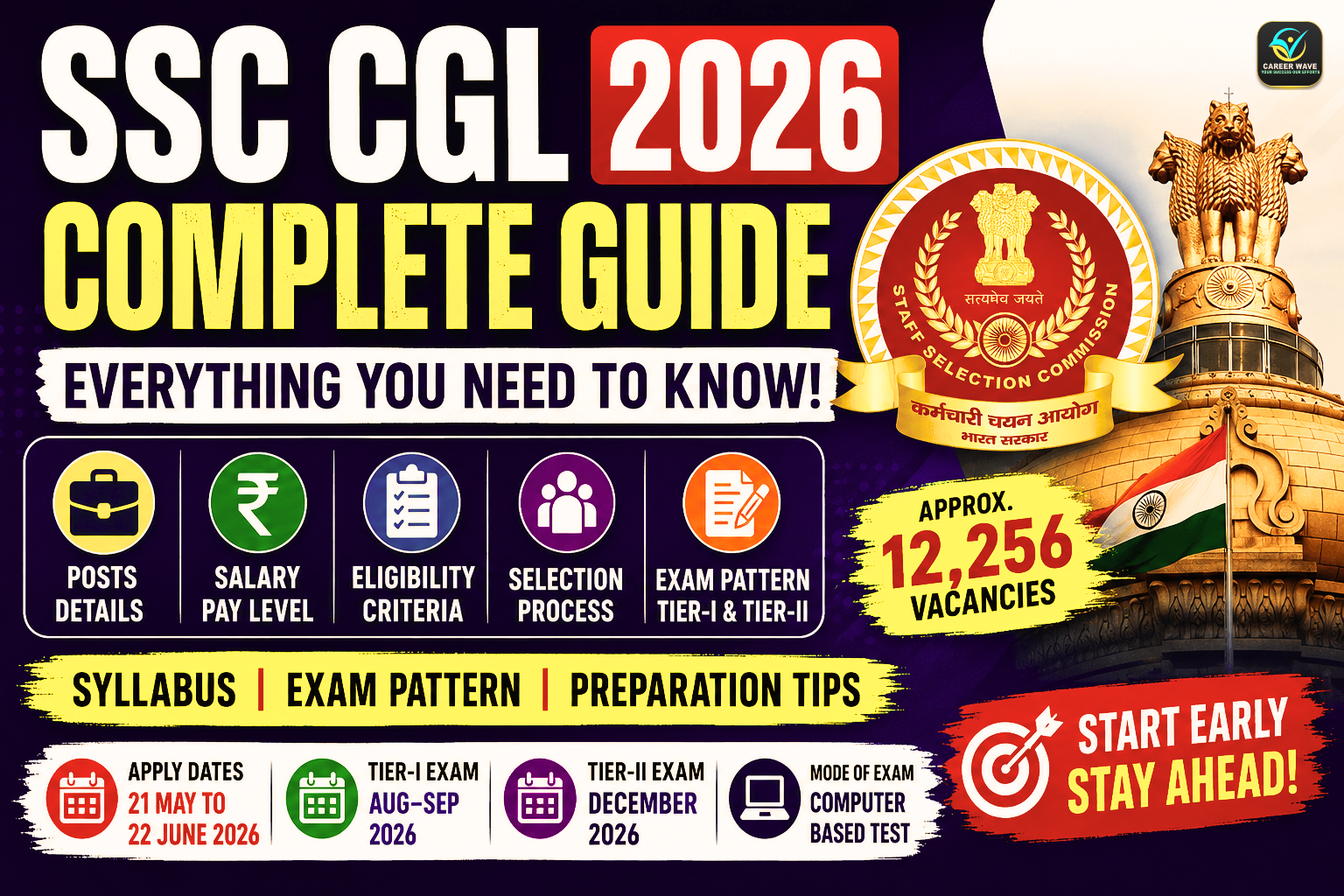
For students aiming for a stable government career after graduation, SSC CGL offers a wide range of posts such as Assistant Section Officer, Income Tax Inspector, Assistant Audit Officer, Auditor, Accountant, Tax Assistant, Postal Assistant and many others. As per the official SSC CGL 2026 notice, approximately 12,256 vacancies have been announced, and the final post-wise vacancy details may be updated later by SSC.
At Career Wave, we believe that SSC CGL preparation should not start with random study material. Students must first understand the exam structure, post hierarchy, salary levels, eligibility rules and final selection process. This guide explains SSC CGL 2026 in a clear and student-friendly manner.
SSC CGL 2026 Overview
Particular | Details |
Exam Name | SSC CGL 2026 |
Full Form | Staff Selection Commission Combined Graduate Level Examination |
Conducting Body | Staff Selection Commission |
Posts | Group B and Group C |
Vacancies | Approx. 12,256 |
Application Dates | 21 May 2026 to 22 June 2026 |
Last Date for Fee Payment | 23 June 2026 |
Correction Window | 29 June 2026 to 01 July 2026 |
Tier-I Exam | August–September 2026 |
Tier-II Exam | December 2026 |
Mode of Exam | Computer Based Test |
Qualification | Bachelor’s Degree |
The application schedule, fee payment deadline, correction window and tentative Tier-I and Tier-II months are mentioned in the official SSC CGL 2026 notice.
1. What is SSC CGL?
SSC CGL stands for Staff Selection Commission Combined Graduate Level Examination. It is conducted for graduate-level posts in different central government departments.
Through SSC CGL, candidates can get jobs in departments such as:
• Central Secretariat Service
• Ministry of External Affairs
• Income Tax Department
• Central Board of Indirect Taxes and Customs
• Directorate of Enforcement
• Central Bureau of Investigation
• Comptroller and Auditor General of India
• Department of Posts
• Other ministries and government offices
The exam is highly competitive because it provides central government job security, decent salary, promotion opportunities and social respect.
2. SSC CGL 2026 Important Dates
Event | Date |
Online Application Starts | 21 May 2026 |
Last Date to Apply | 22 June 2026 |
Last Date for Online Fee Payment | 23 June 2026 |
Application Correction Window | 29 June 2026 to 01 July 2026 |
Tier-I Exam | August–September 2026 |
Tier-II Exam | December 2026 |
Students should not wait for the last date to apply. SSC clearly advises candidates to submit their application much before the closing date to avoid server load, login failure or payment issues.
3. SSC CGL 2026 Vacancy
SSC has announced approximately 12,256 vacancies for SSC CGL 2026. These vacancies are tentative because SSC collects vacancy data from different ministries, departments and organizations. Final post-wise and category-wise vacancies may be released later on the official SSC website.
This means candidates should not judge the exam only by the first vacancy number. Final vacancies may change depending on department requirements.
4. SSC CGL 2026 Posts and Salary
SSC CGL posts are classified under different pay levels. Higher pay level means higher basic pay, better initial salary and usually higher responsibility.
Pay Level 8: ₹47,600 – ₹1,51,100
Post | Department |
Assistant Audit Officer | Indian Audit & Accounts Department under C&AG |
Assistant Accounts Officer | Indian Audit & Accounts Department under C&AG |
These are among the highest salary posts under SSC CGL. They are Group B Gazetted posts and are preferred by candidates who want a strong administrative and audit-related profile.
Pay Level 7: ₹44,900 – ₹1,42,400
Post | Department |
Assistant Section Officer | Central Secretariat Service |
Assistant Section Officer | Intelligence Bureau |
Assistant Section Officer | Ministry of Railways |
Assistant Section Officer | Ministry of External Affairs |
Inspector of Income Tax | CBDT |
Inspector, Central Excise | CBIC |
Inspector, Preventive Officer | CBIC |
Inspector, Examiner | CBIC |
Assistant Enforcement Officer | Directorate of Enforcement |
Sub Inspector | CBI |
Inspector Posts | Department of Posts |
Inspector | Central Bureau of Narcotics |
These posts are very popular because they offer good salary, reputation, promotion scope and strong departmental value. The official notice lists these posts under Pay Level 7.
Pay Level 6: ₹35,400 – ₹1,12,400
Post | Department |
Assistant / Assistant Section Officer | Other Ministries/Departments |
Executive Assistant | CBIC |
Research Assistant | NHRC |
Divisional Accountant | Offices under C&AG |
Sub Inspector | NIA |
Junior Statistical Officer | Ministry of Statistics & Programme Implementation |
Statistical Investigator Grade-II | Ministry of Home Affairs |
Office Superintendent | CBDT |
These posts are also good options for candidates who want respectable Group B positions with stable career growth.
Pay Level 5: ₹29,200 – ₹92,300
Post | Department |
Auditor | C&AG |
Auditor | CGDA |
Auditor | Other Ministries/Departments |
Accountant | C&AG |
Accountant | Controller General of Accounts |
Junior Accountant | Other Ministries/Departments |
These posts are generally office-based and suitable for candidates who prefer stable desk jobs with accounting or audit-related work.
Pay Level 4: ₹25,500 – ₹81,100
Post | Department |
Postal Assistant / Sorting Assistant | Department of Posts |
Senior Secretariat Assistant / UDC | Central Government Offices |
Senior Administrative Assistant | Military Engineering Services |
Tax Assistant | CBDT |
Tax Assistant | CBIC |
Sub-Inspector | Central Bureau of Narcotics |
These are Group C posts. They are suitable for candidates looking for central government entry-level jobs with good promotion opportunities.
5. SSC CGL 2026 In-Hand Salary
The actual in-hand salary depends on:
• Basic pay
• Dearness Allowance
• House Rent Allowance
• Transport Allowance
• City of posting
• Department
• Deductions
In general, higher pay-level posts like AAO, ASO, Income Tax Inspector, Examiner and Assistant Enforcement Officer offer better initial salaries. Lower pay-level posts still provide strong job security and long-term government benefits.
6. SSC CGL 2026 Eligibility Criteria
6.1 Nationality
A candidate must generally be:
• A citizen of India, or
• A subject of Nepal or Bhutan, or
• A person of Indian origin who has migrated from specified countries with the intention of permanently settling in India.
Candidates other than Indian citizens may need a certificate of eligibility from the Government of India.
6.2 Educational Qualification
The basic educational qualification for most SSC CGL posts is a Bachelor’s Degree from a recognized University or Institute. The qualification must be completed as per the date mentioned in the official notice.
Some posts have additional requirements:
Post | Special Requirement |
Assistant Audit Officer | Bachelor’s Degree required; CA/CMA/CS/M.Com/MBA Finance-type qualifications are desirable |
Junior Statistical Officer | Bachelor’s Degree with required Mathematics marks at Class 12 level or Statistics at degree level |
Statistical Investigator Grade-II | Degree-level subject requirement related to Statistics/Mathematics/Economics as per official conditions |
The official notice mentions educational qualification as on 01 August 2026.
6.3 Age Limit
The age limit is different for different posts. It is calculated as on 01 August 2026.
Age Limit | Candidate Should Be Born |
18–27 years | Not earlier than 02-08-1999 and not later than 01-08-2008 |
20–30 years | Not earlier than 02-08-1996 and not later than 01-08-2006 |
18–30 years | Not earlier than 02-08-1996 and not later than 01-08-2008 |
18–32 years | Not earlier than 02-08-1994 and not later than 01-08-2008 |
Age relaxation is also available as per government rules. For example, SC/ST candidates get 5 years, OBC candidates get 3 years, PwBD candidates get 10 years, PwBD-OBC candidates get 13 years and PwBD-SC/ST candidates get 15 years of relaxation.
6.4 Application Fee
The application fee for SSC CGL 2026 is ₹100. Women candidates and candidates belonging to SC, ST, PwBD and eligible Ex-Servicemen categories are exempted from paying the fee.
7. SSC CGL 2026 Selection Process
The SSC CGL 2026 selection process includes:
1. Tier-I Computer Based Examination
2. Tier-II Computer Based Examination
3. Post Preference
4. Document Verification by user departments
5. Final allotment based on merit, preference and eligibility
SSC CGL 2026 will be conducted in two tiers: Tier-I and Tier-II. Tier-I is mainly used for shortlisting candidates for Tier-II. Final merit is prepared on the basis of Tier-II performance.
8. SSC CGL 2026 Tier-I Exam Pattern
Subject | Questions | Marks |
General Intelligence and Reasoning | 25 | 50 |
General Awareness | 25 | 50 |
Quantitative Aptitude | 25 | 50 |
English Comprehension | 25 | 50 |
Total | 100 | 200 |
Tier-I Key Points
• Mode: Computer Based Test
• Type: Objective multiple-choice questions
• Total Questions: 100
• Total Marks: 200
• Duration: 1 hour
• Sectional Timer: 15 minutes for each subject
• Negative Marking: 0.50 marks for each wrong answer
• Language: English and Hindi, except English Comprehension
The introduction of sectional timing makes time management more important. Students cannot spend extra time in one section by taking time from another section.
SSC CGL 2026 Tier-II Exam Pattern
Tier-II is the most important stage because final selection is based on Tier-II marks.
Paper-I: Mandatory for All Posts
Section | Subject | Questions | Marks |
Section I | Mathematical Abilities | 30 | 90 |
Section I | Reasoning and General Intelligence | 30 | 90 |
Section II | English Language and Comprehension | 45 | 135 |
Section II | General Awareness | 25 | 75 |
Section III | Computer Knowledge Test | 20 | 60 |
Section IV | Data Entry Speed Test | One Task | Qualifying |
Paper-I is compulsory for all posts. Computer Knowledge Test and DEST are mandatory, but they are qualifying in nature.
Paper-II: Statistics
Subject | Questions | Marks |
Statistics | 100 | 200 |
Paper-II is only for candidates shortlisted for Junior Statistical Officer and Statistical Investigator Grade-II posts.
Paper-III: Finance and Economics
Subject | Questions | Marks |
General Studies: Finance and Economics | 100 | 200 |
Paper-III is only for candidates shortlisted for Assistant Audit Officer and Assistant Accounts Officer posts.
Tier-II Negative Marking
Paper/Section | Negative Marking |
Paper-I Section I, II and III | 1 mark for each wrong answer |
Paper-II | 0.50 marks for each wrong answer |
Paper-III | 0.50 marks for each wrong answer |
9. Final Merit and Post Allotment
Final selection is based on:
• Tier-II performance
• Category-wise vacancies
• Post preferences
• Post-specific eligibility
• Physical/medical standards, if applicable
• Document verification
SSC clearly mentions that final selection will be made on the basis of overall performance in Tier-II and post preference. Once a candidate gets the first available preference according to merit, they will not be considered for any other option. Therefore, post preference must be filled very carefully.
10. Best SSC CGL Posts: How to Choose?
Students should not choose posts only by popularity. Every post has a different work profile, transfer policy, promotion path and lifestyle.
Priority | Suitable Posts |
High salary | AAO, Assistant Accounts Officer |
Desk job | ASO, Auditor, Accountant |
Field and power profile | Income Tax Inspector, Examiner, Preventive Officer |
Investigation profile | CBI SI, NIA SI, AEO |
Foreign posting possibility | ASO MEA |
Stable entry-level job | Tax Assistant, UDC, Postal Assistant |
Career Wave advises students to fill post preferences after checking:
• Job profile
• Department
• Promotion scope
• Posting location
• Physical standards
• Medical standards
• Personal comfort with field duty
11. SSC CGL 2026 Preparation Strategy
1. Understand the Exam First
Before starting preparation, students must understand the complete exam pattern. Tier-I is important for qualification, but Tier-II decides the final selection.
2. Build Strong Basics
For Quant and Reasoning, concepts matter more than shortcuts in the beginning. Shortcuts are useful only after basic clarity.
Important Quant areas:
• Percentage
• Ratio and Proportion
• Profit and Loss
• Simple Interest and Compound Interest
• Time and Work
• Time, Speed and Distance
• Algebra
• Geometry
• Trigonometry
• Mensuration
• Data Interpretation
Important Reasoning areas:
• Analogy
• Classification
• Series
• Coding-Decoding
• Blood Relation
• Direction
• Syllogism
• Venn Diagram
• Mirror and Water Image
• Figure Counting
• Puzzle
3. Prepare English Daily
English can become a scoring section if practiced regularly.
Focus areas:
• Error Detection
• Sentence Improvement
• Fill in the Blanks
• Cloze Test
• Reading Comprehension
• Vocabulary
• Idioms and Phrases
• Synonyms and Antonyms
• One Word Substitution
4. Follow Smart General Awareness
Do not read random GK. SSC CGL General Awareness needs a balanced approach.
Important areas:
• Polity
• History
• Geography
• Economy
• General Science
• Static GK
• Current Affairs
• Government Schemes
• Important Days
• Awards and Honours
5. Practice Sectional Timing
Since Tier-I has a sectional timer of 15 minutes per subject, students must practice with a timer. A student may know the answer but still lose marks if speed is weak.
6. Start Tier-II Preparation Early
Many students make the mistake of preparing only for Tier-I first. This is risky because final merit depends on Tier-II. Preparation should be Tier-II oriented from the beginning.
7. Attempt Mock Tests Regularly
Mock tests help students understand:
• Speed
• Accuracy
• Weak topics
• Time pressure
• Silly mistakes
• Section-wise performance
After every mock test, analysis is more important than score.
12. Common Mistakes Students Should Avoid
• Starting preparation without understanding the exam pattern
• Ignoring Tier-II in the beginning
• Depending only on shortcuts
• Reading too much random GK
• Not practicing with sectional timing
• Filling post preferences without checking physical standards
• Not revising formulas and vocabulary regularly
• Attempting mock tests without proper analysis
Career Wave Guidance for SSC CGL 2026 Aspirants
At Career Wave, our student-first approach is simple: understand the exam, complete the syllabus in a structured manner, revise regularly, practice mocks and analyze mistakes. SSC CGL is not just about hard work; it requires discipline, planning and exam-oriented execution.
Students preparing for SSC CGL 2026 should make a 6–8 month structured plan covering Quant, Reasoning, English, General Awareness, mock tests and revision. The goal should not be only to clear Tier-I, but to secure a strong score in Tier-II.
13. FAQs
Q1. What is SSC CGL 2026?
SSC CGL 2026 is a graduate-level government exam conducted by the Staff Selection Commission for recruitment to various Group B and Group C posts in central government departments.
Q2. How many vacancies are there in SSC CGL 2026?
SSC has announced approximately 12,256 vacancies for SSC CGL 2026. Final post-wise and category-wise vacancies may be updated later.
Q3. What is the last date to apply for SSC CGL 2026?
The last date to apply online for SSC CGL 2026 is 22 June 2026. The last date for online fee payment is 23 June 2026.
Q4. What is the qualification for SSC CGL 2026?
For most posts, candidates must have a Bachelor’s Degree from a recognized university or institute. Some posts like JSO, Statistical Investigator and AAO have additional or desirable requirements.
Q5. What is the age limit for SSC CGL 2026?
The age limit varies by post. It may be 18–27 years, 20–30 years, 18–30 years or 18–32 years, depending on the post. Age is calculated as on 01 August 2026.
Q6. Is there negative marking in SSC CGL 2026?
Yes. Tier-I has a negative marking of 0.50 marks for each wrong answer. In Tier-II, Paper-I has 1 mark negative marking in major sections, while Paper-II and Paper-III have 0.50 marks negative marking.
Q7. Is Tier-I counted in final merit?
Final merit is prepared on the basis of Tier-II performance. Tier-I is mainly used for shortlisting candidates for Tier-II.
Conclusion
SSC CGL 2026 is a major opportunity for graduates who want a stable and respected central government job. With approximately 12,256 vacancies, multiple posts and salary levels, this exam gives students many career options. However, competition is high, and the selection process now requires better time management because of sectional timing.
A serious candidate should focus on Tier-II from the beginning, revise consistently, practice mocks and avoid random preparation. With a disciplined plan and correct guidance, SSC CGL 2026 can become a strong career opportunity.
Career Wave recommends students to prepare with clarity, consistency and exam-oriented practice rather than depending only on motivation or last-minute study.