SSC Jobs After 10th: Eligibility, Salary, Posts and Selection Process
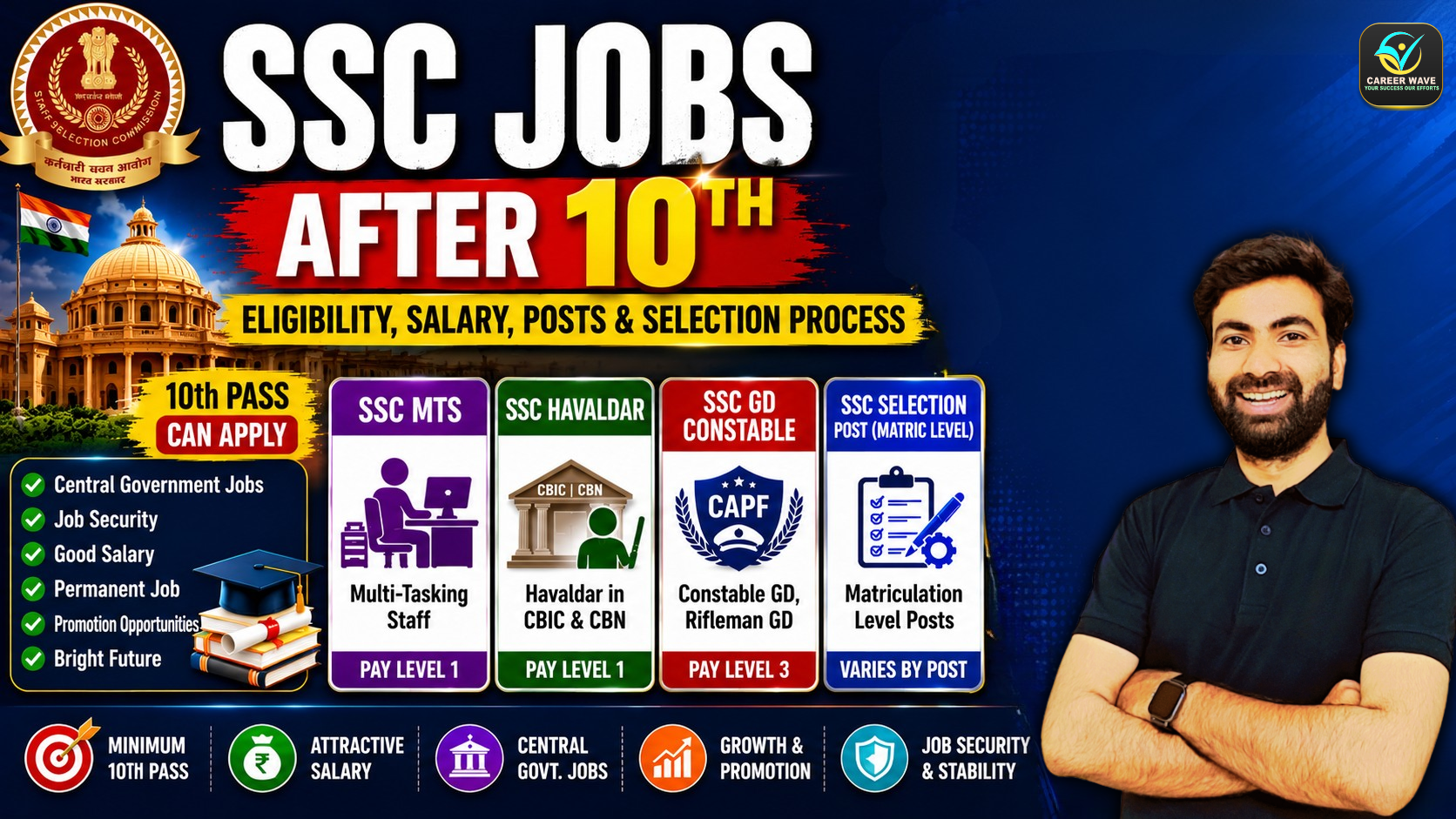
Many students believe that government jobs are available only after graduation. This is not correct. SSC also provides good central government job opportunities for 10th-pass candidates. If a student has passed Class 10 and wants a secure government career, SSC exams like MTS, Havaldar, GD Constable and Selection Post Matriculation Level can be strong options.
These exams are popular because they offer early career entry, government job security, salary benefits, promotion opportunities and stable work profiles. At Career Wave, we always advise students to choose the right exam after understanding the eligibility, post profile, salary and selection process properly.
The major SSC job options after 10th are:
• SSC MTS
• SSC Havaldar
• SSC GD Constable
• SSC Selection Post Matriculation Level
Why SSC Jobs After 10th Are Popular
SSC jobs after 10th are suitable for students who want to start earning early and enter the government sector without waiting for graduation.
Main benefits include:
• Central government job opportunity
• Minimum qualification is Class 10
• Stable salary and allowances
• Promotion opportunities
• Departmental growth
• Social respect
• Job security
• Opportunities in office work and uniformed services
However, students should not treat these exams as easy. The syllabus may be basic, but the competition is very high because lakhs of candidates apply.
List of SSC Jobs After 10th
Exam | Main Posts | Qualification | Job Type |
SSC MTS | Multi-Tasking Staff | 10th Pass | Office-support job |
SSC Havaldar | Havaldar in CBIC and CBN | 10th Pass | Physical + field-support job |
SSC GD Constable | Constable GD, Rifleman GD | 10th Pass | Uniformed force job |
SSC Selection Post | Matriculation-level posts | 10th Pass | Department-specific jobs |
1. SSC MTS After 10th
SSC MTS stands for Multi-Tasking Staff. It is one of the most common SSC jobs for 10th-pass candidates.
The SSC MTS post is a Group C, non-gazetted and non-ministerial post in various ministries, departments, offices, constitutional bodies, statutory bodies and tribunals of the Government of India. In the official SSC MTS notice, MTS is placed in Pay Level 1 of the 7th Pay Commission.
SSC MTS Eligibility
Criteria | Details |
Qualification | Matriculation / Class 10 pass |
Age Limit | Generally 18–25 years |
Some Posts | 18–27 years, depending on department |
Nationality | As per SSC rules |
The previous SSC MTS notification required candidates to pass Matriculation or equivalent from a recognized board by the prescribed cut-off date.
SSC MTS Job Profile
SSC MTS is mainly an office-support role. Selected candidates may work in central government offices and assist senior staff in routine tasks.
Common duties include:
• Carrying files and official papers
• Maintaining office records
• Photocopying and scanning
• Dispatch and diary work
• Assisting clerical staff
• Basic office maintenance
• Helping in routine administrative work
• Watch and ward duties, if assigned
This post is suitable for candidates who want a stable office-based government job after Class 10.
SSC MTS Salary
SSC MTS comes under Pay Level 1. The basic pay starts from around ₹18,000, and the final in-hand salary depends on posting city, DA, HRA, TA and deductions. The official MTS notice places MTS in Pay Level 1 as per the 7th Pay Commission.
2. SSC Havaldar After 10th
SSC Havaldar is recruited through the SSC MTS and Havaldar Examination. It is mainly for Havaldar posts in CBIC and CBN under the Department of Revenue, Ministry of Finance.
The official notice mentions Havaldar in CBIC and CBN as a Group C, non-gazetted and non-ministerial post in Pay Level 1.
SSC Havaldar Eligibility
Criteria | Details |
Qualification | Class 10 / Matriculation pass |
Age Limit | Generally 18–27 years |
Department | CBIC and CBN |
Physical Test | Required |
For Havaldar, candidates must qualify the Computer Based Examination and also clear PET/PST. The official MTS notice mentions that MTS selection includes CBE, while Havaldar selection includes CBE plus PET/PST.
SSC Havaldar Job Profile
Havaldar work is more physical and field-oriented compared to MTS.
Common duties include:
• Assisting officers in departmental work
• Watch and ward duties
• Field support
• Physical checking and movement-related support
• Supporting CBIC and CBN operations
• Maintaining discipline and security
• Basic record and office assistance
SSC Havaldar Physical Test
For Havaldar posts, candidates must qualify PET/PST. In the previous notification, the walking standard was:
Candidate | PET Requirement |
Male | 1600 meters in 15 minutes |
Female | 1 km in 20 minutes |
These standards were listed in the official SSC MTS/Havaldar examination notice.
3. SSC GD Constable After 10th
SSC GD Constable is one of the biggest uniformed-service opportunities after Class 10. It is conducted for Constable GD posts in CAPFs and SSF, and Rifleman GD in Assam Rifles.
The official SSC GD 2026 notification includes recruitment for Constable GD in BSF, CISF, CRPF, ITBP, SSB, SSF and Rifleman GD in Assam Rifles. The recruitment process includes CBE, PST, PET, Medical Examination and Document Verification.
SSC GD Eligibility
Criteria | Details |
Qualification | 10th pass / Matriculation |
Age Limit | 18–23 years |
Job Type | Uniformed force job |
Physical Test | Required |
For SSC GD 2026, candidates must have passed Matriculation or 10th Class from a recognized board/university on or before the cut-off date.
SSC GD Age Limit
The official SSC GD 2026 notice mentions the age limit as 18–23 years as on 01 January 2026, with category-wise relaxation as per rules.
SSC GD Salary
SSC GD Constable posts are placed in Pay Level 3, with pay scale of ₹21,700 to ₹69,100.
SSC GD Job Profile
The work profile depends on the force allotted.
Common duties include:
• Border guarding
• Patrolling
• Security duty
• Internal security support
• Law and order support
• Force-level operational duties
• Field deployment
• Guard duty
• Disaster and emergency assistance, when required
SSC GD Selection Process
The selection process generally includes:
1. Computer Based Examination
2. Physical Efficiency Test
3. Physical Standard Test
4. Medical Examination
5. Document Verification
6. Final merit and force allocation
SSC GD is suitable for candidates who want a uniformed job and are physically fit.
4. SSC Selection Post Matriculation Level
SSC Selection Post exam is conducted for different department-specific posts. Some posts are available for Matriculation-level candidates, meaning Class 10 pass students can apply for those posts.
Eligibility
Criteria | Details |
Qualification | Class 10 pass for Matriculation-level posts |
Age Limit | Varies by post |
Job Type | Department-specific |
Selection | Usually CBE + document verification |
Job Profile
The job profile varies according to the department and post. It may include:
• Office support
• Lab assistance
• Field assistance
• Record handling
• Departmental support work
• Technical or semi-technical support, if mentioned in the post requirement
Students must read the post-specific notification carefully because every Selection Post has its own qualification, age limit and duties.
SSC Jobs After 10th: Salary Comparison
Exam/Post | Pay Level | Salary Nature |
SSC MTS | Pay Level 1 | Basic pay around ₹18,000 + allowances |
SSC Havaldar | Pay Level 1 | Basic pay around ₹18,000 + allowances |
SSC GD Constable | Pay Level 3 | ₹21,700 to ₹69,100 |
Selection Post Matric Level | Varies | Depends on department and post |
The in-hand salary depends on basic pay, DA, HRA, TA, posting city, department and deductions.
SSC Jobs After 10th: Selection Process Comparison
Exam | Selection Process |
SSC MTS | CBE + Document Verification |
SSC Havaldar | CBE + PET/PST + Document Verification |
SSC GD Constable | CBE + PET/PST + Medical + Document Verification |
Selection Post Matric Level | CBE + document verification; skill/physical test if required |
SSC MTS and Havaldar Exam Pattern
The SSC MTS/Havaldar CBE generally has two sessions.
Session I
Subject | Questions | Marks |
Numerical and Mathematical Ability | 20 | 60 |
Reasoning Ability and Problem Solving | 20 | 60 |
Session II
Subject | Questions | Marks |
General Awareness | 25 | 75 |
English Language and Comprehension | 25 | 75 |
In the official MTS notice, Session I and Session II are mandatory, Session I has no negative marking, and Session II has negative marking of 1 mark for each wrong answer.
SSC GD Constable Exam Pattern
Subject | Questions | Marks |
General Intelligence and Reasoning | 20 | 40 |
General Knowledge and General Awareness | 20 | 40 |
Elementary Mathematics | 20 | 40 |
English / Hindi | 20 | 40 |
Total | 80 | 160 |
The SSC GD exam is objective and computer-based. Students should prepare both the written exam and physical test from the beginning.
Which SSC Job After 10th is Best?
The best option depends on the student’s preference.
Choose SSC MTS if:
• You want office-support work
• You prefer a stable routine job
• You do not want a physical test
• You want early entry into central government service
Choose SSC Havaldar if:
• You are physically fit
• You can clear walking and physical standards
• You are comfortable with field-support work
• You want CBIC/CBN department exposure
Choose SSC GD if:
• You want a uniformed job
• You are physically active
• You are ready for field duty
• You want to serve in CAPFs, SSF or Assam Rifles
Choose Selection Post if:
• You want department-specific posts
• You want more options apart from MTS and GD
• You are ready to check post-wise eligibility carefully
Preparation Strategy for SSC Jobs After 10th
1. Start With the Right Exam
Do not prepare blindly for every SSC exam. First decide whether you want an office job, field-support job or uniformed service.
2. Build Basic Maths
Important topics:
• Number System
• Simplification
• Percentage
• Ratio and Proportion
• Average
• Profit and Loss
• Simple Interest
• Compound Interest
• Time and Work
• Time, Speed and Distance
• Mensuration
3. Practice Reasoning Daily
Important topics:
• Analogy
• Classification
• Series
• Coding-Decoding
• Blood Relation
• Direction
• Ranking
• Mirror Image
• Figure Counting
• Non-verbal Reasoning
4. Prepare GK With Revision
Focus on:
• History
• Geography
• Polity
• Economy
• General Science
• Static GK
• Current Affairs
• Important Days
• Sports
• Awards
5. Improve English or Hindi Section
For MTS, English is important in Session II. For GD, candidates can choose English or Hindi. Students should choose the language where accuracy is better.
6. Practice Mock Tests
Mock tests help improve:
• Speed
• Accuracy
• Time management
• Question selection
• Exam confidence
• Mistake analysis
7. Prepare Physically for GD and Havaldar
For SSC GD and Havaldar, written preparation alone is not enough. Students must start running, walking practice, stamina training and basic fitness from the beginning.
Career Wave Guidance for 10th-Pass SSC Aspirants
At Career Wave, we believe that 10th-pass students need clarity before preparation. Many students start studying without knowing which post suits them. This creates confusion and wastes time.
A smart student should first decide:
• Do I want an office job or uniformed job?
• Am I ready for physical tests?
• What is my age eligibility?
• Which exam gives me the best chance?
• Can I prepare consistently for 6–8 months?
For SSC jobs after 10th, students should prepare with a simple plan: basic concepts, daily practice, weekly mocks, repeated revision and physical fitness where required.
Common Mistakes Students Should Avoid
• Thinking 10th-level exams are very easy
• Ignoring official notification details
• Not checking age limit properly
• Preparing only for written exam in GD/Havaldar
• Avoiding mock tests
• Studying random GK without revision
• Not keeping documents ready
• Filling wrong category or domicile details
• Starting physical preparation too late
FAQs
Q1. Which SSC exams can I apply for after 10th?
After Class 10, candidates can apply for SSC MTS, SSC Havaldar, SSC GD Constable and eligible Matriculation-level Selection Posts.
Q2. Is SSC MTS a good job after 10th?
Yes. SSC MTS is a good central government job for candidates who want stable office-support work after Class 10.
Q3. What is the salary of SSC MTS?
SSC MTS is placed in Pay Level 1. The basic pay starts around ₹18,000, and the final in-hand salary depends on allowances and posting city.
Q4. Can a 10th-pass candidate apply for SSC GD?
Yes. SSC GD requires Matriculation or 10th Class pass from a recognized board, subject to other eligibility conditions.
Q5. What is the salary of SSC GD Constable?
SSC GD Constable salary is under Pay Level 3, from ₹21,700 to ₹69,100.
Q6. Is physical test required for SSC MTS?
No. Physical test is generally not required for MTS. However, Havaldar and SSC GD posts require physical tests.
Conclusion
SSC jobs after 10th are a strong opportunity for students who want to enter the government sector early. SSC MTS is suitable for office-support work, Havaldar is suitable for candidates who can clear physical standards, and SSC GD is best for students who want a uniformed service career.
The most important thing is to choose the right exam according to your interest, age, fitness and career goal. With proper planning, regular revision, mock tests and physical preparation where required, a 10th-pass student can build a stable government career through SSC.
Career Wave recommends students to start early, follow official SSC updates, avoid random preparation and focus on exam-oriented practice.
Related Blogs -
SSC GD Constable 2026 Complete Guide: CAPF, NIA, SSF and Rifleman Posts
SSC Exams List 2026: Complete List of SSC Jobs After 10th, 12th and Graduation
SSC MTS 2026 Complete Guide: Eligibility, Salary and Job Profile
SSC CHSL 2026 Complete Guide: LDC, DEO, PA/SA Jobs Explained