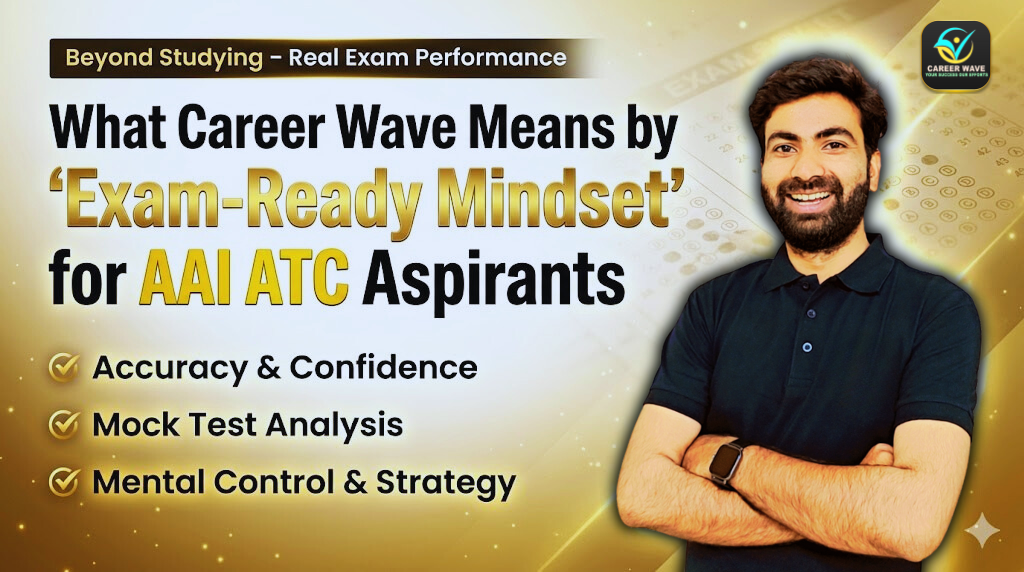
What Career Wave Means by ‘Exam-Ready Mindset’
Most AAI ATC aspirants believe that completing the syllabus means they are ready for the exam.
But at Career Wave, we define readiness differently.
Finishing the syllabus is preparation.
Performing under pressure is an Exam-Ready Mindset.
And this difference decides selection.
AAI ATC is not just a test of knowledge. It is a test of:
• Decision-making
• Emotional control
• Speed under pressure
• Accuracy under time limits
• Strategic thinking
Let’s break this down deeply.
1) Preparation vs Performance: The Hidden Gap
Many students:
• Complete all subjects
• Solve hundreds of questions
• Watch multiple lectures
• Make notes
Yet in the exam hall:
• Their hands feel heavy
• Time feels faster
• Accuracy drops
• Panic increases
Why does this happen?
Because preparation was theoretical.
The exam is psychological.
An Exam-Ready Mindset bridges that gap.
2) What Exactly Is an Exam-Ready Mindset?
An Exam-Ready Mindset means:
You are mentally conditioned to perform consistently, even under stress.
It includes:
1. Clarity of concepts
2. Awareness of strengths & weaknesses
3. Ability to manage time strategically
4. Emotional stability during difficulty
5. Controlled risk-taking
6. Consistent accuracy
It transforms preparation into performance.
3) The 7 Core Components of Career Wave’s Exam-Ready Framework
1. Conceptual Depth (Not Surface Learning)
Many students memorize formulas.
Exam-ready students understand:
• Why the formula works
• When it fails
• How it can be twisted
This prevents confusion when questions are framed differently.
2. Error Pattern Identification
Most students review mocks casually.
Exam-ready students ask:
• Why did I make this mistake?
• Was it conceptual or careless?
• Does this mistake repeat?
• What system can prevent it?
At Career Wave, error logs are maintained systematically.
Because repeated mistakes are not knowledge problems — they are system problems.
3. Time Architecture Planning
Time management is not about speed alone.
It involves:
• Section priority strategy
• Question scanning skills
• Skip-and-return method
• Micro time control (seconds saved per question)
Exam-ready students know:
• When to leave a question
• When to attempt via elimination
• When to conserve time
4. Mock-to-Exam Transition Strategy
Many aspirants score well in mocks but underperform in the real exam.
Why?
Because they:
• Take mocks casually
• Pause in between
• Check answers mid-test
• Don’t simulate pressure
An exam-ready mindset demands:
• Strict exam environment simulation
• Fixed time discipline
• Post-mock analytics
• Emotional control training
When mocks feel intense, the real exam feels manageable.
5. Accuracy Optimization
AAI ATC includes negative marking.
This means:
• Over-attempting can be dangerous
• Under-attempting can reduce cutoff chances
Exam-ready candidates:
Track accuracy % regularly
• Improve elimination techniques
• Avoid ego attempts
• Balance risk intelligently
Accuracy is engineered — not accidental.
6. Mental Endurance Training
The exam is a mental marathon.
Mental fatigue leads to:
• Silly mistakes
• Calculation errors
• Misreading questions
Career Wave emphasizes:
• Long-duration practice sessions
• No-distraction policy
• Brain conditioning through timed sets
Endurance creates stability.
7. Emotional Regulation
The most underrated factor.
During the exam:
• One tough question can disturb rhythm
• One wrong answer can reduce confidence
• Seeing unfamiliar questions can trigger panic
Exam-ready students:
• Reset quickly
• Focus on the next question
• Maintain breathing control
• Avoid emotional reaction
Emotional stability improves performance more than extra study hours.
4) Signs You Have Developed an Exam-Ready Mindset
✔ Your mock scores are stable
✔ Accuracy remains above 80–85%
✔ You rarely panic in difficult sections
✔ You know your safe attempt range
✔ You revise strategically, not randomly
✔ You trust your strategy
If these are present, you are moving toward selection.
5) Why Most Aspirants Fail to Build This Mindset
Because they focus only on:
• Completing books
• Collecting resources
• Comparing with others
• Increasing study hours
But they ignore:
• Performance analysis
• Psychological readiness
• Strategic refinement
• Emotional control
Selection requires internal transformation, not just external preparation.
6) How Career Wave Trains the Exam-Ready Mindset Step-by-Step
Phase 1: Foundation Clarity
Strong conceptual base.
Phase 2: Controlled Practice
Topic-wise timed drills.
Phase 3: Performance Tracking
Data-driven improvement tracking.
Phase 4: Full Simulation Training
Exam-like strict mock sessions.
Phase 5: Strategic Polishing
Fine-tuning attempt order, elimination, time control.
This layered system builds confidence naturally.
7) Final Thought
An Exam-Ready Mindset means:
You don’t just hope to clear.
You are prepared to perform.
When:
• Your preparation is measurable
• Your emotions are controlled
• Your decisions are strategic
• Your accuracy is consistent
Selection becomes predictable.
8) FAQs:
1. What is the difference between preparation and exam readiness?
Preparation is completing the syllabus.
Exam readiness is the ability to perform consistently under time pressure with high accuracy and emotional control.
2. How long does it take to build an exam-ready mindset?
depends on the candidate, but typically 2–3 months of structured mock practice and analysis can significantly build exam temperament.
3. Can mock tests alone make me exam-ready?
No.
Mocks without deep analysis do not build readiness.
Improvement happens in post-mock review, error correction, and strategy refinement.
4. How important is emotional control in AAI ATC?
Extremely important. Even well-prepared candidates lose marks due to panic, rushed attempts, or frustration. Emotional discipline maintains accuracy.
5. What accuracy percentage should I target before the real exam?
Ideally, maintain:
• 80–90% accuracy in mocks
• Stable score variation
• Controlled negative marking
Consistency matters more than one high score.
Helpful links-
AAI ATC Selection Is Not Hard — Strategy Is Rare (Case Studies)
How Career Wave Designs AAI ATC Study Plans Differently
Which Physics Topics Are Decision-Heavy vs Calculation-Heavy in AAI ATC?
AAI ATC JE Syllabus 2026 – Complete, Detailed Guide with Career Wave Preparation Support