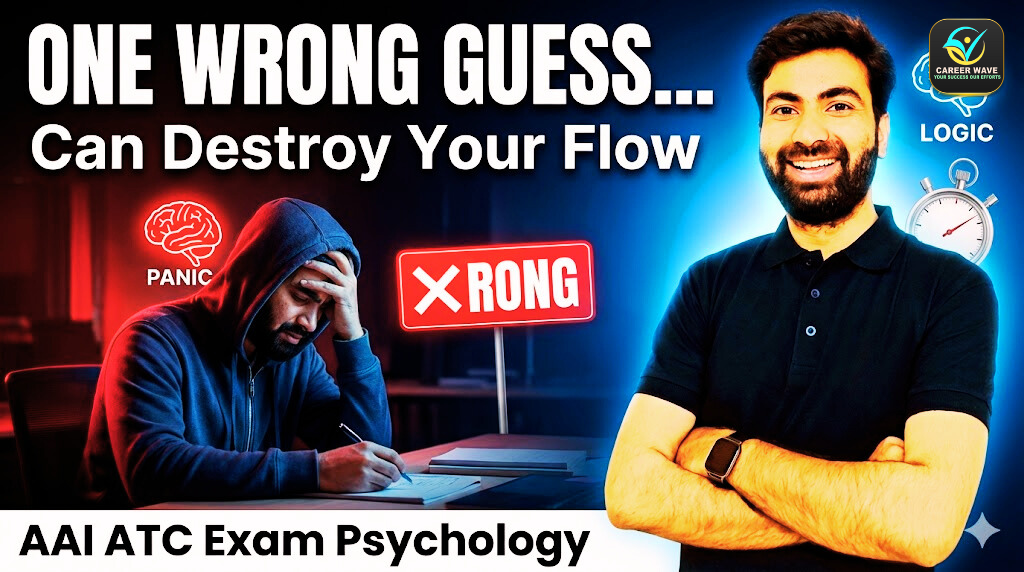
The Psychological Cost of One Wrong Guess in AAI ATC
In a high-stakes exam like AAI ATC, one wrong guess is not just a lost mark.
It can cost you confidence.
It can disturb your focus.
It can change your entire performance curve.
Let’s understand what really happens inside your mind when you realize — “That answer might be wrong.”
1) The Instant Emotional Reaction: Shock
The moment you doubt your answer, your brain sends a subtle stress signal.
Even before you consciously process it, your emotional brain reacts:
• Heart rate increases slightly
• Thoughts speed up
• Attention narrows
This micro-stress response is automatic.
In competitive exams like AAI ATC, where precision matters, this reaction is amplified.

2) The Confidence Drop Effect
One wrong guess creates a dangerous mental chain:
“If this is wrong… maybe I’m not prepared enough.”
This thought can silently reduce your self-belief.
And here’s the real danger:
You stop trusting your preparation.
After that:
• You start double-checking easy questions.
• You hesitate on moderate ones.
• You waste time on re-evaluating correct answers.
The exam doesn’t become harder.
Your mind becomes heavier.
3) Cognitive Load Increases
AAI ATC requires:
• Fast decision-making
• Logical clarity
• Calm under pressure
When you regret a guess, your working memory gets occupied with:
• Replay of the previous question
• Self-criticism
• Fear of negative marking
This reduces mental bandwidth for the next question.
Psychologically, this is called performance interference.
4) The Negative Marking Fear Loop
AAI ATC has negative marking.
One doubtful guess can trigger:
• “What if I lose 1 mark?”
• “What if cutoff increases?”
• “What if this costs my selection?”
Now you’re no longer solving the present question.
You’re fighting imaginary future consequences.
That’s the psychological cost.
5) The Domino Effect on Time Management
After one wrong guess, candidates usually:
• Spend extra time on next question
• Become overly cautious
• Lose flow state
Exams reward momentum.
Overthinking breaks momentum.
6) The Identity Threat
For serious aspirants, AAI ATC is not just an exam.
It’s a dream.
So, when a guess feels wrong, it attacks identity:
• “I am a serious aspirant.”
• “I should know this.”
That internal conflict creates anxiety.
But Here’s the Truth
One wrong guess rarely decides the result.
But one wrong mental reaction can.
The exam is not testing perfection.
It’s testing stability.
7) How to Protect Your Psychology During AAI ATC
1. Follow a Pre-Decided Guess Rule
Before the exam, decide:
• Guess only if 2 options eliminated.
• Skip if pure blind guess.
Rule reduces emotional regret.
2. Never Review Emotionally During Exam
If answered, move forward.
No mental replay.
3. Reset Ritual (10-Second Technique)
After a doubtful answer:
• Take one deep breath.
• Look away from screen for 3 seconds.
• Tell yourself: “Next question matters more.”
4. Remember: Everyone Guesses
Top rankers also make guesses.
Difference?
They don’t emotionally react to them.
8) Final Thought
In AAI ATC, your biggest enemy is not negative marking.
It is emotional instability.
One wrong guess is normal.
But letting it disturb your next 20 questions is optional.
Control the reaction.
And you control the result.
9) Frequently Asked Questions (FAQs)
Question 1. Does one wrong guess significantly affect my AAI ATC result?
No, one wrong guess rarely determines your final result. However, the psychological reaction to that mistake can affect your focus, time management, and confidence during the remaining questions.
Question 2. How does negative marking psychologically impact candidates?
Negative marking increases fear of uncertainty. It makes candidates more cautious, sometimes overly cautious, which can lead to hesitation, second-guessing, and wasted time.
Question 3. Should I attempt a question if I am unsure in AAI ATC?
You should follow a pre-decided strategy.
If you can eliminate at least two options logically, a calculated guess may be reasonable.
Avoid blind guessing without reasoning.
Question 4. Why do I lose confidence after realizing a mistake during the exam?
Because your brain interprets mistakes as threats to performance. This triggers stress and self-doubt, which can temporarily reduce clarity and logical thinking.
Question 5. How can I mentally recover after making a doubtful attempt?
Use a quick reset technique:
• Take one deep breath
• Shift focus immediately to the next question
• Avoid mentally replaying the previous one
Momentum is more important than perfection.
Question 6. Do toppers avoid guessing completely?
No. Even top scorers make calculated guesses. The key difference is emotional control. They move forward without overthinking past responses.
Related blogs-
AAI ATC Success Patterns Observed in Career Wave Toppers
What Happens in the Brain When You See an Unfamiliar Question?
The One Habit That Separates Selected vs Non-Selected ATC Aspirants