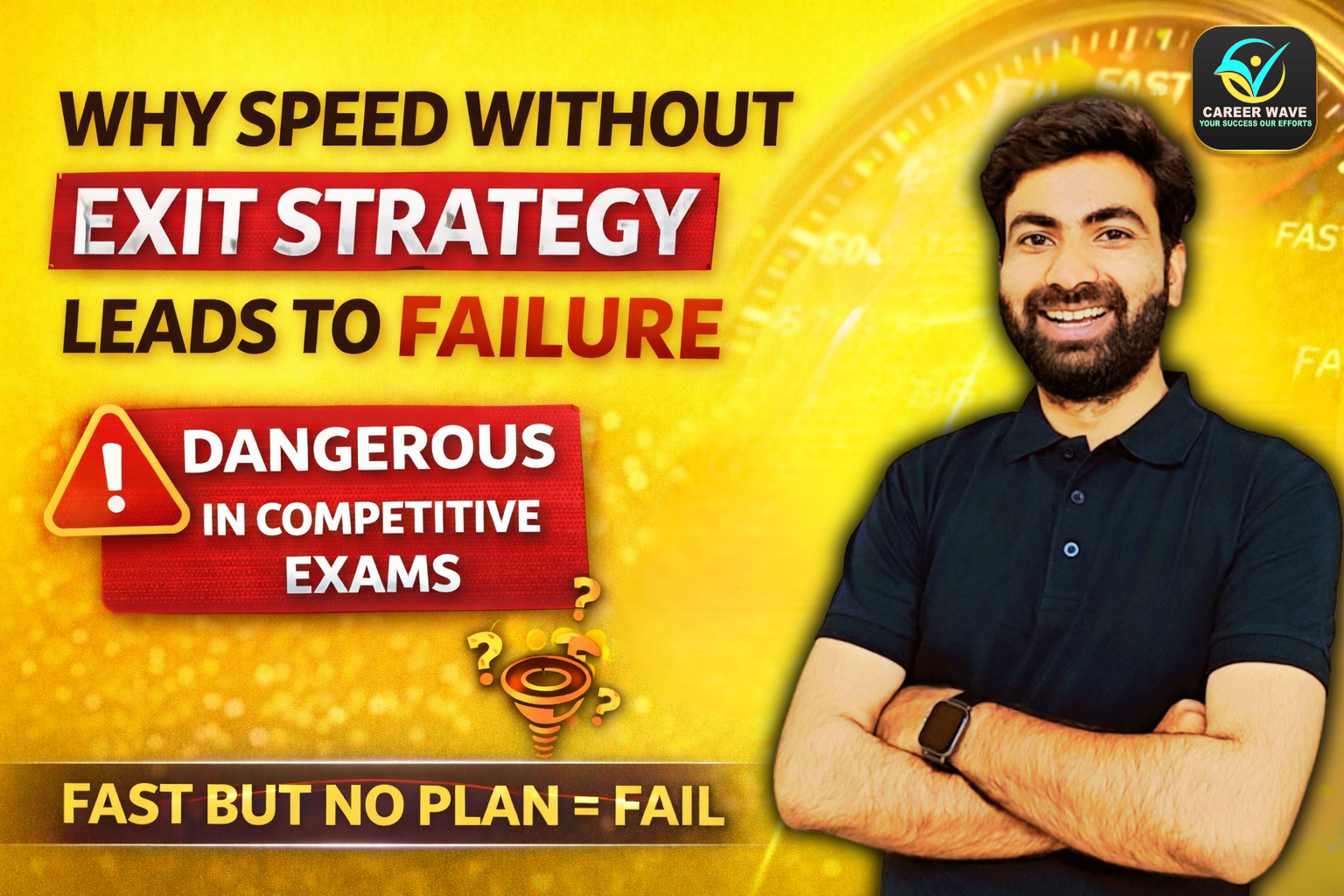
Why Speed Without Exit Strategy Leads to Failure
In competitive environments — whether it’s AAI ATC CBT, UPSC, banking exams, startups, trading, or even corporate projects — speed is often glorified as the ultimate weapon.
“Be fast.”
“Finish first.”
“Move quickly.”
“Take action.”
But here’s the uncomfortable reality:
Speed without an exit strategy is controlled chaos.
It may look impressive at the start — but it often collapses under pressure.
This article dives deeper into the psychological, strategic, and performance-related risks of speed without exit planning — and how to correct it.
🚨 The Core Problem: Speed Creates Momentum, But No Safety Net
When you move fast:
• You gain confidence.
• You feel ahead of others.
• You build early momentum.
But without an exit plan:
• You lose control during unexpected difficulty.
• You panic when things don’t go as expected.
• You waste time trying to “fix” decisions emotionally.
Speed creates motion.
Exit strategy creates control.
1) The Psychology Behind Speed Without Strategy
1.1 Adrenaline Distorts Judgment
When you start fast in exams:
• Your brain releases adrenaline.
• Decision speed increases.
• Impulse control decreases.
Initially, performance feels sharp.
But sustained adrenaline reduces logical thinking.
That’s why:
• Silly mistakes increase.
• Easy questions get overanalyzed.
• Tough questions trigger panic.
Without exit rules, your brain enters “fight mode” instead of “strategy mode.”
1.2 The Sunk Cost Trap
Once you spend time on a question, your brain refuses to let go.
You think:
“I’ve already spent 4 minutes.”
“Just 1 more calculation.”
“Almost there.”
But exams don’t reward effort.
They reward accuracy and selection.
Without exit discipline:
⏳ 4 minutes become 7.
⏳ 7 become 10.
And time vanishes silently.
1.3 Ego Attachment to Speed
Many aspirants equate speed with intelligence.
They believe:
“Smart students finish early.”
“I should not skip.”
“Skipping means weakness.”
But strategic skipping is not weakness.
It’s advanced time management.
Professionals skip.
Amateurs struggle.
2) Why Tough Questions Are Less Dangerous
It may sound strange — but tough questions are often safer.
Because:
• You approach them cautiously.
• You calculate carefully.
• You accept the possibility of skipping.
Easy questions, however:
• Lower your guard.
• Invite overconfidence.
• Trigger unnecessary rechecking.
Ironically, easy questions consume more total time due to double-checking and doubt.
3) The Hidden Cost of No Exit Strategy
Let’s break it down practically.
🔻 Time Imbalance
Without exit planning:
• First 30 minutes: Over-speeding.
• Middle phase: Energy drop.
• Final 20 minutes: Panic mode.
Result:
• Random guessing.
• Increased errors.
• Mental fatigue.
🔻 Energy Misallocation
Speed burns mental energy quickly.
If you don’t control pacing:
• Accuracy drops in last section.
• Logical clarity decreases.
• Risk tolerance increases (dangerous).
Exams are marathons, not sprints.
🔻 Review Chaos
Many students finish early but:
• Don’t know what to review.
• Randomly change correct answers.
• Overthink simple logic.
Structured review requires a plan
.Speed without review strategy creates negative correction.
4) The Right Formula: Controlled Speed + Exit Plan
Success formula:
Fast Decision Making + Clear Skip Rules + Sectional Buffer + Emotional Discipline = Stable High Score
5) How to Build a Practical Exit Strategy (Exam Context)
5.1 Define Your Question Time Cap
Before exam:
• Easy question → 45–60 sec
• Moderate → 90 sec
• Tough → 120 sec max
If no breakthrough → skip.
No negotiation.
5.2 Use the 3-Level Marking System
• ✔️ Sure – no need to review
• ? Doubtful – revisit later
• ✖️ Skip – if time remains
This prevents emotional revisits.
5.3 Build a Final 15-Minute Blueprint
Last 15 minutes:
• First 5 → Revisit marked questions
• Next 5 → Cross-check high-value answers
• Final 5 → Scan for unattempted easy ones
Without pre-deciding this, panic takes control.
5.4 Practice Exit During Mock Tests
Most students practice solving.
Few practice skipping.
Train yourself:
• To leave questions calmly.
• To accept uncertainty.
• To move forward without guilt.
That’s elite-level exam behavior.
6) Real-World Applications Beyond Exams
📈 Trading
Entering trade fast is easy.
Exiting without stop-loss is financial suicide.
🚀 Startups
Scaling quickly without fallback planning destroys capital.
💼 Corporate Decisions
Fast execution without risk analysis leads to operational damage.
Speed is powerful.
But without exit planning, it becomes reckless.
7) Signs You’re Speeding Blindly
• You rarely leave questions.
• You feel anxious while skipping.
• You run out of time frequently.
• You change answers often during review.
• Your mock scores fluctuate heavily.
These are red flags.
8) The Deeper Truth
Failure is rarely caused by lack of knowledge.
It’s caused by:
• Poor decision timing.
• Emotional attachment.
• Lack of structured control.
Speed amplifies these weaknesses.
Strategy corrects them.
9) The Ultimate Rule
Don’t aim to finish first.
Aim to finish stable.
Exams reward:
• Consistency
• Controlled aggression
• Smart skipping
• Time discipline
Not reckless speed.
10) FAQs
Q1. Is speed important in competitive exams?
Yes — but only when controlled. Speed helps maximize attempts. However, without time boundaries and skip rules, speed reduces accuracy and increases stress.
Q2. How do I know when to skip a question?
If:
• No clear approach in 60–90 seconds.
• You’re rereading without progress.
• You’re calculating repeatedly.
Skip immediately.
Return later with a fresh mind.
Q3. Doesn’t skipping reduce confidence?
Initially yes.
But strategically skipping protects overall score. Confidence should come from total performance, not individual attachment.
Q4. How do toppers manage speed?
Toppers:
• Pre-decide skip rules.
• Track time subconsciously.
• Avoid emotional revisits.
• Protect final 15 minutes strictly.
They don’t rush.
They control.
Q5. Why do I panic in the last section?
Because:
• You overspent time earlier.
• You burned mental energy.
• You didn’t reserve buffer time.
Panic is a symptom of poor pacing.