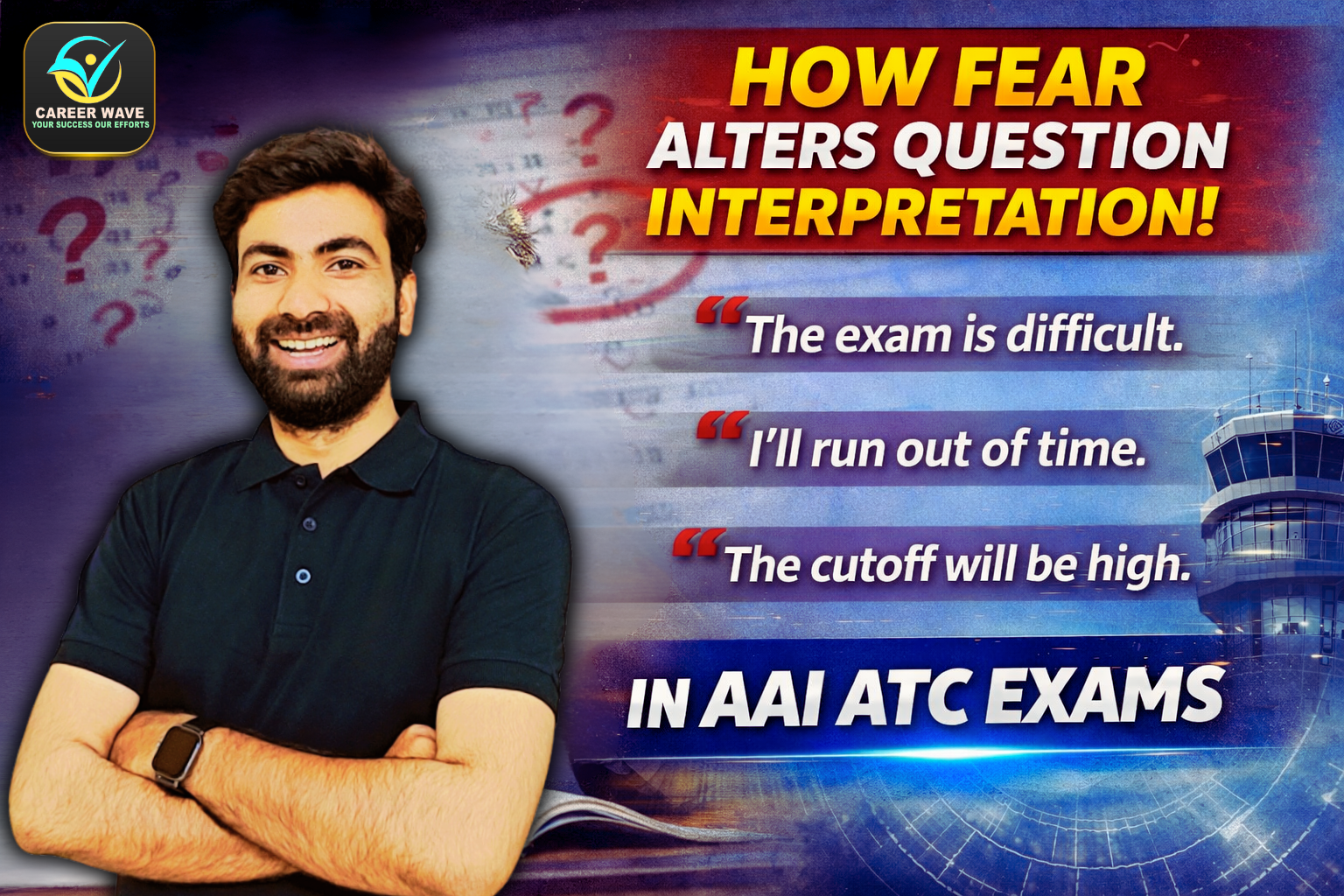
How Fear Alters Question Interpretation in AAI ATC Exams
By Career Wave
Most AAI ATC aspirants believe they lose marks because of:
• Lack of preparation
• Tough questions
• Time shortage
But after analyzing hundreds of mock tests at Career Wave, we’ve found something surprising:
👉 Many students lose marks not because they don’t know the answer —
👉 They lose marks because fear changes how they read the question.
Fear doesn’t just reduce confidence.
It alters interpretation.
And in AAI ATC CBT, interpretation decides accuracy.
1) The Hidden Effect of Fear in Competitive Exams
When you feel anxious during the exam:
• Heart rate increases
• Breathing becomes shallow
• Mind shifts into “threat mode”
In this state, your brain prioritizes speed over clarity.
That’s where mistakes begin.
You stop reading.
You start assuming.
2) How Fear Distorts Question Interpretation
Let’s break it down practically.
2.1 You Rush Through Key Words
AAI ATC questions often include:
• “Not correct”
• “Most appropriate”
• “Approximately”
• “Closest value”
Under fear, aspirants:
• Skip these keywords
• Assume it’s a standard question
• Select the first matching option
Result?
Concept was clear.
Answer became wrong.
At Career Wave, we call this:
“Keyword Blindness Under Pressure.”
2.2 You Overcomplicate Simple Questions
Fear creates doubt.
Even when the question is direct, your mind says:
“It can’t be this easy.”
You start re-solving.
You re-check unnecessarily.
You change the correct answer.
This is extremely common in Physics and Mathematics sections.
Fear makes simple look suspicious.
2.3 You Misread Numerical Data
Under stress:
• Units get ignored
• Negative signs get skipped
• Decimal points get misplaced
And these are not knowledge errors.
They are attention errors.
AAI ATC CBT rewards precision.
Fear destroys precision.
2.4 You Interpret Based on Assumption, Not Reading
Instead of reading the full question, fear triggers pattern recognition:
“This looks like that mock question.”
So, you apply the previous logic without verifying conditions.
But AAI ATC examiners slightly twist framing.
One small word change = different answer.
2.5 You Panic After One Tough Question
This is the most dangerous chain reaction.
You see one tough question early.
Internal dialogue begins:
• “The paper is tough.”
• “Time won’t be enough.”
• “The cutoff will be high.”
Now every next question is read through anxiety.
Your mind is no longer neutral.
And interpretation suffers.
3) The Psychological Mechanism Behind This
Fear activates the fight-or-flight response.
In that mode:
• Brain seeks speed
• Brain avoids deep analysis
• Brain reacts emotionally
But AAI ATC requires:
• Calm reading
• Logical breakdown
• Controlled execution
Fear and accuracy cannot coexist.
4) Real Pattern Observed at Career Wave
When we compare two students:
Student A:
• Same preparation
• Same conceptual clarity
• High anxiety
Student B:
• Same preparation
• Calm approach
Student B consistently scores 8–12 marks higher.
Not because of intelligence.
Because of interpretation stability.
5) How to Prevent Fear-Based Misinterpretation
Here are practical methods used by serious Career Wave aspirants:
1. Slow the First 10 Questions
Start calm.
Even if paper feels easy, do not rush.
First 10 questions set psychological tone.
2. Underline or Mentally Highlight Keywords
Train yourself during mocks to focus on:
• NOT
• Only
• Incorrect
• Approximate
• Maximum / Minimum
Make this a habit before exam day.
3. Use the 5-Second Reset Rule
If panic rises:
• Stop.
• Take one slow breath.
• Re-read the question from the start.
This simple reset restores interpretation clarity.
4. Separate Difficulty From Danger
Tough question ≠ Dangerous exam.
One difficult question does not define the paper.
Treat each question independently.
5. Practice Exam-Like Pressure
Fear reduces when familiarity increases.
At Career Wave, we emphasize:
• Full-length timed mocks
• No pause solving
• Strict exam environment
Confidence is not motivational.
It is situational familiarity.
6)The Bigger Truth
AAI ATC is not just testing knowledge.
It tests:
• Emotional stability
• Cognitive control
• Reading precision
• Decision discipline
Fear changes how you see the question.
Calmness restores what you already know.
Final Words from Career Wave
Most aspirants don’t need more books.
They need better emotional control during execution.
Knowledge gives you potential.
Calmness converts it into marks.
Fear doesn’t reduce intelligence.
It reduces interpretation accuracy.
Master fear, and your marks will reflect your preparation.
— Career Wave
FAQs –
Q1. Why do I make silly mistakes only in the real exam?
Because anxiety increases cognitive load. Your brain becomes reactive instead of analytical.
Q2. Can fear really change how I read questions?
Yes. Stress affects attention span and keyword detection, which directly impacts interpretation accuracy.
Q3. How can I stop overthinking easy questions?
Trust your first logical solution if concept clarity is strong. Avoid re-solving unless you detect a genuine calculation error.
Q4. Is fear completely avoidable?
No. Even toppers feel fear. The goal is control, not elimination.
Q5. How does Career Wave help reduce exam fear?
Career Wave focuses on:
• Exam-oriented mock simulation
• Strategy training
• Mental stability techniques
• Pattern recognition through past paper analysis
Q6. What is the biggest mistake caused by fear?
Misreading keywords and emotionally investing time in tough questions.
Helpful links-
The Myth of Equal Time Per Question in AAI ATC
The Confidence Crash Point in AAI ATC CBT (And How to Cross It)
How the Brain Switches Modes Between Physics & Maths in AAI ATC
Why Students Change Correct Answers in AAI ATC (The Hidden Exam-Day Trap)