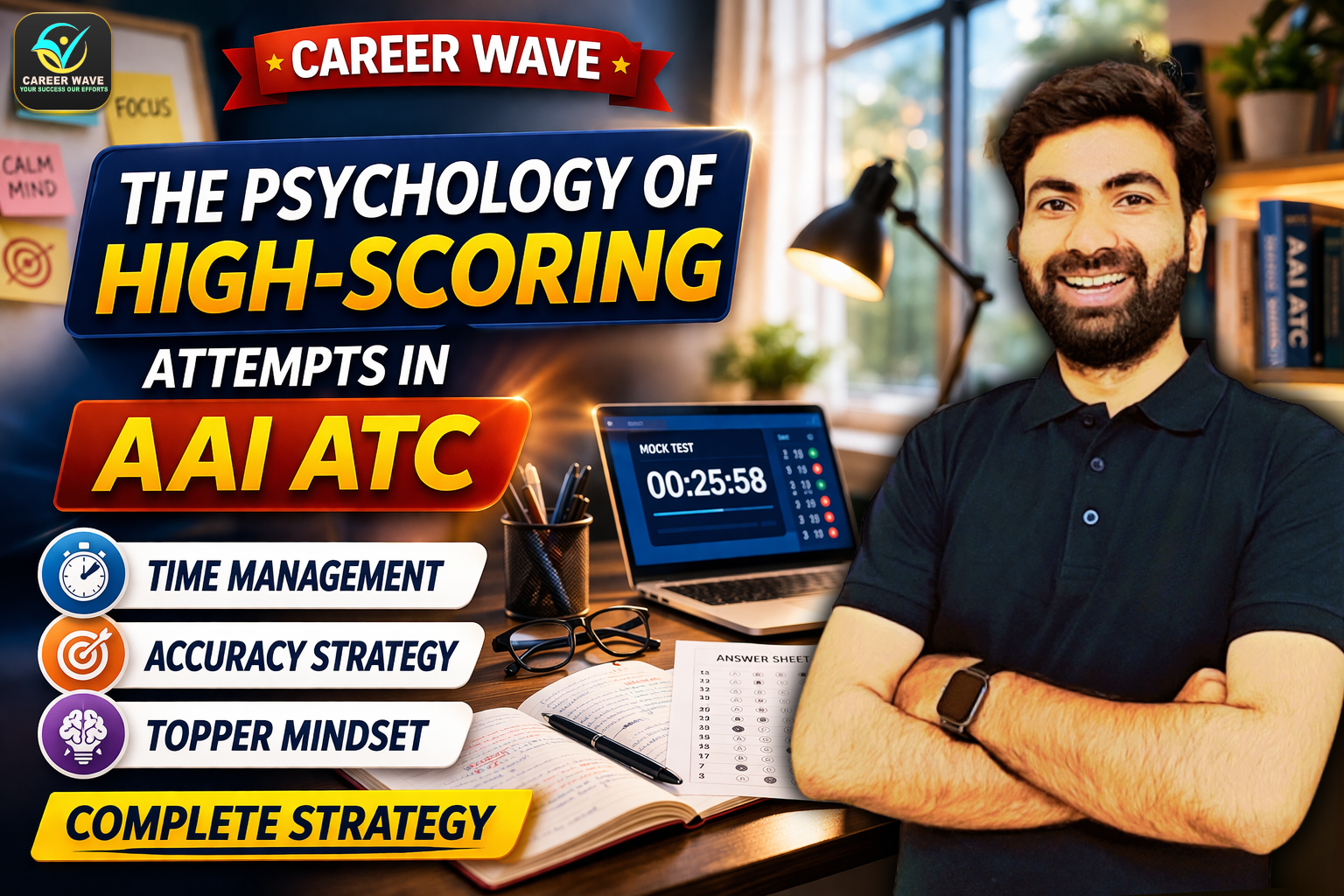
🧠 The Psychology of High-Scoring Attempts
(What Top Performers Do Differently in the Exam Hall)
When students prepare for exams like AAI ATC, most of their focus stays on:
• Completing syllabus
• Solving questions
• Giving mock tests
But there’s one factor that silently decides your final score:
👉 Your thinking process during the exam
At Career Wave, we repeatedly emphasize:
“Selection doesn’t happen during preparation — it happens during the attempt.”
And that attempt is purely psychological.
🔍 1) The “Selection Mindset” vs “Preparation Mindset”
Most aspirants stay stuck in preparation mode even inside the exam.
Preparation mindset:
• “I studied this, I should solve it”
• “I can’t leave this question”
• “Let me try one more method”
Selection mindset:
• “Is this question worth my time?”
• “What is the safest scoring decision?”
• “Skip now, return later”
👉 High scorers shift from solver → decision maker
⚖️ 2) Risk Management Is the Real Game
Every question in the exam has 2 possibilities:
• ✔️ Correct attempt
• ⏭️ Skipped
Average students think:
More attempts = more marks
Top scorers think:
Right attempts = more marks
At Career Wave, students are trained to evaluate:
• Probability of correctness
• Time required
• Risk vs reward
👉 This transform guessing into controlled decision-making
⏱️ 3) Micro Time Decisions Decide Your Rank
It’s not just about total time — it’s about micro time control.
Low performers:
• Spend 3–4 minutes on one question
• Lose time for easy questions
High scorers:
• Set internal limits (e.g., 40–60 seconds per question)
• Exit quickly if stuck
• Protect time for scoring zones
👉 They don’t solve questions — they manage time blocks
🧩 4) The Power of “First Round Advantage”
Top scorers follow a golden rule:
👉 Maximize score in the first pass
First round strategy:
• Attempt only easy + direct questions
• Build confidence
• Secure safe marks quickly
This creates:
• Momentum
• Confidence boost
• Reduced pressure
At Career Wave, students are trained:
👉 “Your first 20–30 minutes decide your final rank.”
🧠 5) Cognitive Load Management
During exams, your brain has limited capacity.
If you:
• Overthink
• Switch too many concepts
• Panic
Your brain slows down.
High scorers:
• Keep thinking simple
• Avoid unnecessary mental load
• Stick to familiar patterns
👉 They protect their mental energy like a resource
😰 6) Handling Difficult Questions Without Panic
What happens when a tough question appears?
Average reaction:
• Panic
• Spend extra time
• Lose confidence
Top scorer reaction:
• Recognize difficulty instantly
• Skip without emotional reaction
• Move forward
👉 Their mindset is:
“One tough question cannot decide my result.”
🔁 7) The Role of Mock Conditioning
Psychology is not built in one day.
It is trained through:
• Repeated mock exposure
• Pressure simulation
• Pattern recognition
At Career Wave, mocks are designed to:
• Build decision speed
• Improve accuracy under pressure
• Train emotional control
👉 Students don’t just practice questions — they practice thinking under pressure
🎯 8) Attempt Strategy Is Pre-Decided, Not Random
High scorers NEVER decide strategy inside the exam.
They already know:
• Which section first
• How much time per section
• When to skip
• When to guess
This removes:
• Confusion
• Panic
• Time waste
👉 Clarity = Speed = Score
⚡ 9) The “Let Go” Skill (Most Underrated)
One of the most powerful skills:
👉 Letting go of questions
Students lose marks because they:
• Get emotionally attached
• Don’t want to leave questions
• Keep trying till the end
High scorers:
• Detach instantly
• Move forward
• Protect their score
At Career Wave, we teach:
👉 “Leaving a question is sometimes the smartest attempt.”
📊 10) Accuracy Zones & Smart Attempting
Every student has an accuracy zone:
• Easy → 90–100% accuracy
• Moderate → 60–80% accuracy
• Difficult → <50% accuracy
Top scorers:
• Maximize easy + moderate
• Minimize risky attempts
👉 They don’t chase difficult questions — they maximize scoring zones
🧠 11) Emotional Neutrality (The Hidden Secret)
During exam:
• One wrong question → frustration
• One tough section → panic
High scorers remain:
• Emotionally neutral
• Stable
• Focused
They don’t let:
• Fear reduce speed
• Confidence cause over-attempting
👉 Emotional balance = Consistent performance
🔄 12) Post-Attempt Thinking Matters Too
Even after solving, mindset matters:
Low scorers:
• Doubt correct answers
• Change answers randomly
High scorers:
• Trust first instinct (if confident)
• Change only with strong logic
👉 They avoid self-sabotage
🏁 Final Thoughts
High-scoring attempts are not about:
• Solving the most questions
• Knowing everything
They are about:
• Making the right decisions
• Managing time smartly
• Controlling emotions
• Playing the exam strategically
At Career Wave, students are trained not just to study —
👉 but to think, decide, and perform like toppers in the exam hall.
❓ FAQs
Q1. Why do I scoreless despite good preparation?
Because performance depends on:
• Decision-making
• Time management
• Attempt strategy
Not just knowledge.
Q2. How can I improve my attempt strategy?
• Practice full-length mocks
• Analyze mistakes deeply
• Fix a clear attempt plan
• Track accuracy
Q3. Should I attempt all questions in the exam?
No.
👉 Attempt only those where probability of correctness is high.
Q4. How does Career Wave help with exam psychology?
Career Wave trains students through:
• Strategy-based mocks
• Performance analysis
• Time management drills
• Mentorship and guidance
Q5. What is the biggest psychological mistake?
👉 Trying to prove knowledge instead of maximizing score.
Q6. Can mindset really increase marks?
Yes. A strong mindset:
• Improves accuracy
• Reduces negative marking
• Boosts confidence
• Increases overall score significantly
Related Blogs -
The Career Wave Attempt Strategy Framework
Career Wave ATC Test Series 2026 – Features, Benefits & Complete Strategy Guide
AAI ATC Online Mock Test 2026 – Complete Guide (Strategy, Analysis, Score Boost Plan)