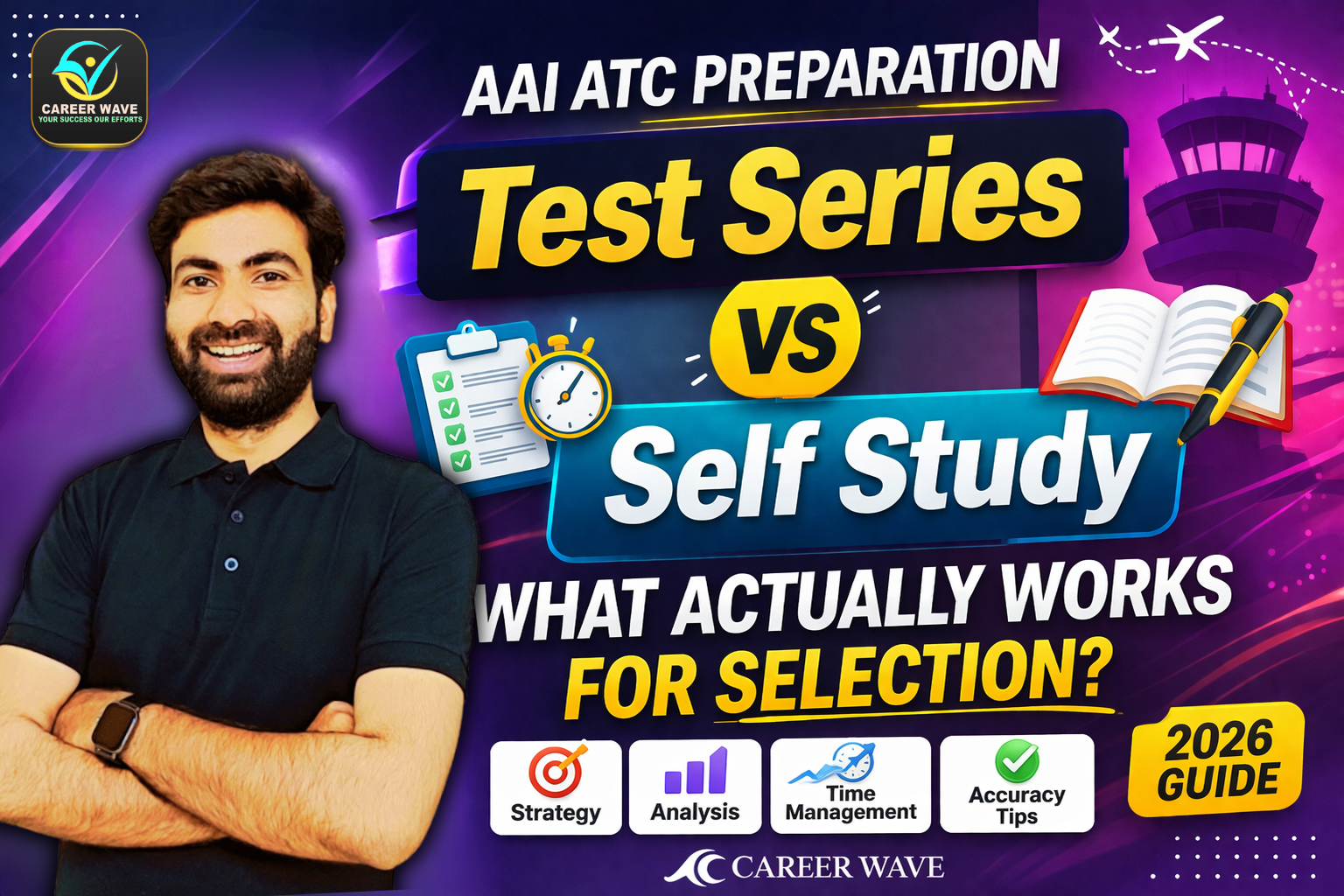
Test Series vs Self Study: What Actually Works in ATC? (Deep Analysis)
AAI ATC preparation is not about how much you study —
it is about how effectively you perform in 120 minutes.
Most aspirants get confused between:
• Self Study
• Test Series
The truth is:
👉 Selection happens when knowledge + execution work together
1. Self Study: Concept Building Stage
Self-study is your foundation layer.
What Self Study Actually Does:
• Builds Physics & Maths fundamentals
• Strengthens formula clarity
• Helps in PYQ understanding
• Improves problem-solving approach
Where Self Study Fails:
• No real exam pressure
• No time constraint practice
• No measurement of performance
• Overconfidence ("I know everything.")
👉 Many students feel prepared but fail in exam because:
they never tested their execution
2. Test Series: Execution Training Stage
Test series is where selection actually starts.
At Career Wave, test series is not just practice — it is:
• 📊 Performance tracking system
• 📉 Accuracy improvement tool
• ⏱️ Time optimization training
• 🎯 Strategy building platform
🔗 Join ATC Full Test Series 2026:
https://careerwave.org/test-series/22-atc-full-test-series-2026
3. Real Gap: Knowledge vs Performance
Most aspirants prepare like this:
👉 Study → Revise → Study → Revise
But toppers prepare like this:
👉 Study → Test → Analyze → Improve → Repeat
Why This Works:
Because exam does not check:
• How much you studied
It checks:
• How many correct answers you can mark in limited time

4. Deep Comparison (ATC Perspective)
Factor | Self Study | Test Series |
Concept Clarity | High | Moderate |
Speed Development | Low | High |
Accuracy Tracking | No | Yes |
Time Management | Weak | Strong |
Pressure Handling | Zero | Real |
Strategy Building | No | Yes |
Rank Prediction | Impossible | Possible |
👉 ATC is a speed + accuracy game, not just knowledge game
5. Why Students Fail Despite Studying Hard
After analyzing thousands of mocks at Career Wave, common reasons:
❌ 5.1 No Exam Simulation
Students never practiced 120 questions in 120 minutes.
❌ 5.2 Poor Attempt Strategy
• Trying all questions
• Not skipping tough ones
❌ 5.3 High Micro-Mistakes
• Calculation errors
• Misreading questions
• Overconfidence
❌ 5.4 No Data Analysis
They only see:
👉 “What was the score?”
Instead of:
👉 “Why did the score drop?”
6. Role of Test Series in Fixing These Problems
A structured test series helps you:
✔ Identify Weak Areas
• Topic-wise analysis
• Section-wise performance
✔ Control Accuracy
• Understand mistake types
• Reduce silly errors
✔ Improve Time Usage
• Learn where to spend time
• Learn what to skip
✔ Build Exam Temperament
• Reduce panic
• Improve decision-making
7. The Most Important Part: Mock Analysis
👉 Giving mocks is 20%
👉 Analyzing mocks is 80%
Ideal Analysis Method:
After every test, track:
• Score
• Attempts
• Accuracy %
• Time spent per section
• Mistake type:
◦ Conceptual
◦ Silly
◦ Time-related
◦ Guess-based
👉 This is exactly what Career Wave trains students to do.
8. Ideal Preparation Model (Career Wave System)
Step-by-Step Flow:
1. Concept Learning (Self Study)
2. Practice Questions
3. Mock Test Attempt
4. Deep Analysis (1.5–2 hrs)
5. Error Correction
6. Re-application in next mock
👉 This loop creates predictable improvement
9. Advanced Strategy Used by Toppers
🔹 3-Round Attempt Strategy:
1. Easy questions (first sweep)
2. Moderate questions
3. Risk-based attempts
🔹 Accuracy Target:
• 80–90% = Ideal selection zone
🔹 Safe Attempt Range:
• Maintain a fixed attempt range
• Avoid over-attempting
10. Ideal Ratio (Phase-wise)
📘 Early Stage:
• 70% Self Study
• 30% Test Series
📊 Mid Stage:
• 50% Self Study
• 50% Test Series
🚀 Final Stage:
• 30% Self Study
• 70% Test Series
👉 As exam approaches, shift from learning → performance
11. Career Wave Advantage
At Career Wave, test series is designed for selection-focused preparation:
• 📊 Detailed performance analytics
• 📉 Accuracy improvement tracking
• ⏱️ Time management training
• 📘 PYQ-based pattern alignment
• 🎯 Personalized strategy
👉 Not just “practice tests” —
👉 Complete performance system
12. Final Conclusion
❌ Self Study Alone → Knowledge without control
❌ Test Series Alone → Practice without base
✅ Combination → Selection
👉 ATC exam is not about:
“How much you know”
👉 It is about:
“How well you perform under pressure”
FAQs
1. When should I start test series for ATC?
Start as soon as basic concepts are covered. Do not wait for “perfect preparation”.
2. How many mocks are enough?
Quality matters more than quantity.
👉 20–30 well-analyzed mocks are enough for selection.
3. What is the biggest mistake students make in mocks?
• Not analyzing deeply
• Repeating same mistakes
• Focusing only on score
4. Can test series improve my score significantly?
Yes. Many students improve 20–30 marks just by:
• Fixing mistakes
• Improving accuracy
• Optimizing time
5. How much time should I spend on analysis?
👉 Minimum 1.5–2x of test duration
If test = 2 hours → analysis = 3–4 hours
6. Should I give mocks daily?
Not necessary.
👉 Better to give fewer mocks with deep analysis than many without analysis.
7. How do I know I am improving?
• Accuracy increasing
• Mistakes reducing
• Score becoming stable
• Less panic in mocks
8. Is Career Wave test series suitable for beginners?
Yes. It is designed with:
• Gradual difficulty
• Structured analysis
• Student-friendly approach
Final Message
👉 Stop choosing between self-study and test series
👉 Start combining them strategically
Because:
Selection is not about effort…
It is about optimized performance.
Related Blogs -
Daily Study Routine of ATC Top Rankers (Realistic Plan)
Mistakes Even Top Scorers Make in ATC Exam (Detailed Analysis)
Rank Booster Strategy for Last 30 Days Before ATC Exam
How to Build Exam Temperament (Advanced Guide by Career Wave)