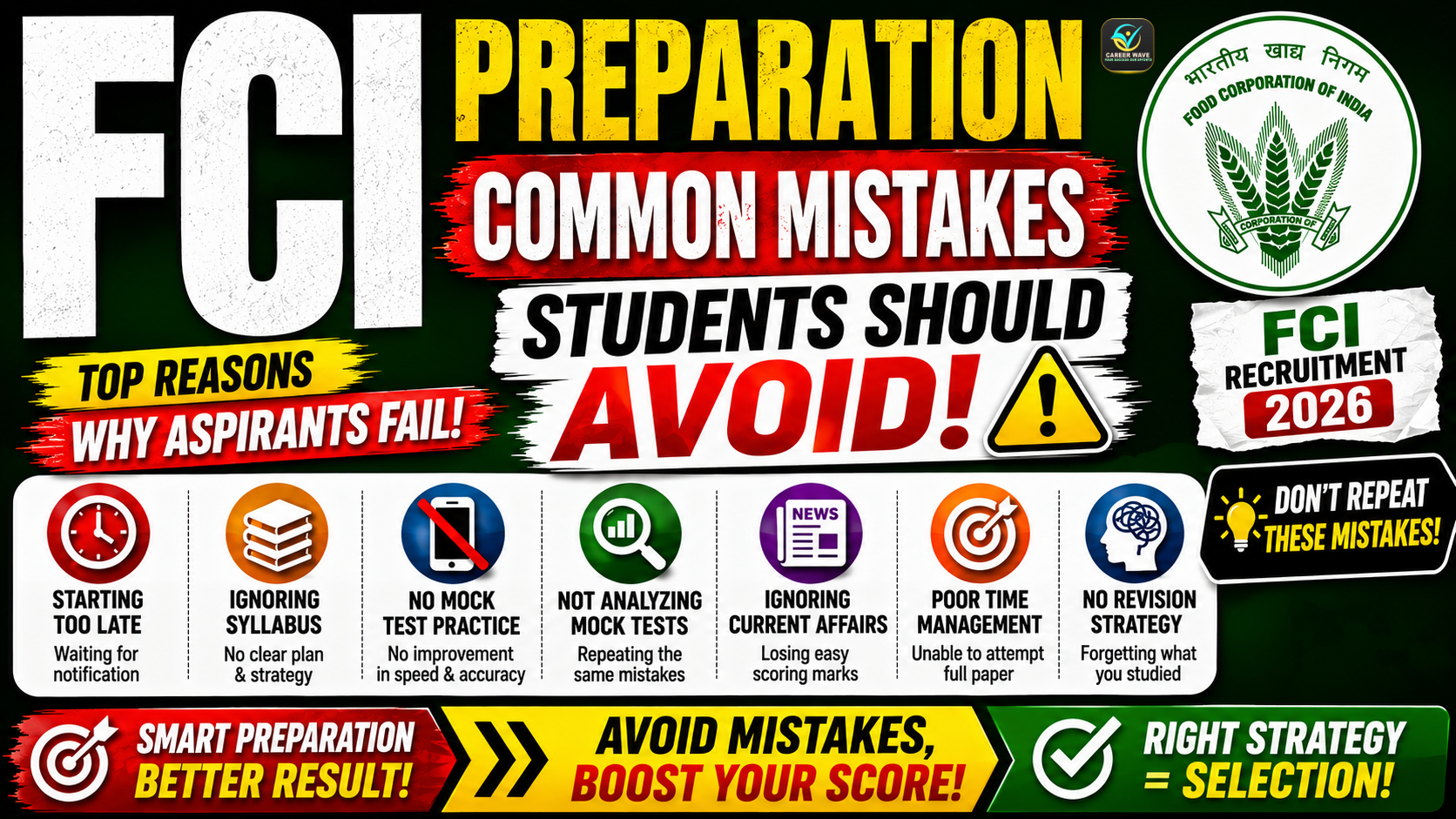
Common Mistakes Students Should Avoid in FCI Preparation
FCI Recruitment is one of the important government job opportunities for students preparing for SSC, Banking, Railways, Insurance, and other competitive exams. Many aspirants become excited whenever FCI vacancy news comes out because the exam offers good salary, job security, and career growth.
But selection in FCI is not achieved only by hard work. It requires the right direction, proper planning, regular practice, mock test analysis, and strong revision.
Many students study for months but still fail to score well because they repeat common preparation mistakes. This blog explains those mistakes in detail and how students can avoid them.
1. Waiting for the Official Notification
One of the biggest mistakes students make is waiting for the official notification before starting preparation.
Many aspirants think:
“I will start serious preparation once the notification comes.”
This approach is risky. After the notification, students get limited time for:
• syllabus completion,
• mock tests,
• revision,
• current affairs,
• speed improvement,
• and mistake correction.
FCI exams usually require strong preparation in Quant, Reasoning, English, General Studies, and Current Affairs. These subjects cannot be completed properly in a few weeks.
Correct Approach
Students should start early. Even if the notification has not been released, they should begin with common subjects like:
• Quantitative Aptitude
• Reasoning Ability
• English Language
• General Awareness
Early preparation gives students enough time to build concepts, revise properly, and improve speed.
2. Not Understanding the Exam Pattern
Many students start solving random questions without understanding the actual exam pattern. This makes preparation directionless.
Before beginning preparation, students must understand:
• number of sections,
• number of questions,
• marks distribution,
• time duration,
• negative marking,
• difficulty level,
• and selection stages.
Without this clarity, students may waste time on less relevant topics and ignore high-scoring areas.
Correct Approach
Before starting preparation, make a simple exam structure sheet:
Area | What to Check |
Exam Mode | Online CBT |
Sections | English, Reasoning, Quant, GS |
Negative Marking | Usually applicable |
Time Limit | Must be checked from notification |
Selection Stages | CBT, Skill Test, DV, Interview if applicable |
Once the pattern is clear, preparation becomes more focused.
3. Ignoring the Official Syllabus
Some students prepare only from SSC or Banking material and assume it will be enough for FCI. This is a partial approach.
FCI preparation may overlap with other exams, but students must still follow the official syllabus. Every exam has its own demand, question style, and subject weightage.
Common Subjects in FCI Preparation
• English Language
• Reasoning Ability
• Quantitative Aptitude
• General Studies
• Current Affairs
• Computer Awareness, if required
• Post-specific subjects, if applicable
Correct Approach
Make a topic-wise syllabus checklist. Mark every topic as:
• Not Started
• Basic Done
• Practice Done
• Mock Level Done
• Revised
This helps students track real preparation instead of assuming that syllabus is complete.
4. Studying Without a Proper Plan
Many aspirants study randomly. One day they study Quant, next day Reasoning, then they skip preparation for several days. This creates inconsistency.
A competitive exam needs a structured plan.
Problems With Random Study
• No syllabus tracking
• No revision cycle
• No mock schedule
• Weak topics remain weak
• Current affairs pile up
• Confidence decreases near exam
Correct Approach
A practical daily study plan should include:
• 1 subject for concept building
• 1 subject for practice
• 20–30 minutes current affairs
• 20–30 minutes revision
• weekly mock test
• weekly mistake analysis
A simple and realistic study plan is better than an overambitious timetable.
5. Ignoring Previous Year Questions
Previous Year Questions are one of the most powerful tools for exam preparation. Still, many students ignore them and only solve random practice questions.
PYQs help students understand:
• actual exam level,
• repeated topics,
• question framing,
• difficulty level,
• important chapters,
• and scoring areas.
Correct Approach
Students should solve PYQs in three stages:
Stage 1: Topic-Wise PYQs
Solve PYQs after completing each topic.
Stage 2: Section-Wise PYQs
Solve subject-wise previous year questions with time limits.
Stage 3: Full Paper PYQs
Attempt previous year papers like real exams.
This builds exam temperament and improves accuracy.
6. Not Practicing Mock Tests Regularly
Mock tests are essential for FCI preparation. Many students avoid mocks because they fear low marks.
This is a serious mistake.
Mock tests are not only for checking scores. They are for improving performance.
Mock Tests Help In
• speed improvement,
• time management,
• accuracy control,
• question selection,
• exam temperament,
• weak area identification.
Correct Approach
Start with:
• topic tests,
• sectional mocks,
• then full-length mocks.
In the beginning, low marks are normal. The goal is not to score high from day one. The goal is to improve after every mock.
7. Not Analyzing Mock Tests
Only attempting mocks is not enough. Mock analysis is more important than mock attempt.
Many students give mock tests, check marks, feel happy or sad, and then move to the next mock. This gives very little improvement.
After Every Mock, Check
• Which questions were wrong?
• Which questions took too much time?
• Which questions were skipped?
• Which topics are weak?
• Were mistakes due to concept, calculation, or carelessness?
• Was the attempt strategy correct?
Correct Approach
Maintain a mock analysis notebook with columns:
Mock No. | Score | Wrong Topics | Silly Mistakes | Action Plan |
This creates measurable improvement.
8. Ignoring Accuracy Due to Over-Attempting
Many students believe that attempting more questions will automatically increase marks. This is not true when negative marking exists.
Blind attempts can reduce the final score.
Example
If a student attempts 90 questions but makes too many mistakes, the score may fall sharply due to negative marking.
Correct Approach
Focus on:
• easy questions first,
• avoid blind guessing,
• skip lengthy questions initially,
• read questions carefully,
• maintain accuracy above speed.
A smart attempt is always better than a high-risk attempt.
9. Weak Time Management
FCI exams are time-bound. Many students know the answers but cannot complete the paper in time.
This happens because they do not practice under exam conditions.
Common Time Management Mistakes
• spending too much time on one question,
• solving lengthy questions first,
• poor section switching,
• slow calculation,
• overthinking simple questions,
• not using elimination.
Correct Approach
During mock tests:
• set section-wise time targets,
• attempt easy questions first,
• mark doubtful questions for review,
• avoid emotional attachment to any question.
The exam rewards smart selection, not stubbornness.
10. Ignoring General Studies and Current Affairs
Many students focus only on Quant, Reasoning, and English. They keep General Studies and Current Affairs for the last month.
This is a major mistake.
GS and Current Affairs require regular revision. They cannot be mastered overnight.
Important GS Areas
• Current Affairs
• Indian Economy
• History
• Geography
• Polity
• General Science
• Static GK
• Government schemes
Correct Approach
Study GS daily in small portions. Revise weekly. Maintain short notes for:
• monthly current affairs,
• important appointments,
• awards,
• schemes,
• economy updates,
• science facts.
Small daily revision works better than last-minute bulk study.
11. Ignoring English Preparation
Many aspirants, especially from Hindi-medium background, ignore English or fear it. But English can become a scoring section with consistent practice.
Important English Topics
• Reading Comprehension
• Cloze Test
• Error Detection
• Fill in the Blanks
• Para Jumbles
• Vocabulary
• Sentence Improvement
Correct Approach
Students should practice English daily for at least 30 minutes.
Daily routine:
• 10 vocabulary words
• 1 reading passage
• 10 grammar questions
• revision of previous mistakes
English improves gradually, not instantly.
12. Weak Calculation Practice
Quantitative Aptitude requires both concept and speed. Many students understand formulas but are slow in calculation.
This reduces overall attempt.
Calculation Areas to Improve
• tables,
• squares,
• cubes,
• percentage conversions,
• fractions,
• ratio calculations,
• approximation,
• simplification.
Correct Approach
Spend 10–15 minutes daily on calculation practice. This small habit improves Quant speed significantly.
13. Preparing Too Many Resources
One common mistake is collecting too many books, PDFs, Telegram notes, YouTube playlists, and coaching materials.
Too many resources create confusion.
Students start material collection instead of actual preparation.
Correct Approach
Use limited but reliable resources:
• one main source for concepts,
• one practice source,
• one mock test platform,
• one current affairs source,
• PYQs.
Repetition from one good source is better than incomplete study from ten sources.
14. Not Revising Regularly
Revision is the backbone of exam preparation. Many students keep studying new topics but do not revise old ones.
As a result, they forget:
• formulas,
• vocabulary,
• grammar rules,
• reasoning methods,
• current affairs,
• and GS facts.
Correct Approach
Follow this revision cycle:
Time | Revision Target |
Daily | Previous day topics |
Weekly | Full week topics |
Monthly | Complete subject revision |
Before Exam | Mock mistakes + formulas + current affairs |
Without revision, preparation remains incomplete.
15. Ignoring Weak Topics
Some students keep practicing topics they already know because it gives confidence. They avoid weak topics because they feel uncomfortable.
This creates imbalance.
Correct Approach
Identify weak topics from mocks and PYQs. Give extra time to them.
For example:
• If DI is weak, practice one DI set daily.
• If puzzles are weak, solve 2 puzzles daily.
• If vocabulary is weak, revise words daily.
• If current affairs are weak, make monthly notes.
Improvement happens only when weak areas are attacked directly.
16. Not Making Short Notes
Short notes save time during revision. Many students depend on full books till the end, which becomes difficult near exam.
What to Include in Short Notes
• formulas,
• grammar rules,
• vocabulary,
• current affairs,
• static GK facts,
• mock mistakes,
• shortcut methods.
Short notes should be simple and revision-friendly.
17. Poor Exam Temperament
Some students prepare well but panic during the actual exam. They lose marks due to pressure, confusion, and poor decision-making.
Correct Approach
Build exam temperament through:
• timed mocks,
• exam-like environment,
• section-wise practice,
• controlled breathing before exam,
• realistic target setting.
Mock tests train the mind to handle pressure.
18. Ignoring Post-Specific Requirements
FCI has different posts. Some may require technical knowledge, typing skills, skill tests, or specific qualifications.
Students must not prepare only common subjects if their target post has additional requirements.
Correct Approach
Check the target post carefully:
• Assistant Grade 3
• Manager
• Technical
• Accounts
• Hindi
• Typist
• Stenographer
Prepare according to the post-specific demand.
19. Not Checking Eligibility Properly
Many students start preparation without checking eligibility. Later they realize issues related to:
• age,
• qualification,
• category certificate,
• computer knowledge,
• typing requirement,
• percentage criteria.
Correct Approach
Before applying, verify:
• educational qualification,
• age limit,
• category relaxation,
• certificate validity,
• post-specific requirements.
This prevents last-minute rejection.
20. Lack of Consistency
The final and biggest mistake is inconsistency.
Many students study seriously for a few days, then stop, then restart again. This breaks momentum.
FCI preparation does not require extreme study hours every day. It requires disciplined daily effort.
Correct Approach
Even 3–4 focused hours daily can produce strong results if maintained consistently.
A good daily structure:
• 1 hour Quant/Reasoning
• 1 hour English/GS
• 1 hour practice
• 30 minutes revision
• 30 minutes current affairs
Consistency beats irregular hard work.
Best Preparation Strategy for FCI Exam
Students should follow this system:
Step 1: Understand the Syllabus
Make a complete topic-wise list.
Step 2: Complete Concepts
Study basic concepts subject-wise.
Step 3: Practice Daily
Solve topic-wise questions every day.
Step 4: Solve PYQs
Understand real exam demand.
Step 5: Attempt Mocks
Start with sectional mocks and move to full tests.
Step 6: Analyze Mistakes
Maintain a mistake notebook.
Step 7: Revise Weekly
Do not allow topics to fade.
Step 8: Improve Speed and Accuracy
Use timed practice.
Step 9: Stay Updated
Revise current affairs regularly.
Step 10: Avoid Random Material
Follow one structured preparation path.
Final Conclusion
FCI preparation is not difficult if students follow the right strategy. Most aspirants fail not because they lack intelligence, but because they prepare without structure.
Students should avoid:
• waiting for notification,
• ignoring syllabus,
• skipping mocks,
• avoiding mock analysis,
• neglecting revision,
• depending on random resources,
• and ignoring current affairs.
A serious aspirant should start early, follow a disciplined study plan, practice regularly, revise consistently, and learn from every mistake.
In exams like FCI, selection is not decided by motivation alone. It is decided by preparation quality, accuracy, speed, revision, and consistency.
Students who avoid these common mistakes will always stay ahead of the crowd.
FAQs –
Q1. When should I start preparing for FCI Recruitment?
Answer: Start preparation as early as possible. Waiting for the official notification reduces the time available for syllabus completion, mock tests, and revision.
Q2. Is solving Previous Year Questions important for FCI preparation?
Answer: Yes. PYQs help you understand the exam pattern, difficulty level, frequently asked topics, and important chapters.
Q3. How many mock tests should I attempt before the FCI exam?
Answer: There is no fixed number, but serious aspirants should attempt at least 20–30 full-length mocks along with sectional tests and analyze each mock properly.
Q4. What is the biggest mistake students make during FCI preparation?
Answer: The biggest mistake is waiting for the notification and starting preparation late. This leaves insufficient time for revision and practice.
Q5. Should I focus more on speed or accuracy?
Answer: Accuracy should come first. High attempts with low accuracy can reduce your score due to negative marking. Aim for a balance of speed and accuracy.
Related Blogs -
Data-Driven Study Strategy Using Mock Scores
AAI ATC Preparation Audit: How to Check If You Are Exam-Ready