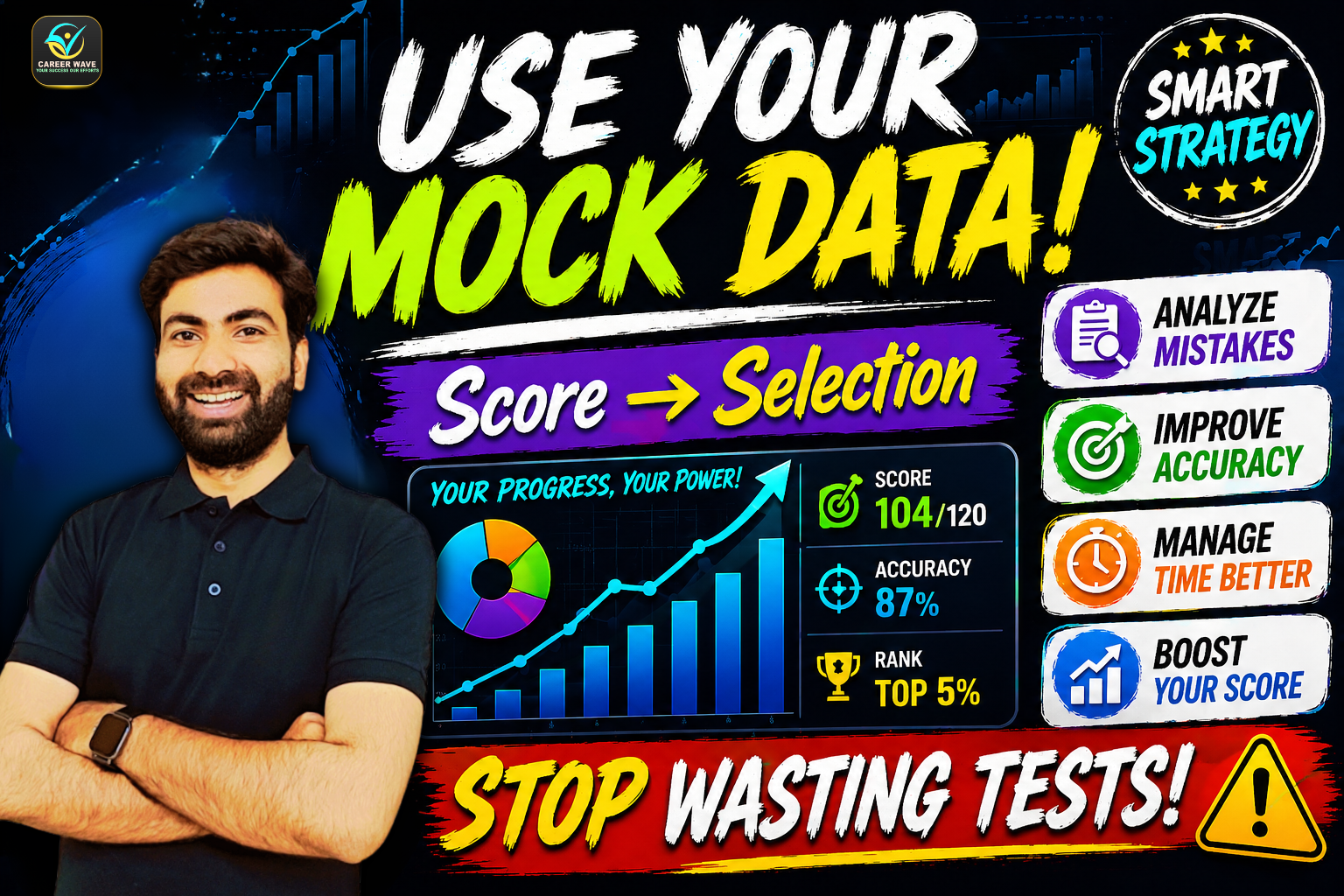
Data-Driven Study Strategy Using Mock Scores
Most AAI ATC aspirants take mock tests regularly, but very few actually improve from them.
Why?
Because they treat mocks as:
• a test of preparation, not
• a tool for improvement
At Career Wave, the approach is clear:
👉 Mocks are data. Data gives direction. Direction leads to selection.

1) What is a Data-Driven Study Strategy?
A Data-Driven Study Strategy is a method of preparation where study decisions are based on measurable performance indicators from mock tests, rather than assumptions or guesswork.
In simple terms:
👉 You study what your performance data tells you to study
Instead of relying on intuition, you rely on:
• actual scores
• actual mistakes
• actual time usage
2) Why This Strategy Matters for AAI ATC
The AAI ATC exam is:
• objective
• time-bound
• accuracy-driven
Improvement is possible only when:
• mistakes are identified
• patterns are tracked
• strategy is refined
Without data:
• preparation becomes random
• improvement becomes inconsistent
3) Core Data Points in Mock Tests
Every mock test provides four key metrics:
1. Score
Total marks obtained
👉 Indicates overall performance level
2. Attempt
Number of questions attempted
👉 Reflects confidence and speed
3. Accuracy
Correct ÷ Attempt × 100
👉 Shows quality of attempts
4. Time Distribution
Time spent per section
👉 Measures time management efficiency
👉 These four metrics define your exam readiness
4) Step-by-Step Data-Driven Strategy
Step 1: Deep Score Analysis
Instead of asking:
👉 “What is my score?”
Ask:
• How many correct?
• How many wrong?
• How many guesses?
Example
• Score: 100
• Attempt: 110
• Correct: 100
• Wrong: 10
👉 Insight:
• Over-attempting
• Accuracy issue
Step 2: Accuracy vs Attempt Balance
Accuracy is the percentage of correct answers out of total attempts, while Attempt reflects how many questions you tried.
Ideal ATC Range
• Attempt → 100–110
• Accuracy → 85–90%
Interpretation
• High attempt + low accuracy → careless or guessing
• Low attempt + high accuracy → lack of confidence
👉 Balance is essential
Step 3: Section-Wise Analysis
Break performance into:
• Physics
• Mathematics
• Reasoning
• English
• General Knowledge
• Aptitude
Identify:
• Strong section → maintain
• Weak section → improve
• Slow section → optimize
👉 Example:
• Physics weak → needs focus
• Reasoning strong → scoring area
Step 4: Error Classification (Most Critical Step)
Error Classification is the process of categorizing mistakes based on their root cause to enable targeted improvement.
Types of Errors
1. Conceptual Error
• Concept not clear
👉 Fix: Re-study the topic
2. Calculation Error
• Concept known but mistake in execution
👉 Fix: Practice
3. Silly Mistake
• Misreading the question
• Marking the wrong option
👉 Fix: Improve attention and discipline
4. Guessing Error
• Attempting without clarity
👉 Fix: Avoid guessing
👉 This step converts mistakes into actionable improvements
Step 5: Time Analysis
Time Analysis evaluates how efficiently time is distributed across sections and questions.
Key Questions
• Where am I spending too much time?
• Where am I solving quickly?
Goal
• Easy questions → solve quickly
• Difficult questions → skip strategically
👉 Efficient time use increases attempts
Step 6: Progress Tracking System
Progress Tracking is the process of recording and analyzing performance trends across multiple mock tests.
Maintain a record of:
• Test number
• Score
• Attempt
• Accuracy
• Weak areas
Outcome:
• Clear improvement trend
• Measurable consistency
• Repeated weak topics identified
👉 Data provides clarity
Step 7: Strategy Building from Data
After 5–10 mock tests:
• Fix your attempt range
• Decide section order
• Optimize time allocation
👉 Your strategy should be:
Data-based, not guess-based
Step 8: Avoid Unproductive Comparison
Instead of:
👉 “Others are scoring higher”
Focus on:
👉 “Is my performance improving consistently?”
👉 Consistency matters more than comparison
5) Career Wave Approach
At Career Wave, mock analysis includes:
• detailed performance breakdown
• structured error tracking
• accuracy improvement methods
• personalized strategy
Because:
👉 Mocks without analysis do not lead to improvement
Ideal Study Flow
Mock → Analysis → Error Correction → Practice → Next Mock
6) Final Conclusion
A data-driven approach transforms:
• random study → focused study
• repeated mistakes → controlled accuracy
• unstable scores → consistent performance
Final Takeaway
Mocks show what happened
Data shows what to fix
7) FAQs
1. What is a data-driven study strategy?
A method of studying based on actual performance data from mock tests.
2. Why is my score not improving?
Because you are not analyzing your mocks deeply.
3. What is ideal accuracy?
85–90% for a safe score.
4. How many mocks should I take?
2–3 per week with proper analysis.
5. Should I guess answers?
No, avoid guessing to maintain accuracy.
6. How do I track improvement?
Maintain a performance sheet.
7. What matters more—score or trend?
Trend improvement over time.
8. When should I start mocks?
After covering basic syllabus.
9. Can this strategy improve rank?
Yes, it directly improves performance.
10. How does Career Wave help?
By providing structured mock analysis and guidance.
Related Blogs -
Reasoning Section Strategy: 100% Accuracy Plan (AAI ATC)
Expected Cutoff for AAI ATC 2026 (Data-Based Prediction)
Psychological Mistakes That Reduce ATC Scores
Medical Test Requirements for ATC (Vision, Hearing, Fitness)