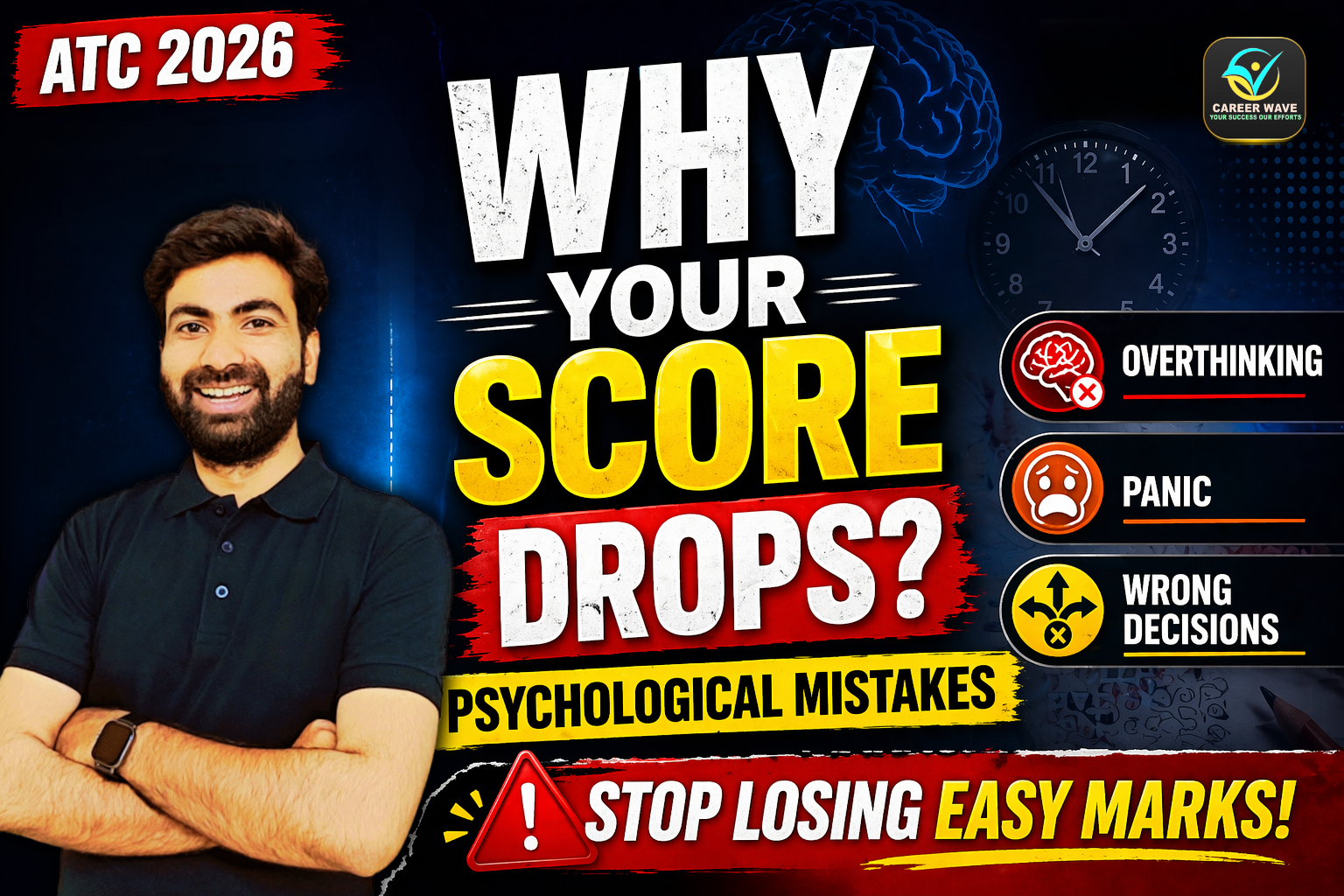
Psychological Mistakes That Reduce ATC Scores
A Complete Exam Mindset Guide for AAI ATC Aspirants | Career Wave
Most AAI ATC aspirants focus heavily on:
• Physics
• Mathematics
• Previous Year Questions
• Mock tests
Yet, despite good preparation, many students experience a drop in scores during actual exams.
The reason is not always lack of knowledge.
👉 The real reason is psychological mistakes during the exam
At Career Wave, we consistently observe:
Top scorers are not just better prepared—they are mentally more controlled and disciplined.
Core Understanding
The AAI ATC exam is not just:
• a knowledge test
• a speed test
It is also a:
👉 decision-making + pressure-handling test
Your performance depends on:
• what you attempt
• what you skip
• how you manage time
• how you control your emotions
Major Psychological Mistakes
1. Over-Attempting (Greed for More Questions)
Thought Pattern
“More attempts will increase my score.”
Reality
• Doubtful questions get attempted
• Negative marking increases
• Accuracy drops
👉 ATC rewards accuracy, not aggression
2. Getting Stuck on One Question
Situation
• A difficult question appears
• You spend 3–4 minutes trying to solve it
Impact
• Easy questions are missed
• Time pressure builds
• Panic increases later
👉 One wrong time decision can affect the entire paper
3. Ego-Based Solving
Thought
“I studied this topic; I must solve this question.”
Problem
• Emotional attachment to the question
• Overthinking
• Forced attempts
👉 Exams reward smart selection, not ego satisfaction
4. Fear of Skipping Questions
Thought
“What if I skip and it turns out to be easy?”
Result
• You attempt without clarity
• Confusion increases
• Wrong answers occur
👉 Skipping is not weakness
👉 It is a strategic decision
5. Panic After One Mistake
Situation
• One mistake happens
• Confidence drops
Chain Reaction
• Doubt increases
• Speed decreases
• More mistakes follow
👉 The real problem is not the mistake
👉 It is losing control after the mistake
6. Lack of Attempt Strategy
Problem
Students enter the exam without:
• a clear plan
• time division
• question priority
Result
• Random solving
• Poor time management
• Inconsistent performance
👉 Without strategy, preparation loses its value
7. Overconfidence
Thought
“The paper is easy; I can solve everything.”
Result
• Careless mistakes
• Ignoring accuracy
• Loss of marks
👉 Overconfidence silently reduces performance
8. Underconfidence
Thought
“I don’t think I can solve this.”
Result
• Easy questions get skipped
• Attempts decrease
• Fear-based decisions
👉 Underconfidence hides your true potential
9. Last-Minute Rush
Situation
• Time is about to end
• Panic leads to rushed attempts
Result
• Guessing
• Calculation errors
• Marking mistakes
👉 The last minutes should be controlled, not rushed
10. Comparing Yourself with Others
Thought
“Others must be solving faster than me.”
Result
• Focus breaks
• Pressure increases
• Decision quality drops
👉 Your performance depends only on your own paper
11. Sunk Cost Fallacy
Thought
“I have already spent 3 minutes; I cannot leave it now.”
Reality
• More time gets wasted
• No guarantee of solving
👉 Past time should not control future decisions
12. Lack of Recovery Ability
Average Student
• One mistake → panic → performance drop
Top Performer
• One mistake → ignore → continue
👉 Recovery ability is a rank-deciding factor
What Top Performers Do Differently
At Career Wave, top students:
• Skip quickly without hesitation
• Follow strict time limits
• Stay calm under pressure
• Focus on accuracy
• Recover immediately after mistakes
👉 They do not try to prove themselves
👉 They try to maximize score efficiently
Career Wave Strategy to Avoid These Mistakes
1. 3-Round Attempt System
Round 1: Easy Questions
• Attempt only sure-shot questions
• Skip immediately if confused
Round 2: Moderate Questions
• Attempt with 70–80% confidence
Round 3: Smart Attempts
• Attempt selected doubtful questions
• Avoid blind guessing
2. Time Management Rule
• Do not spend more than 60–90 seconds per question initially
3. 80% Confidence Rule
• Attempt only when you are at least 80% sure
• Otherwise mark and move ahead
4. Mock Analysis
• Identify wrong attempts
• Track time usage
• Analyze psychological mistakes
👉 Improvement comes from analysis, not just practice
Career Wave Insight
At Career Wave, we train students not only in:
• subject knowledge
but also, in:
• exam mindset
• decision-making
• pressure control
Because:
Selection is decided in 120 minutes—not by how much you studied, but by how well you performed.
Final Conclusion
Psychological mistakes are silent score killers.
They:
• reduce accuracy
• waste time
• break confidence
• lower rank
The difference between an average student and a topper is often:
👉 Mental control during the exam
Final Takeaway
Your preparation gives you potential
Your mindset converts it into results
FAQs
1. Do psychological mistakes affect ATC scores?
Yes, they significantly impact accuracy and decision-making.
2. What is the most common mistake?
Over-attempting and getting stuck on difficult questions.
3. Should I skip questions in ATC exam?
Yes, strategic skipping improves overall performance.
4. How can I avoid panic during the exam?
Practice mock tests and follow a fixed strategy.
5. What matters more—speed or accuracy?
Accuracy always matters more.
6. Why do scores drop in the actual exam?
Due to pressure, poor decisions, and lack of control.
7. Can mindset alone improve scores?
Yes, a controlled mindset can significantly improve performance.
8. What is the 80% confidence rule?
Attempt only when you are mostly sure of the answer.
9. How can I improve exam temperament?
Through regular mock practice and analysis.
10. How does Career Wave help?
By developing both subject knowledge and exam mindset.
Related Blogs -
Medical Test Requirements for ATC (Vision, Hearing, Fitness)
Career Growth in AAI ATC (Level-Wise Promotion Path)
ATC Cutoff Trends (2018–2025): Complete Analysis for AAI ATC Aspirants
AAI ATC Online Mock Test 2026 – Complete Guide (Strategy, Analysis, Score Boost Plan)