Career Growth in AAI ATC (Level-Wise Promotion Path)
Complete Long-Term Career Roadmap, Salary Growth & Real Progression | Career Wave
Selection is Just the Beginning
Most students preparing for AAI ATC focus only on one goal—clearing the exam. That is important, but not enough.
A more mature question is:
• “How will life be after selection?”
• “Will the career grow or remain stuck at the same level?”
• “Will I get stability and respect in the long term?”
AAI ATC is not just a job you join and stay at one level. It is a structured, progressive, long-term career system where you move from a trainee-level officer to leadership roles over time.
At Career Wave, we always guide students to think beyond selection. Because the real value of any career lies in its growth, stability, and long-term scope.
Understanding the Nature of ATC Career Growth
Before discussing levels, one thing must be clear:
AAI ATC growth is:
• Structured (defined hierarchy exists)
• Stable (no sudden fluctuations)
• Performance-linked (not purely time-based)
• Vacancy-dependent (not automatic every year)
This means growth is:
• Not extremely fast like startups
• Not stagnant like some traditional government roles
👉 It is balanced and predictable, which is ideal for long-term planning.
Level 1: Junior Executive (ATC) – The Foundation Stage
Entry Position
Junior Executive (Air Traffic Control)
Pay Structure
• E1 Level
• Salary range: approx. ₹40,000 – ₹1,40,000 (including allowances)
What Happens at This Stage?
This is where your actual ATC career begins—not just technically, but mentally.
Training Phase
• Intensive ATC training (classroom + simulator + practical)
• Learning communication protocols
• Understanding airspace structure
• Radar and non-radar operations
Operational Phase
• Initially work under supervision
• Gradually handle real aircraft traffic
• Develop decision-making ability
What You Build Here
This stage is extremely important because it defines your entire career.
You develop:
• Technical clarity
• Real-time decision-making
• Focus under pressure
• Communication precision
👉 A strong foundation here directly impacts your future promotions and performance.
Level 2: Assistant Manager (ATC) – Responsibility Begins
Timeline
• Typically, 3–5 years
Pay Level
• E2 Level
Role Transition
At this stage, you move from:
“Learning and executing” → “Handling responsibility independently”
Responsibilities
• Independent handling of aircraft traffic
• Managing more complex scenarios
• Supporting junior officers
• Initial leadership exposure
What Changes?
• Confidence improves
• Accountability increases
• Decision impact becomes higher
👉 You are no longer just following instructions—you are taking responsibility for outcomes.
Level 3: Manager (ATC) – System Control Stage
Timeline
• Around 5–7 years after Assistant Manager
Pay Level
• E3 Level
Role Expansion
Now your role becomes broader.
Responsibilities
• Managing operational teams
• Handling high-pressure traffic situations
• Making critical decisions
• Coordinating across departments
Key Shift
You move from:
Individual performer → Team and system manager
At this stage:
• Leadership becomes important
• Decision-making complexity increases
• Accountability becomes broader
Mid-Level Growth: Senior Manager & AGM
Senior Manager (ATC)
Role
• Advanced operational authority
• Supervising teams and systems
• Handling critical operational situations
Assistant General Manager (AGM)
Role
• Involvement in planning and policies
• Strategic decision-making begins
• Administrative responsibilities increase
Key Transition
This is where your career shifts from:
Operations → Management + Strategy
You are no longer just executing tasks.
You are influencing how systems work.
Senior Leadership Levels: DGM & GM
Deputy General Manager (DGM)
Role
• Managing large operational zones
• Overseeing major airport operations
• High-level decision authority
General Manager (GM)
Role
• Top-level leadership
• Policy formulation
• Organizational strategy
Final Transition
You move from:
Manager → Leader → Decision Maker
At this stage:
• You influence policies
• You lead large teams
• You shape operational direction
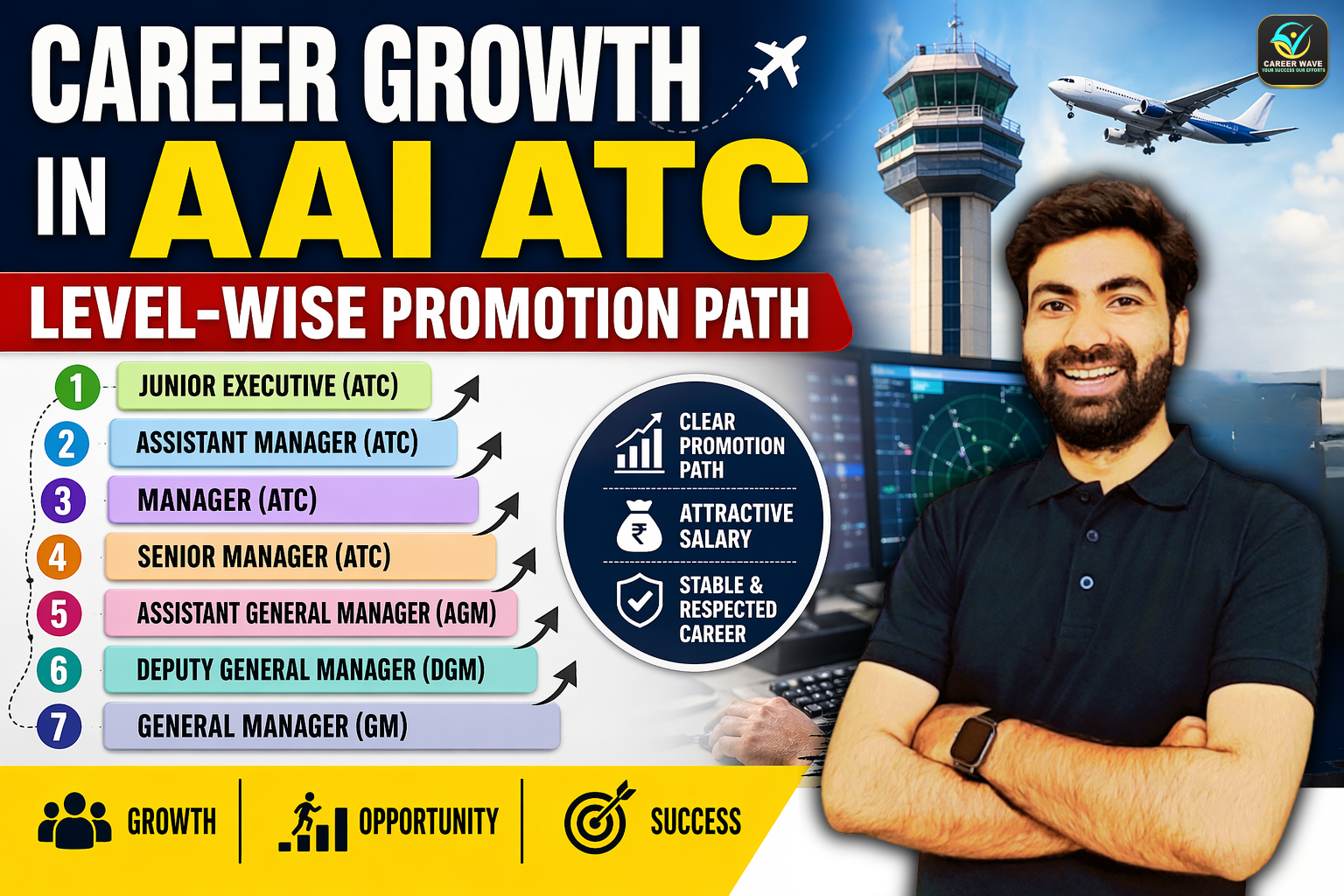
Complete Promotion Hierarchy
Junior Executive
↓
Assistant Manager
↓
Manager
↓
Senior Manager
↓
Assistant General Manager
↓
Deputy General Manager
↓
General Manager
↓
Executive Director
Promotion System: Real Mechanism
Promotion is based on a combination of:
• Years of service
• Internal evaluation
• Performance record
• Vacancy availability
Important Reality
• Promotion is not random
• But also, not automatic every year
👉 It is a controlled progression system
Salary Growth Over Time
With each promotion:
• Basic salary increases
• Allowances increase
• Perks improve
Long-Term Financial Benefits
• Strong income stability
• Government benefits
• Housing / HRA
• Medical facilities
• Travel allowances
👉 Over time, ATC becomes a financially secure career
Growth Beyond Salary
Career growth is not just about money.
1. Technical Growth
• Advanced radar systems
• Airspace management
• Real-time operational expertise
2. Personality Growth
• Calmness under pressure
• Confidence in decisions
• Communication clarity
3. Leadership Growth
• Team management
• Strategic thinking
• Responsibility handling
👉 ATC builds both career and personality
Transfers & Posting Reality
• Transfers are part of ATC career
• Posting depends on AAI requirements
Advantage
• Exposure to different airports
• Diverse experience
• Better career profile
Growth Speed: Practical Analysis
Compared to other careers:
• Faster than many govt jobs
• Slower than private sector
👉 Best described as:
Stable + Predictable + Balanced
Challenges in Career Growth
• Promotion depends on vacancies
• Increasing responsibility
• Shift duties continue
• Performance consistency required
👉 These are not disadvantages—they are part of a serious professional career
Why ATC is a Strong Long-Term Career
AAI ATC provides:
• Structured promotion path
• Stable salary growth
• Government job security
• High-responsibility role
• Respect and recognition
👉 It is not just employment.
It is a career with identity and progression
Career Wave Insight
At Career Wave, we focus on:
• Career clarity before preparation
• Real job understanding
• Long-term mindset development
• Structured preparation strategy
Because:
Exam clears entry.
Mindset builds career.
Final Conclusion
AAI ATC is a career where:
• You start as an officer
• Grow into a manager
• Become a leader
If you are:
• disciplined
• consistent
• serious about responsibility
this career offers:
• Financial stability
• Career growth
• Leadership opportunities
• Long-term respect
FAQs
1. What is the starting post in AAI ATC?
Junior Executive (ATC)
2. How long does first promotion take?
Around 3–5 years
3. What is the promotion hierarchy?
JE → AM → Manager → Sr Manager → AGM → DGM → GM →ED
4. Is promotion guaranteed?
Structured but depends on performance and vacancies
5. Does salary increase after promotion?
Yes, significantly
6. Are transfers compulsory?
Yes, based on operational needs
7. Is ATC a good long-term career?
Yes, due to stability and growth
8. What matters most for growth?
Consistency, discipline, performance
9. Does Career Wave guide beyond exam?
Yes, complete career guidance is provided
10. Is growth fast?
Moderate but stable and reliable
Related Blogs --
Can Non-Technical Students Crack AAI ATC?
Ray Optics in AAI ATC: PYQ Pattern + Expected Questions (Detailed Guide by Career Wave)
Revision Framework: 3-Layer Revision Strategy for AAI ATC (Complete System by Career Wave)
Maths for AAI ATC: What to Study & What to Skip (Deep, Practical Guide by Career Wave)