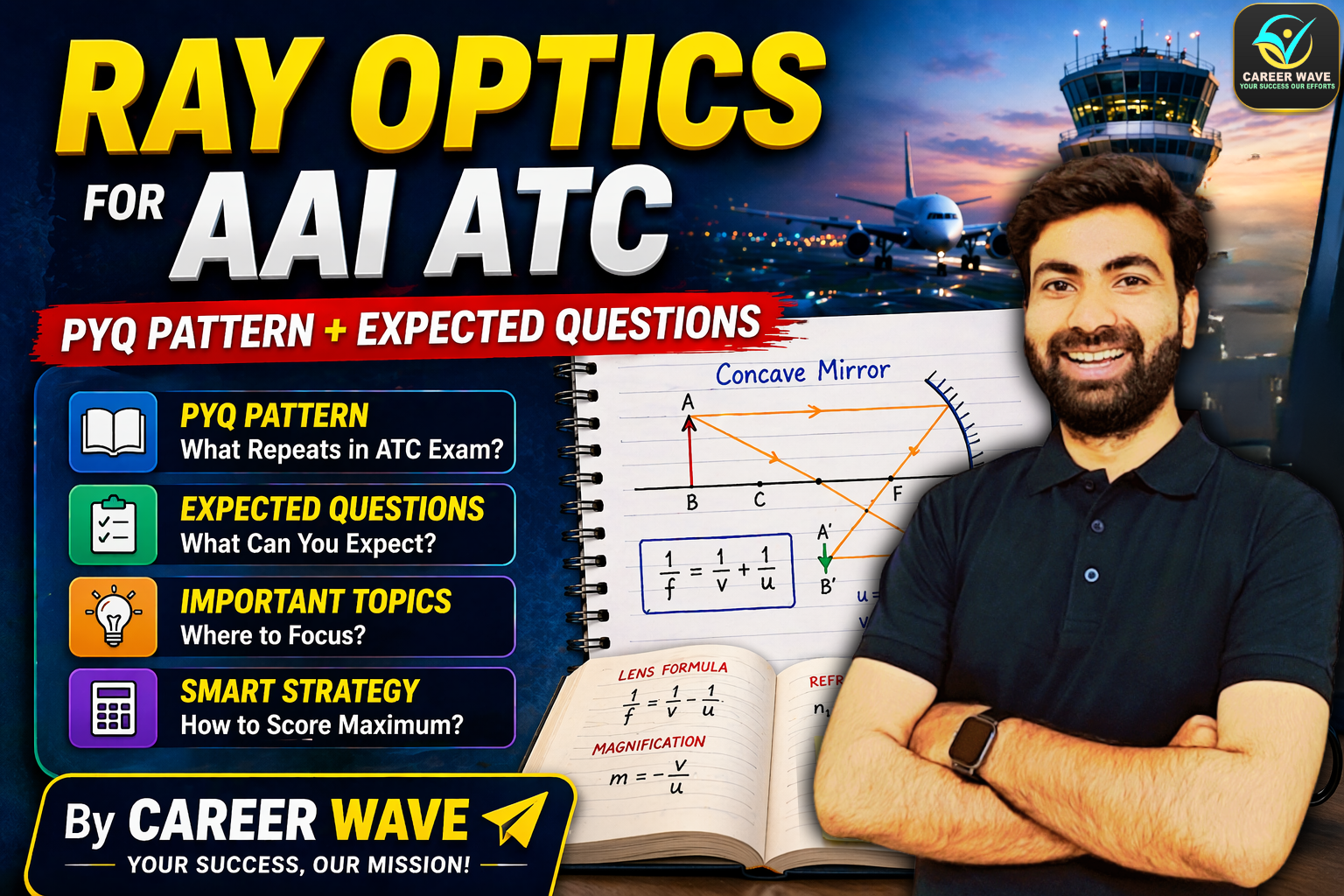
Ray Optics in AAI ATC: PYQ Pattern + Expected Questions (Detailed Guide by Career Wave)
When students prepare for AAI ATC Physics, they usually divide chapters into three categories:
• Very important
• Moderate importance
• Can be done later
Ray Optics almost always belongs to the first category.
And that is not just because it is a Class 12 chapter.
It is because this chapter has a very practical exam advantage:
👉 It is concept-based
👉 It is formula-driven
👉 It gives direct scoring opportunities if prepared properly
At Career Wave, after studying previous AAI ATC papers and repeated question styles, one thing is very clear:
👉 Ray Optics is not a chapter to fear
👉 It is a chapter to systematize and score from
1) What is Ray Optics?
Ray Optics is the branch of Physics that studies the behavior of light by treating it as rays traveling in straight lines.
It mainly deals with:
• Reflection
• Refraction
• Image formation by mirrors and lenses
• Optical instruments
In simple words:
👉 Ray Optics explains how light travels, bends, reflects, and forms images
This is why the chapter feels both visual and numerical.
If the concepts are clear, questions become much easier.
2) Why Ray Optics is Important for AAI ATC
There are some chapters in AAI ATC that are important because they are difficult.
There are some chapters that are important because they are frequently asked.
Ray Optics is important for both performance and scoring reasons.
Why this chapter matters:
• It has a strong history of appearing in exams
• Questions are often direct or moderately conceptual
• Formula usage is frequent
• Mistakes are avoidable if sign convention is clear
• It helps secure marks in a high-competition paper
At Career Wave, Ray Optics is treated as a chapter where students should aim not just to “cover” it, but to convert it into a confident scoring area.
3) PYQ Pattern in Ray Optics for AAI ATC
If you closely observe ATC-style Physics papers, Ray Optics questions usually do not come in a completely random way.
They follow a pattern.
That is the biggest reason this chapter is manageable.
Common PYQ patterns seen in Ray Optics:
3.1 Mirror Formula Questions
These are among the most repeated patterns.
Questions may ask:
• Image distance
• Object distance
• Focal length
• Nature of image
Usually based on:
• Concave mirror
• Convex mirror
These questions are often direct and scoring, provided the student:
• remembers the formula
• applies the sign convention properly
3.2 Lens Formula Questions
This is another very important category.
Questions may involve:
• Convex lens
• Concave lens
• Image position
• Focal length
• Magnification
These are highly expected because they fit the AAI ATC pattern well:
• objective
• formula-based
• limited steps
3.3 Sign Convention Based Questions
Sometimes students know the formula but still lose marks because of wrong signs.
PYQ pattern shows that many Ray Optics questions indirectly test whether you actually understand:
• positive and negative focal length
• positive and negative image distance
• real vs virtual image cases
This is one of the most important hidden areas of preparation.
3.4 Refraction Questions
These may include:
• refractive index
• Snell’s law
• apparent depth
• relation between speed of light and medium
These questions are often easier than students expect, but only when the basic concept is clear.
3.5 Lens Combination Questions
Sometimes moderate-level questions come from:
• equivalent focal length
• power of combination
• multiple lens systems
These are not always very difficult, but they require careful formula application.
3.6 Optical Instruments
This area may not dominate every paper, but it should not be ignored.
Possible areas:
• microscope
• telescope
• magnifying power
• normal adjustment concepts
These questions are usually concept + formula based.
4) What Type of Questions Can Be Expected in Upcoming ATC Exam?
Based on past trends, Ray Optics questions in AAI ATC are usually expected in the following style:
Most expected question types:
• direct numerical from mirror formula
• direct numerical from lens formula
• conceptual question on image nature and position
• sign convention-based trap question
• basic refraction question
• one moderate application-based question from lens combination or optical instrument
Difficulty level:
• Mostly easy to moderate
• Rarely very difficult
• More dangerous due to carelessness than complexity
This means:
👉 Ray Optics is not usually a chapter that defeats students through depth
👉 It defeats students through confusion, sign mistakes, and weak revision
5) The Real Nature of Ray Optics Questions in ATC
Many students prepare Ray Optics like a board exam chapter.
That is a mistake.
AAI ATC does not reward long derivations or descriptive understanding in the exam hall.
It rewards:
• fast formula recall
• correct sign application
• conceptual clarity
• calculation accuracy
So, the chapter should be prepared from an objective exam perspective, not from a purely academic perspective.
At Career Wave, this distinction is very important:
👉 Board-style reading is not enough
👉 Exam-style solving is necessary
6) Most Important Topics to Prepare in Ray Optics
If you want a practical list, these are the highest priority areas:
High Priority Topics
• Mirror formula
• Lens formula
• Magnification
• Sign convention
• Refraction and refractive index
• Snell’s law
• Apparent depth
• Combination of lenses
• Power of lens
• Optical instruments basics
Moderate Priority Topics
• Total internal reflection basics
• Prism-related concepts
• Critical angle concepts
Lower Priority but still useful
• advanced instrument derivations
• very lengthy theory portions
The focus should always remain on:
• repeated concepts
• quick numericals
• MCQ-compatible ideas
7) Common Mistakes Students Make in Ray Optics
This chapter is scoring, but only if common mistakes are avoided.
Mistake 1: Memorizing formulas without understanding usage
Students remember the mirror formula but don’t know when signs change.
Mistake 2: Ignoring sign convention
This is the biggest reason easy questions go wrong.
Mistake 3: Reading theory but not solving enough numericals
Ray Optics is not a passive chapter. It needs active solving.
Mistake 4: Avoiding diagrams
Even in MCQs, rough diagrams help in quick understanding.
Mistake 5: Leaving optical instruments completely
Even if frequency is low, one question can matter in a tight cutoff exam.
Mistake 6: Not practicing PYQs chapter-wise
Without PYQs, students don’t recognize patterns.
At Career Wave, students are repeatedly told:
👉 In Ray Optics, most mistakes are not due to low IQ
👉 They are due to poor method
8) How to Prepare Ray Optics Smartly
A good Ray Optics preparation strategy should have 5 layers.
Step 1: Build concept clarity
Before formulas, understand:
• what is real image
• what is virtual image
• how reflection and refraction differ
• how mirror and lens image behavior works
Without this, formulas become mechanical.
Step 2: Learn formulas with meaning
Don’t just memorize formulas.
Know:
• when to apply
• what each term means
• what sign changes are possible
This avoids confusion in actual exam conditions.
Step 3: Practice topic-wise numericals
After understanding, solve:
• mirror formula numericals
• lens formula numericals
• refractive index based numericals
• magnification questions
This builds comfort and speed.
Step 4: Solve chapter-wise PYQs
This is the most important performance layer.
PYQs help you understand:
• which concepts repeat
• which question styles are favorite
• where silly mistakes happen
At Career Wave, PYQs are used not as final revision, but as a central preparation tool.
Step 5: Revise with short notes and formula drills
Ray Optics becomes strong only when revision is regular.
Keep a short sheet containing:
• mirror formula
• lens formula
• magnification relation
• sign convention summary
• key refractive index relations
• optical instrument formulas
This makes last-stage revision much easier.
9) How Ray Optics Should Be Revised Before Exam
The best revision style for Ray Optics is not full chapter rereading.
Instead, revise like this:
Layer 1: Formula Revision
Quick recall of all standard formulas
Layer 2: Pattern Revision
Revisit PYQ types:
• mirror
• lens
• refraction
• instrument
Layer 3: Mistake Revision
Check:
• sign convention mistakes
• previous calculation mistakes
• question types where confusion happened
This is how the chapter becomes exam-ready.
10) Career Wave Approach to Ray Optics
At Career Wave, Ray Optics is not taught as just another chapter from Physics.
It is taught as an ATC chapter.
That means the focus remains on:
• exam-relevant concepts
• PYQ pattern recognition
• formula accuracy
• sign convention discipline
• quick application
Students are trained to:
• identify question type quickly
• avoid avoidable mistakes
• solve with confidence under time pressure
The goal is simple:
👉 Convert Ray Optics from “a chapter to study” into “a chapter to score from”
11) Why Ray Optics Can Become a Rank Booster
In a high-cutoff exam like AAI ATC, selection often depends on small differences.
Sometimes:
• 2 marks separate hundreds of candidates
• 1 easy question changes rank significantly
Ray Optics is one of those chapters that can give you these extra marks if prepared smartly.
It is not the most impossible chapter.
It is one of the most controllable chapters.
That is why serious aspirants should not neglect it.
Final Words from Career Wave
Ray Optics is not a chapter that demands fear.
It demands method.
If you:
• understand the core concepts
• apply formulas correctly
• master sign convention
• solve PYQs seriously
• revise regularly
then this chapter can become one of your strongest scoring areas in AAI ATC Physics.
At Career Wave, the focus is always clear:
👉 Don’t just complete Ray Optics
👉 Master the pattern, and secure the marks
FAQs
1. Is Ray Optics important for AAI ATC?
Yes. It is one of the important Physics chapters because it regularly contributes direct or concept-based questions.
2. How many questions can be expected from Ray Optics?
Usually 1–2 questions are common, though paper pattern can vary. Even one question matters in a close competition exam.
3. What is the most important part of Ray Optics for ATC?
Mirror formula, lens formula, sign convention, magnification, and basic refraction are the most important areas.
4. Is Ray Optics difficult for beginners?
Not really. It feels difficult mainly because of sign convention and image formation confusion. With practice, it becomes very manageable.
5. Should I focus more on theory or numericals?
Numericals with concept clarity. AAI ATC is an objective exam, so application matters more than long descriptive understanding.
6. Are PYQs enough for Ray Optics preparation?
PYQs are essential, but they should be supported with targeted practice questions and regular formula revision.
7. Why do students lose marks in Ray Optics?
Mostly because of:
• wrong sign convention
• formula misuse
• weak revision
• lack of PYQ-based practice
8. How does Career Wave help in Ray Optics preparation?
Career Wave provides:
• exam-oriented concept teaching
• PYQ-focused preparation
• formula-based revision support
• practice designed specifically for ATC pattern
Conclusion
Ray Optics is a scoring chapter for AAI ATC if prepared the right way.
It does not require overcomplicated study.
It requires:
• clarity
• repetition
• pattern awareness
• disciplined revision
And in a competitive exam where every mark matters, chapters like Ray Optics can quietly become the difference between average performance and real selection.
Prepare smartly, revise properly, and turn Ray Optics into a scoring advantage with Career Wave.
Related Blogs -
Revision Framework: 3-Layer Revision Strategy for AAI ATC (Complete System by Career Wave)
Maths for AAI ATC: What to Study & What to Skip (Deep, Practical Guide by Career Wave)
Why Most Students Fail Without Proper Guidance in AAI ATC (Detailed Analysis)
Subject-Wise Weightage Strategy Based on Last 5 Years Data (AAI ATC)