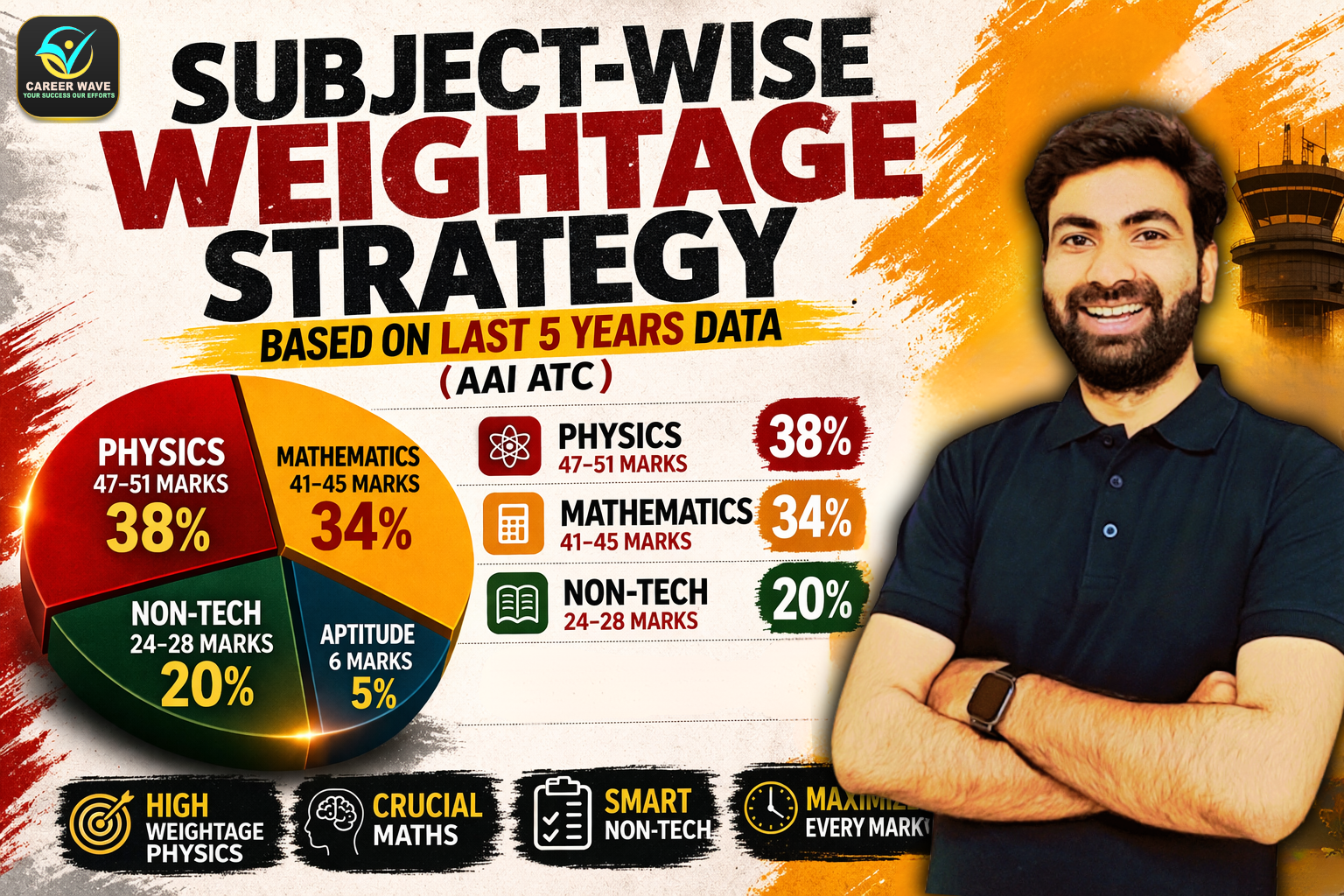
📊 Subject-Wise Weightage Strategy Based on Last 5 Years Data (AAI ATC)
Every serious AAI ATC aspirant eventually realizes one thing:
👉 “I don’t need to study everything. I need to study what actually matters.”
Because in a high cut-off exam like AAI ATC, even a 5–10 mark difference can push you hundreds of ranks up or down.
At Career Wave, after analyzing last 5 years PYQs, mock trends, and student performance data, we’ve identified a powerful truth:
Selection is not about coverage.
It is about weightage-driven execution.
🎯 1) Reality Check: Why Weightage Matters More Than Effort
Most aspirants:
• Study randomly
• Follow long study hours
• Ignore data
Result?
👉 High effort, low output.
But toppers:
• Study based on question frequency
• Focus on high ROI topics
• Align preparation with exam pattern
👉 That’s why they score more with less effort.
📈 2) Deep Subject-Wise Weightage Analysis (5-Year Trend)
🔬 Physics (35–40 Questions) → Rank Decider
Nature of Questions:
• 60% formula-based
• 25% conceptual
• 15% mixed application
High-Frequency Topics (Very Important):
• Modern Physics (5–7 Q)
• Current Electricity (4–6 Q)
• Magnetism (3–5 Q)
• Semiconductor (3–5 Q)
• Optics (3–4 Q)
Strategy:
• Memorize formulas + apply instantly
• Practice PYQs repeatedly (pattern repeats heavily)
• Avoid deep theory → focus on application
👉 Target: 30+ correct
📐 Mathematics (15–20 Questions) → Score Multiplier
Nature:
• Calculation-heavy
• Time-consuming
• Predictable patterns
High ROI Topics:
• Calculus (5–7 Q)
• Vector & 3D (3–5 Q)
• Probability (2–3 Q)
• Coordinate Geometry (2–3 Q)
Strategy:
• Practice timed solving
• Focus on shortcut techniques
• Avoid lengthy methods
👉 Target: 12–15 correct
🧠 Reasoning (15 Questions) → Speed Booster
Nature:
• Pattern recognition
• Low conceptual load
Important Topics:
• Coding-Decoding
• Number/Letter Series
• Puzzles
• Direction/Blood Relations
Strategy:
• Solve daily
• Build pattern familiarity
• Avoid getting stuck on puzzles
👉 Target: 12–14 correct
🌐 General Awareness (10–15 Questions) → Free Marks Section
Nature:
• Direct recall
• No calculation
Focus Areas:
• Last 6–8 months current affairs
• Basic static GK
Strategy:
• Daily revision
• Don’t go too deep
👉 Target: 8–10 correct
📝 English (10–15 Questions) → Quick Scoring
Nature:
• Easy to moderate
• High accuracy potential
Key Areas:
• Reading Comprehension
• Error Detection
• Vocabulary
Strategy:
• Practice daily (20–30 min)
• Focus on accuracy
👉 Target: 10–12 correct
⚡ 3) The Real Game: Weightage × Accuracy × Time
Here’s what most aspirants miss:
👉 Weightage alone is not enough
You must combine:
• High weight → Physics
• High accuracy → English
• High speed → Reasoning
👉 That’s how toppers balance their score.
📊 4) Score Optimization Model (Advanced Insight)
Let’s compare two aspirants:
❌ Random Strategy Student:
• Physics: 20/40
• Maths: 8/20
• Others: 20/40
👉 Total: ~48 marks
✅ Smart Strategy Student:
• Physics: 30/40
• Maths: 13/20
• Others: 25/40
👉 Total: ~68 marks
👉 Difference:
20 marks — purely strategy-based
🧠 5) Micro-Strategy: Topic-Level Planning
Instead of studying full subjects, break into:
Example (Physics):
❌ “I will study Physics”
✅ “I will master Current Electricity today”
Weekly Topic Strategy:
• Day 1–2 → High weight topic
• Day 3 → Practice + PYQs
• Day 4 → Mixed revision
• Day 5 → Mock + analysis
• Day 6 → Weak areas
• Day 7 → Full revision
👉 This builds retention + speed + accuracy
⏳ 6) Exam Hall Execution Strategy
Step-by-Step Flow:
Step 1: Quick Sections First
• English + GA + Aptitude → 20–25 min
Step 2: Medium Effort Section
• Reasoning → 20 min
Step 3: Core Section
• Physics + Maths → Remaining time
Golden Rules:
• Skip tough questions quickly
• Don’t get emotionally attached to questions
• Keep buffer time for review
🔥 7) Data-Based Mistake Patterns (From Career Wave Analysis)
Most aspirants lose marks due to:
• 8–10 marks → Silly mistakes
• 5–8 marks → Time mismanagement
• 5–10 marks → Weak topic selection
👉 Total loss:
15–25 marks (avoidable)
📈 8) How to Fix This (Pro System)
Create 3 Trackers:
📘 1. Error Notebook
• Write every mistake
• Classify it
📊 2. Topic Performance Sheet
• Track:
◦ Accuracy per topic
◦ Time taken
⏱️ 3. Mock Analysis Log
• Attempt
• Accuracy
• Mistakes
👉 Weekly review = Massive improvement
❌ 9) Biggest Strategic Mistakes
• Studying low-weight topics deeply
• Ignoring PYQs
• Over-focusing on GA
• Not analyzing mocks
• Treating all subjects equally
🏆 10) Career Wave Final Strategy Framework
At Career Wave, we follow this formula:
Rank = (Physics Strength + Maths Accuracy) + (Speed Sections Support) – (Mistakes)
If you:
✔ Master Physics
✔ Control Maths accuracy
✔ Use English/GA for quick marks
✔ Reduce mistakes
👉 Selection becomes highly predictable
❓ FAQs –
1. Can I clear ATC by focusing only on Physics?
No.
👉 Physics builds rank
👉 Other subjects stabilize score
2. How important are PYQs?
👉 Extremely important
70–80% pattern repeats directly or indirectly.
3. Should I prepare GA daily?
Yes, but limited.
👉 20–30 minutes is enough
4. What if I’m weak in Maths?
👉 Focus on:
• Easy topics
• Formula-based questions
Even 8–10 marks help a lot.
5. Is equal subject distribution a good strategy?
No.
👉 Always follow weightage-based preparation
🎯 Final Takeaway
In AAI ATC, success is not about studying more.
It’s about:
👉 Studying what matters most
👉 Practicing what repeats most
👉 Avoiding what wastes time
Because:
Smart strategy + consistent execution = Selection
Related Blogs -
Rank Booster Strategy for Last 30 Days Before ATC Exam
Time Management Blueprint for 120 Questions in 120 Minutes (Advanced Guide)
The Science of Cut-Off Prediction Using Test Series Scores
How to Use Mock Test Data Like a Topper (Score vs Accuracy vs Time Analysis)