How to Use Mock Test Data Like a Topper (Score vs Accuracy vs Time Analysis)
Most aspirants give mock tests.
But very few actually use them properly.
At Career Wave, we always emphasize one simple truth:
👉 “Your rank doesn’t improve by giving more mocks — it improves by understanding your data.”
If you start reading your mock test like a report card of your thinking process, your improvement becomes predictable, not random.
Let’s go deeper — much deeper — into how toppers actually use mock test data.
Why Mock Test Data Is Your Real Teacher
Every mock test gives you hidden insights:
• How you behave under pressure
• Where you lose marks unnecessarily
• Which topics are actually strong vs assumed strong
• How your brain makes decisions in limited time
Most students ignore this.
Toppers don’t.
They treat every mock as a performance audit.
1. Advanced Score Analysis (Beyond Just Numbers)
Most students only see:
👉 “I scored 72 marks.”
Topper sees:
• Section-wise score
• Score drop reasons
• Negative marking impact
• Attempt vs score efficiency
🔍 Deep Questions to Ask:
• Did I lose marks due to wrong attempts or low attempts?
• Which section is unstable across mocks?
• What is my minimum guaranteed score?
👉 At Career Wave, we focus on score consistency, not just highest score.
Because selection depends on stable performance, not one lucky test.
2. Accuracy Analysis: The Backbone of Selection
Accuracy is not just a percentage — it is your decision quality indicator.
🔬 Break Accuracy into 3 Types:
1. Conceptual Errors
◦ You didn’t know the concept
◦ Needs revision
2. Silly Mistakes
◦ Calculation error
◦ Misreading question
◦ Overconfidence
3. Risk-Based Errors
◦ Guessing
◦ Over-attempting
👉 Most aspirants improve knowledge, but ignore decision errors.
That’s why scores don’t improve.
🎯 Accuracy Benchmark Strategy:
• Below 70% → High risk, reduce attempts
• 70–80% → Moderate control, improve clarity
• 80–90% → Strong zone (ideal)
• 90%+ → Safe but may need higher attempts
At Career Wave, students are trained to maintain controlled aggression — not blind attempts.
3. Time Analysis: Micro-Level Optimization
Time is where toppers gain an edge silently.
⏱️ Instead of total time, analyze:
• Time per question
• Time per section
• Time wasted on tough questions
🔍 Identify These Patterns:
• Spending too long on one question
• Rushing easy questions and making mistakes
• Not leaving time for revision
⚙️ The “Time Trap” Most Students Fall Into:
👉 They try to solve everything.
Topper mindset:
• Solve what is worth solving
• Skip what is time-consuming
💡 Ideal Time Strategy:
• First round → Easy + direct questions
• Second round → Moderate
• Third round → Risk-based attempts
This layered approach improves both score and accuracy.
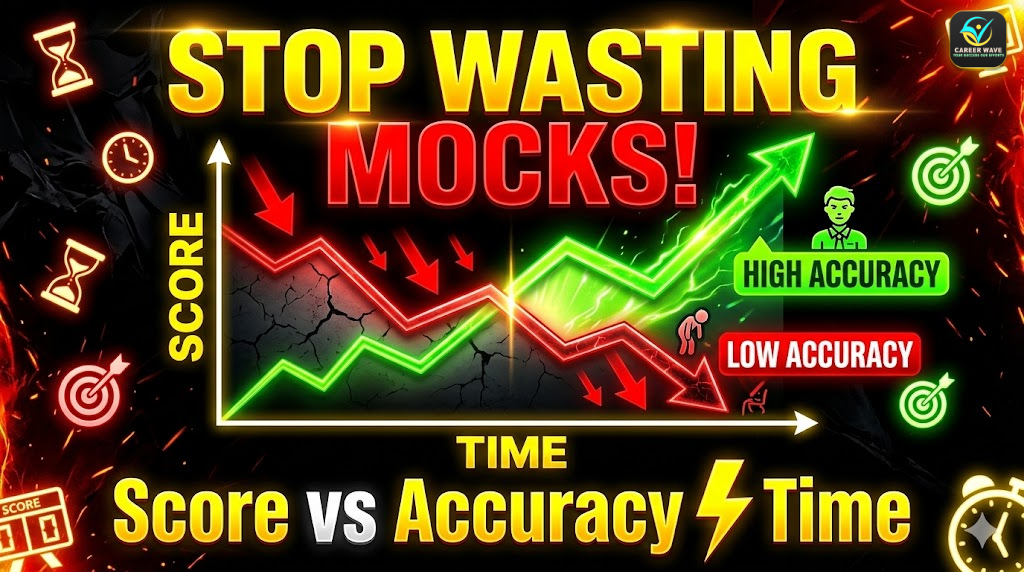
4. The Golden Formula: Score vs Accuracy vs Time
📊 Understand the real relationship:
👉 Score = Attempts × Accuracy
(Because there is no negative marking, wrong answers don’t reduce your score)
⚠️ But here’s the catch…
👉 Attempts depend on time management
👉 Accuracy depends on concept clarity + decision quality
👉 So, increasing attempts alone doesn’t guarantee a higher score
5. Build Your Personal Data Dashboard (Like a Topper)
At Career Wave, we recommend maintaining a simple tracking sheet:
Track After Every Mock:
• Score
• Accuracy %
• Total attempts
• Correct vs incorrect
• Time spent per section
• Weak topics
• Mistake type
📈 Weekly Review:
• Is accuracy improving?
• Is score stable or fluctuating?
• Are mistakes repeating?
👉 If mistakes repeat, your system is weak — not your effort.
6. The Power of Error Log (Most Ignored Tool)
Topper secret: Error Notebook
Write:
• Question you got wrong
• Why you got it wrong
• Correct approach
• What to avoid next time
Revise this weekly.
👉 This alone can increase your score by 15–25 marks over time.
7. Mock-to-Mock Improvement Strategy
Don’t give mocks randomly.
Follow this cycle:
1. Attempt mock seriously
2. Analyze deeply (1–2 hours)
3. Fix mistakes
4. Revise weak areas
5. Apply changes in next mock
👉 Without this loop, mocks become useless.
8. Emotional Data: The Hidden Layer
This is something most blogs don’t talk about.
After every test, ask:
• Did I panic in any section?
• Did one tough question disturb my flow?
• Did I lose confidence mid-exam?
Because:
👉 Your emotions directly affect your accuracy.
At Career Wave, we train students to build emotional stability along with academic strength.
9. Signs You’re Using Mock Data Like a Topper
✔ Your score is becoming consistent
✔ Accuracy is improving gradually
✔ You know your safe attempt range
✔ You panic less during tough sections
✔ Your mistakes are reducing, not repeating
If this is happening — you’re on the right track.
10. Why Most Students Fail Despite Giving Many Mocks
Because they:
• Don’t analyze deeply
• Ignore patterns
• Repeat same mistakes
• Focus only on score
• Don’t change strategy
👉 Giving 50 mocks without analysis = Giving 5 mocks effectively
How Career Wave Helps You Do This Better
At Career Wave, test series is not just about questions.
It’s about:
• 📊 Data-driven performance tracking
• 📉 Accuracy improvement systems
• ⏱️ Time management training
• 📘 Structured error analysis
• 🎯 Personalized strategy building
Because cracking exams is not about studying more —
it’s about optimizing performance scientifically.
Final Thought
Mock test data is like a map.
If you read it properly, it shows:
• Where you are
• Where you’re going wrong
• How to reach selection
👉 Stop chasing marks.
👉 Start understanding patterns.
That’s how toppers think.
That’s how selections happen.
FAQs
1. How much time should I spend on mock test analysis?
Ideally 1.5–2 times the test duration. Deep analysis gives maximum improvement.
2. What is more important: attempts or accuracy?
Accuracy is more important. Balanced attempts with high accuracy give the best score.
3. How can I reduce negative marking?
Avoid guesswork, use elimination techniques, and attempt only when reasonably confident.
4. Should I re-attempt the same mock test?
Not immediately. First analyze mistakes, then revisit after a few days for reinforcement.
5. Can mock test analysis alone improve my score?
Yes, significantly. Many students improve 20–30 marks just by fixing mistakes and optimizing strategy.
Related Blogs -
How to Build Exam Temperament (Advanced Guide by Career Wave)
The Psychology of High-Scoring Attempts
The Career Wave Attempt Strategy Framework
How Test Series Improve Your ATC Exam Performance (Complete Deep Guide by Career Wave)