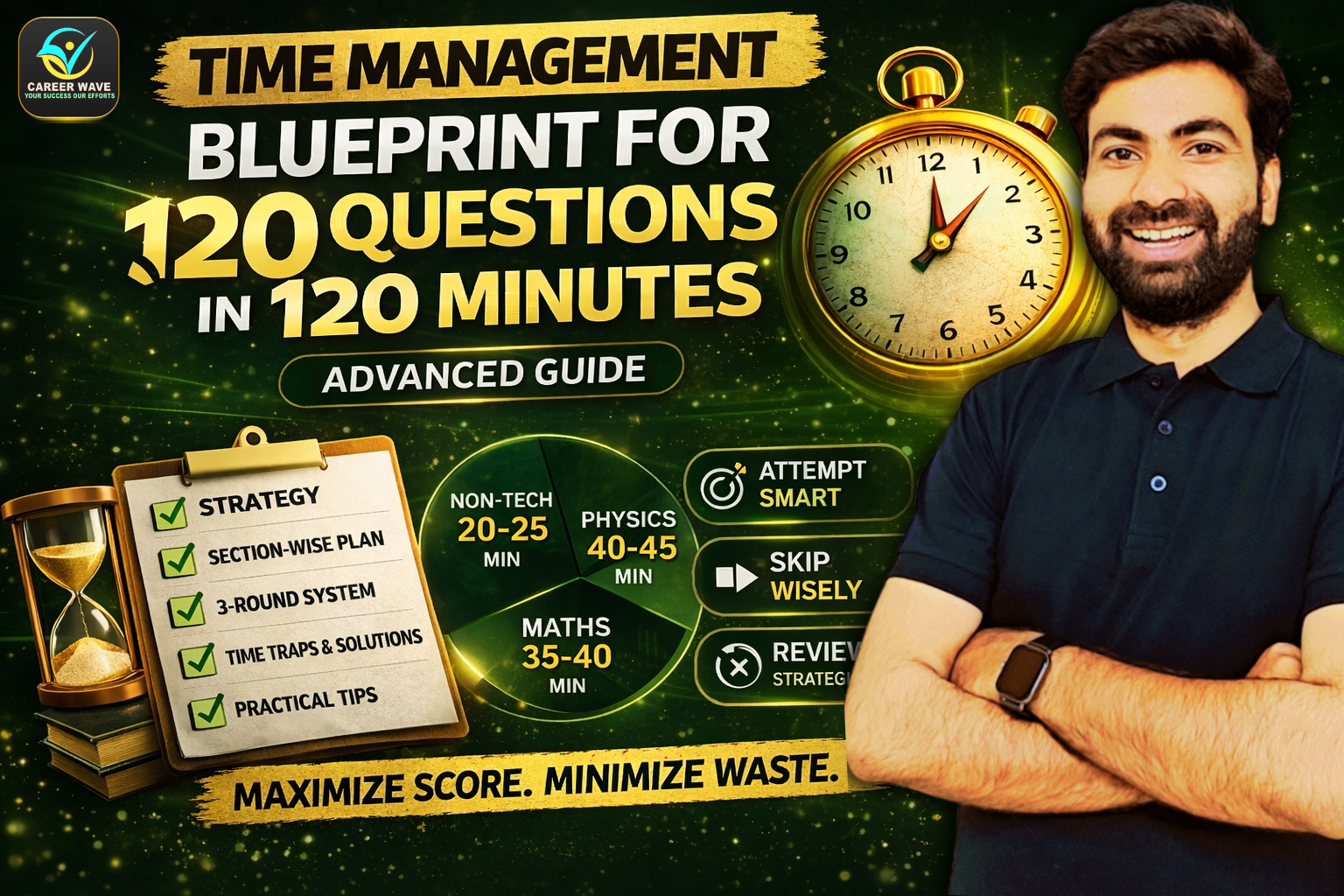
Time Management Blueprint for 120 Questions in 120 Minutes (Advanced Guide)
Every aspirin walk into the exam hall thinking:
👉 “You just have to solve 120 questions.”
But the reality is:
• Time pressure builds rapidly
• Decision-making slows down
• One mistake affects the entire paper
At Career Wave, after analyzing hundreds of student performances, we’ve found:
• Time management is not about speed…
• It’s about decision-making under pressure.
• This guide will help you master exactly that.
🧠 The Core Truth Most Students Miss
AAI ATC is not a knowledge test alone.
It is a performance optimization test.
You are not expected to:
❌ Solve everything
❌ Solve perfectly
You are expected to:
✅ Maximize score within limited time
⏱️ Understanding Time Pressure Mathematically
Let’s break it logically:
• Total Questions = 120
• Total Time = 120 minutes
👉 But actual usable time ≠ 120 minutes
Because:
• 3–5 minutes go in reading + settling
• 5–7 minutes go in final review
👉 Effective solving time = ~105–110 minutes
Now:
• Physics: ~45 minutes
• Maths: ~40 minutes
• Non-tech: ~25 minutes
👉 This is the real distribution, not theoretical.
🔥 Section-Wise Deep Strategy
🔹 Non-Technical Section (Speed Builder Zone)
Objective:
• Maximize attempts
• Save time
Target Time:
👉 20–25 minutes
Ideal Approach:
• English → fastest (start here if strong)
• Reasoning → pattern-based solving
• GA → quick recall
• Aptitude → formula-based & calculation-focused (quick wins if practiced well)
Advanced Tip:
👉 Don’t re-read questions
👉 Trust your first instinct
At Career Wave, we call this:
⚡ “Momentum Building Phase”
🔹 Physics Section (Concept + Speed Balance)
Objective:
• High accuracy
• Smart selection
Target Time:
👉 40–45 minutes
Question Types:
• Direct formula-based
• Conceptual
• Moderate numerical
Advanced Strategy:
• Identify “1-step vs multi-step questions”
• Attempt 1-step questions first
👉 Skip immediately if:
• Long derivation required
• Confusing language
• Too many calculations
🔹 Mathematics Section (Time Killer if Mismanaged)
Objective:
• Controlled attempts
• Avoid time traps
Target Time:
👉 35–40 minutes
Reality:
Maths can consume entire paper if not controlled.
Advanced Strategy:
• Mark lengthy questions instantly
• Focus on:
◦ Algebra
◦ Trigonometry
◦ Calculus basics
👉 Avoid:
• Over-solving
• Perfection obsession
At Career Wave, we emphasize:
“Leave ego, save time.”
🔁 The Advanced 3-Round System (Detailed)
🥇 Round 1: High-Speed Filtering (40–50 minutes)
Goal:
👉 Capture easy + direct questions
Rules:
• Max 30–40 seconds per question
• No deep thinking
• Skip aggressively
👉 Outcome:
• 60–70% paper covered
🥈 Round 2: Smart Solving (40 minutes)
Goal:
👉 Solve moderate-level questions
Approach:
• Slight calculation allowed
• Controlled thinking
👉 Outcome:
• Score boost phase
🥉 Round 3: Optimization Phase (Last 20–25 minutes)
Goal:
👉 Maximize score using remaining questions
Techniques:
• Elimination method
• Approximation
• Intelligent guessing (no negative marking)
👉 This is where selection happens.
⚠️ Time Traps You Must Recognize
🚫 Trap 1: “I Almost Solved It”
👉 Students waste 2–3 minutes extra
Solution:
👉 If not solved, leave immediately
🚫 Trap 2: Perfectionism
👉 Trying to verify every answer twice
Solution:
👉 Trust first correct attempt
🚫 Trap 3: Emotional Reaction
👉 Panic after tough questions
Solution:
👉 Move to next section instantly
🚫 Trap 4: Section Imbalance
👉 Spending too much time on Maths
Solution:
👉 Pre-decide time limits
📊 Real Exam Attempt Strategy (Highly Practical)
Based on Career Wave data:
Section | Attempt Target | Accuracy Target |
Non-Tech | 90–100% | 85–90% |
Physics | 75–85% | 80–90% |
Mathematics | 65–75% | 75–85% |
👉 Final Goal:
Maximum score with minimum time wastage
🧠 Decision-Making Framework (Game Changer)
Every question should trigger 1 of 3 decisions:
✅ Attempt Now
• Direct
• Familiar
• Fast
⏭️ Skip
• Lengthy
• Confusing
• Time-consuming
🔁 Review Later
• Solvable but time-taking
👉 Fast decisions = better time management
🧘 Mental Control During Exam
Time pressure creates mental pressure.
What toppers do differently:
• Stay emotionally neutral
• Accept tough questions
• Focus on next opportunity
At Career Wave, we train:
🧠 “Calm mind = faster brain”
How to Train Time Management Before Exam
You cannot learn this in the exam hall.
Follow this training system:
1. Full-Length Mock Tests
• Simulate real exam
• Build stamina
2. Sectional Timers
• Practice each section with time limits
3. Post-Mock Analysis (Most Important)
Ask:
• Where did I waste time?
• Which questions trapped me?
• How can I skip faster?
4. Attempt Strategy Testing
• Try different sequences
• Find your best pattern
🚀 Career Wave Execution Model
At Career Wave, we go beyond theory:
• ⏱️ Real CBT simulation mocks
• 📊 Time-based performance analytics
• 📉 Question-level time tracking
• 🎯 Personalized attempt strategy
Because:
Success is not just preparation…
It is controlled execution under time pressure.
🔑 Final Insight (Most Important)
The biggest difference between average and selected students is:
👉 Not knowledge
👉 Not intelligence
👉 It is time decisions
So instead of asking:
👉 “Can I solve this question?”
Start asking:
👉 “Is this question worth my time?”
Because:
In AAI ATC, selection is not about solving more…
It’s about choosing better.
❓ FAQs –
1. What is the ideal time split for AAI ATC?
👉 Around 25 min (Non-tech), 45 min (Physics), 35 min (Maths), 5–10 min review.
2. How many questions should I attempt?
👉 Aim for maximum attempts with control, not blind attempts.
3. How do I improve speed in Physics & Maths?
👉 Practice:
• PYQs
• Timed solving
• Formula recall
4. What if I panic during exam?
👉 Immediately switch section to regain control.
5. Is skipping questions a good strategy?
👉 Yes — it is essential for time optimization.
6. Can I manage time without mocks?
👉 No. Real improvement comes only from mock practice + analysis.
Related Bogs -
The Science of Cut-Off Prediction Using Test Series Scores
How Micro-Mistakes Destroy ATC Exam Scores (Deep Analysis)
The Psychology of High-Scoring Attempts
How to Identify Your Weakest Topic in AAI ATC (Complete Deep Strategy by Career Wave)