1. ATC Cutoff Trends (2018–2025)
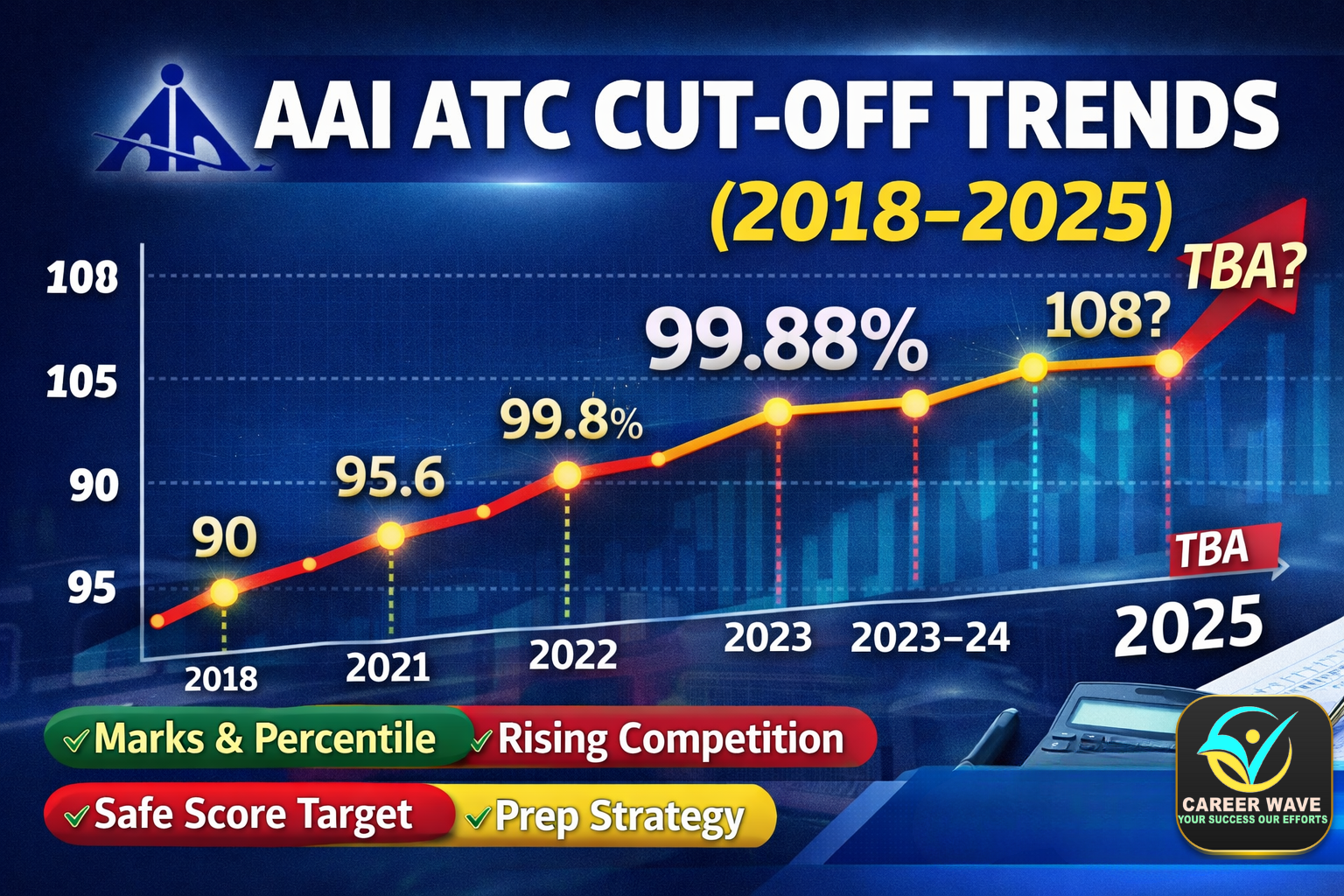
Year | Exam Format | General | EWS | OBC | SC | ST |
2018 | Marks | 90.0 | NA | 86.5 | 81.019 | 77.644 |
2021 | Marks | 95.64 | 91.00 | 92.00 | 86.78 | 84.00 |
2022 | Percentile | 99.82 | 99.61 | 99.60 | 98.67 | 98.001 |
2023 Feb | Normalized Marks | 95.00 | 91.00 | 91.00 | 86.00 | 82.00 |
2023 Dec |
| 103.33 | 99.82 | 100 | 93.35 | 91.13 |
2025 | Marks | 108.00 | 105.00 | 105.02 | 100 | 95.35 |
Trend: Competition increases every year → Cutoff also increases.
2. Percentile Shift in 2022 – What Actually Happened?
Only the 2022 ATC cycle used percentile cutoffs instead of direct marks. Reason: multi-shift CBT where raw marks could not be compared directly; hence AAI normalized scores similar to many national exams.
Key points:
· A percentile of 99.820 for GEN means the candidate scored better than 99.82% of all test takers.
· If 1,00,000 candidates appeared, 99.820 percentile roughly corresponds to being in the top ~180 candidates.
· Percentile is relative to others; raw marks can differ but percentile compares positions.
From a strategy angle:
· Don’t obsess over converting percentile to marks;
· Understand that the relative rank needed in 2022 was tighter than any previous year.
Later cycles (2023–24, 2025) reverted to marks-based cutoffs, but the spirit of normalization (fairness across shifts) remains.
3. Difficulty Level Comparison (2018–2025)
Very roughly, taking GEN CBT cutoffs as a proxy:
· 2018 – Moderate paper, lower competition
o Cutoff 87/120 reflects moderate difficulty + smaller serious crowd.
· 2021 – Slightly easier or better-prepared crowd
o Cutoff 93/120 with similar pattern suggests either:
o marginally easier paper or
o more students coming with dedicated ATC preparation.
· 2022 – Multi-shift, percentile >99.8
o Normalization + focused aspirant base made it a rank-war year; difficulty varied shift-wise, but overall level was moderate—competition, not toughness, pushed the bar high.
· 2023–24 – Cutoff >100
o GEN cutoff around 103/120, EWS/OBC near 99–100, indicates:
o paper overall moderate, very few truly “hard” sections
o serious aspirants leveraging PYQs + targeted tech prep.
· 2025 – GEN 108/120, max heat
o Highest cutoff yet; implies:
o paper on the easier side overall, especially in Tech + Englishvery high awareness + large batch of repeaters with previous-cycle experience.
Conclusion:
The papers are not becoming brutally difficult; instead, students are becoming stronger and competition is denser.
4. Why Did Cutoffs Jump After 2021?
The post-2021 spike is structural, not random. Key reasons:
- Awareness + Coaching Explosion
o Social media, YouTube channels, and specialized platforms (like Career Wave and others) turned ATC into a mainstream PSU-level target. More well-guided applicants per vacancy → higher cutoffs.
- Stable, predictable exam pattern
o Syllabus and pattern have become more “known”. Once PYQs, chapter-wise trends, and mocks matured, high scores became normal, not exceptional.
- No negative marking
o In a paper with no negative marking, top candidates attempt almost all 120 questions. Even a slight improvement in accuracy pushes raw scores sharply upwards.
- Vacancy vs applicant ratio
o Vacancies in each cycle are limited compared to the applicant pool. With more prepared aspirants entering the race each year, the selection band compresses near the top.
- Repeaters & ecosystem maturity
o Candidates who missed by 2–3 marks in 2021/2022 came back stronger in 2023–25 cycles. This creates a “top layer” of highly trained repeaters, pushing cutoffs further.
Net effect:
From a 2018 “good score = 90+” environment, we are now in a “safe score = 110 target” mindset for future cycles.
5. Graph Representation – How to Visualize the Trend
notes, you can plot a simple line graph:
· X-axis: Year (2018, 2021, 2022, 2023–24, 2025)
· Y-axis: Cutoff value (marks or percentile, as appropriate)
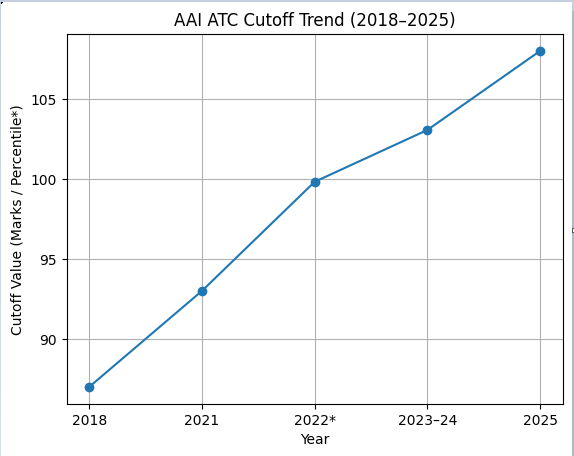
Use two series:
I. CBT line (General)
o 2018: 87
o 2021: 93
o 2022: 99.820 (plot as “99.8 percentile”)
o 2023:94.755
o 2023: 103.06
o 2025: 108
II. Final line (General)
o 2018: 90.019
o 2021: 95.645
o 2022: 99.854 percentile
o 2023:95.000
o 2023: 103.33
o 2025: (leave blank / “TBA” – final not released yet)
Students instantly see a clear upward slope from left to right, with 2022 as a percentile spike and 2025 as the highest marks-based cutoff.
6. Expected Cutoff Range for the Next Cycle
Assuming:
· Similar paper difficulty (moderate, no surprise pattern change),
· Similar or slightly higher competition,
· Same no-negative-marking scheme,
A realistic target range for the next ATC cycle (GEN category) would be:
· GEN: 105–112 marks (safe)
· EWS/OBC: ~3–5 marks lower than GEN
· SC/ST: ~10–15 marks lower than GEN
This is not a prediction of exact numbers, but a working target for preparation planning, built on the 2018–2025 trend. Practical rule for students:
Prepare as if you need 110+ marks to feel genuinely safe, instead of aiming “just above last year’s cutoff”.
7. Actionable Study Plan Based on Cutoff Trend
7.1. Score Architecture – Where should your marks come from?
For a 120-mark paper, design this ideal distribution:
· Technical (Physics + Maths / Engg subjects): 65–75 marks
· Non-Tech (English, Reasoning, GA,Quant,): 40–45 marks
· Flex zone / buffer: 5–10 marks from your strongest area
With cutoffs touching 103–108, you cannot afford a weak zone. You need one “power zone” and zero “disaster zones”.
7.2. 90-Day Macro Plan
Phase 1 – Foundation + PYQ Scanning (Day 1–30)
· Finish all ATC-relevant theory once with crisp notes.
· Solve last 3–4 cycles of PYQs chapter-wise, tagging questions as Easy/Moderate/Tough.
· Build a personal “ATC Formula + Concept Sheet” for top-weight topics (Laws of Motion, EM Waves, Optics, Current Electricity, Electrostatics, Semiconductors etc.).
Phase 2 – Intensive Practice + Sectional Tests (Day 31–60)
· 4–5 full-length sectional tests each week (Tech / Non-Tech alternating).
· For every test, compute:
o Raw score
o Attempt count
o Accuracy %
· Your target by Day 60: 100+ raw marks in at least 2–3 mock papers under strict exam conditions.
Phase 3 – Final Push + Full Mocks (Day 61–90)
· 8–12 full-length CBT-style mocks (120 Q, 2 hrs, no breaks).
· After each mock:
o Redo all wrong + guessed questions.
o Note frequently missed chapters and revise them next day.
· Try to stabilise at 110–115 marks in the last 4–5 mocks.
7.3. Micro Daily Structure (for serious aspirants)
A simple daily template:
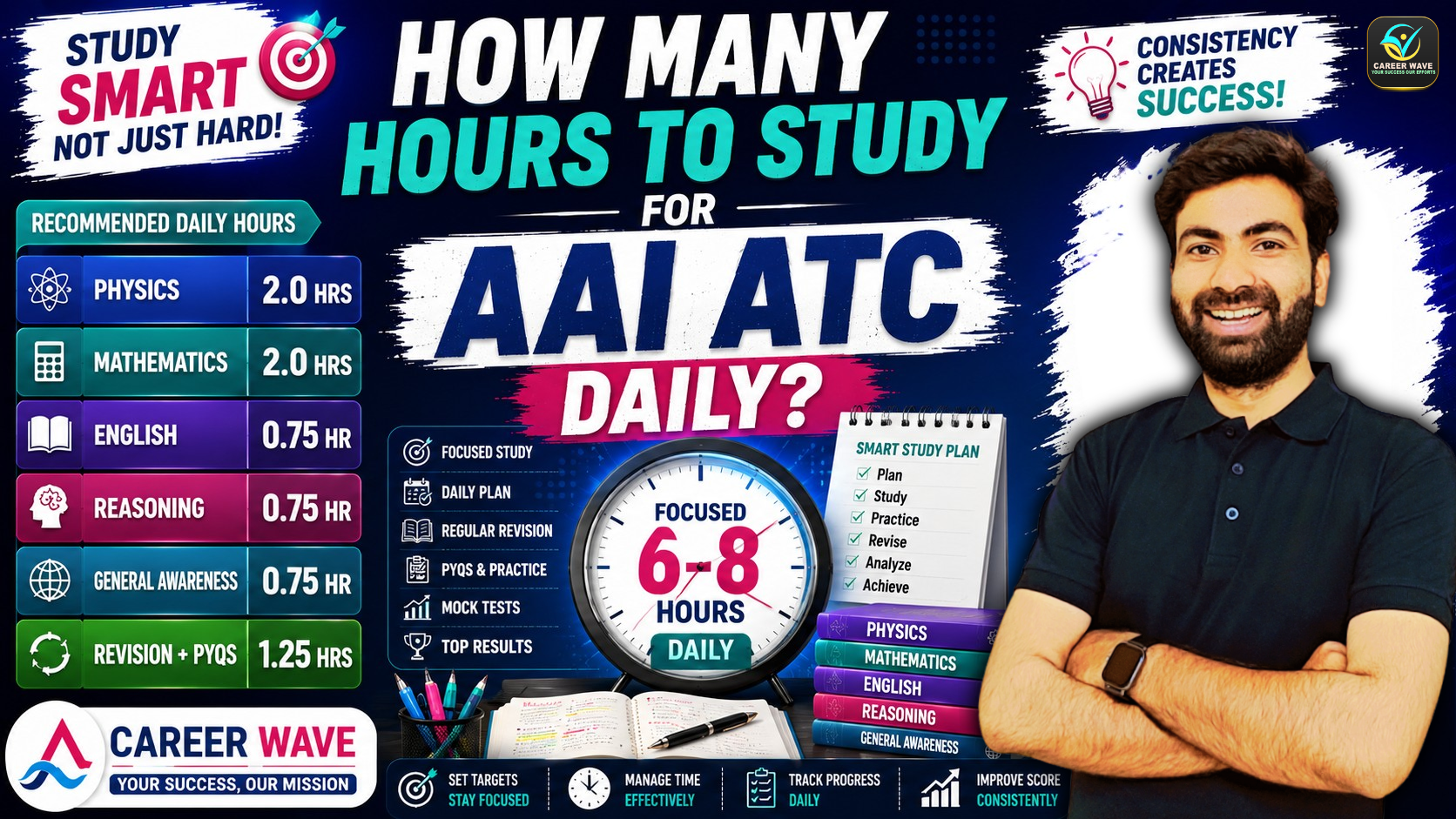
a) 2 hours – Technical core
o Concept revision + 30–40 high-quality MCQs from ATC-relevant topics.
b) 1 hour – Non-Tech
o 15–20 English Qs (RC, grammar, vocab)
o 15–20 Reasoning/Quant questions.
c) 1–1.5 hours – PYQ / Mock analysis
o Only ATC-labelled questions, not random.
d) Once a week – Full mock test
o Same time slot as actual exam; replicate real conditions.
Goal: Convert the cutoff trend into a daily “score pressure”—you are not studying randomly; you are studying to consistently beat 110 marks.