Why Studying More Hours Can Reduce Your AAI ATC Score
A Truth Most Aspirants Learn Too Late
By Career Wave
In AAI ATC preparation, one belief dominates almost every aspirant’s mind:
“The more hours I study, the higher my score will be.”
It sounds logical.
It sounds disciplined.
It sounds… wrong.
At Career Wave, after closely tracking preparation patterns, mock scores, and real exam outcomes of thousands of AAI ATC aspirants, we’ve observed a surprising truth:
👉 Studying more hours often reduces AAI ATC scores instead of increasing them.
This blog explains why this happens, how it silently damages performance, and what actually works in AAI ATC preparation.
AAI ATC Is Not a Memory Test — It Is a Performance Test
AAI ATC is a 120-minute CBT exam where success depends on:
• Speed
• Accuracy
• Mental stability
• Error control
It does not test:
• How long you studied
• How many books you finished
• How tired you can become
Yet many aspirants prepare as if endurance matters more than efficiency.
📌 Career Wave Insight:
If long study hours truly guaranteed success, the most exhausted students would top the exam. In reality, they don’t.
Reason 1: Mental Fatigue Kills Accuracy
The human brain has a limited high-focus capacity per day.
When you exceed it:
• Calculation errors increase
• Formula recall weakens
• Logical flow breaks
• Decision-making slows down
In AAI ATC, one silly mistake = multiple lost ranks.
Students studying 10–12 hours daily often:
• Solve more questions
• But make more mistakes
• And score lower in mocks
👉 Career Wave Rule:
Accuracy drops faster than knowledge increases after mental fatigue sets in.
Reason 2: Long Hours Create False Confidence
Long study sessions often create an illusion:
“I studied all day, so I must be improving.”
But improvement in AAI ATC is measured by:
• Faster solving time
• Fewer errors
• Better mock scores
Not by:
• Total hours
• Number of pages covered
Many Career Wave students realized that despite studying more, their mock scores stayed stagnant — or even declined.
📌 Why?
Because fatigue reduces exam-level performance, not textbook understanding.
Reason 3: Overstudying Destroys Retention
The brain learns best in short, focused bursts.
When study hours stretch too long:
• Concepts overlap
• Revision quality drops
• Memory consolidation fails
This is why students say:
“I studied this, but couldn’t recall it in the exam.”
Career Wave observed that students studying 6 focused hours consistently outperform those studying 10 distracted hours.
Reason 4: More Hours Increase Panic, Not Confidence
Ironically, overstudying increases stress.
Why?
• Constant exposure to syllabus reminds you how much is left
• Fatigue makes problems feel harder
• Confidence drops even when preparation is sufficient
In AAI ATC, panic leads to:
• Rushed calculations
• Poor time management
• Wrong attempt decisions
📌 Calm minds score higher than tired minds.
Reason 5: Long Hours Reduce Exam Simulation Quality
AAI ATC success depends heavily on:
• Mock analysis
• PYQ accuracy
• Exam-like solving conditions
Students who study all day often:
• Skip mock analysis
• Avoid revision
• Delay PYQs
Career Wave emphasizes exam simulation over content consumption — something long study hours actively destroy.
What Actually Improves AAI ATC Score? (Career Wave Formula)
Instead of asking:
❌ “How many hours should I study?”
Ask:
✅ “How many high-quality hours does my brain have?”
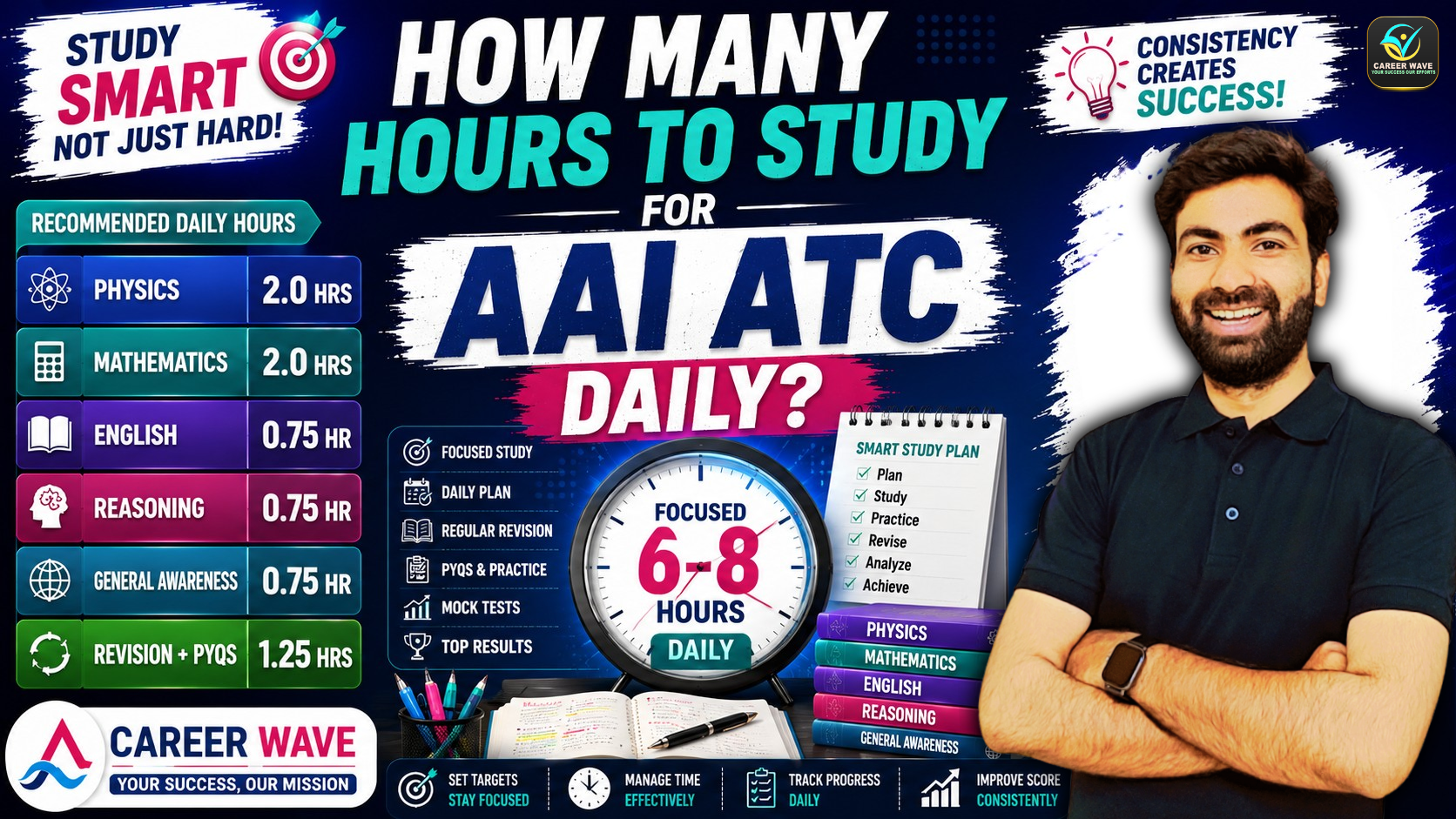
Career Wave’s Ideal Daily Model
• Maths / Physics: 2–3 hours each (deep focus)
• Revision / PYQs: 1–2 hours
• Mocks / Analysis: Regular, not rushed
• Rest & recovery: Non-negotiable
📌 Total: 6–7 focused hours — not more.
Signs You Are Studying Too Much (And Hurting Your Score)
• Mock scores stagnating or falling
• Increasing silly mistakes
• Feeling tired before starting a session
• Difficulty recalling known formulas
• Anxiety despite preparation
If you feel these, reduce hours — don’t increase them.
Why Fewer Hours Work Better for AAI ATC
Because fewer hours allow:
• Better concentration
• Higher accuracy
• Stronger recall
• Faster decision-making
Career Wave students who reduced study time but improved structure often saw 5–15 mark jumps in mocks.
Final Truth from Career Wave
✈️ AAI ATC is not cracked by the most tired student.
✈️ It is cracked by the most mentally fresh one.
Studying more hours feels productive —
But studying smart hours wins selections.
👉 If your goal is AAI ATC selection, protect your brain like an athlete protects muscles.
Less fatigue. More clarity. Higher score.
About Career Wave
Career Wave is India’s trusted platform for AAI ATC preparation, known for realistic strategies, PYQ-driven teaching, and performance-focused guidance — not motivational myths.
FAQs – Why Studying More Hours Can Reduce AAI ATC Score
1. Can studying 10–12 hours daily harm AAI ATC preparation?
Yes, it can.
AAI ATC is a high-focus, analytical exam, not a memory-based one. Studying for very long hours without proper breaks leads to mental fatigue, slower problem-solving, and careless mistakes—especially in Maths and Physics.
2. How many hours of study are actually ideal for AAI ATC?
For most aspirants, 5–7 focused hours per day is more than enough.
What matters is:
• Quality of focus
• Concept clarity
• Daily practice
• Proper revision
Career Wave recommends smart study blocks, not marathon sessions.
3. Why do toppers study fewer hours but score more?
Top scorers:
• Study with clear targets
• Practice exam-relevant questions
• Analyze mistakes regularly
• Revise weak areas instead of rereading theory
They don’t waste energy on over-studying. This is why Career Wave emphasizes strategy over struggle.
4. Does over-studying affect accuracy in the AAI ATC exam?
Absolutely.
Over-studying leads to:
• Brain fog
• Reduced calculation speed
• Silly mistakes in MCQs
• Poor time management
In AAI ATC, accuracy + speed matters more than how many hours you studied.
5. Is burnout common among AAI ATC aspirants?
Yes, very common.
Many students feel:
• Constant tiredness
• Loss of motivation
• Anxiety before tests
This usually happens due to long study hours without rest. Career Wave advises structured study plans with breaks to avoid burnout.
6. Should I study every subject every day?
No. Studying all subjects daily increases mental load.
A better approach is:
• 1 strong subject
• 1 moderate subject
• 1 light revision
This method improves retention and performance, as followed in Career Wave study schedules.
7. What is better: studying more or revising more?Revision is far more important.
Most AAI ATC failures happen due to:
• Forgotten formulas
• Weak basics
• Poor recall under pressure
Career Wave always stresses revision + mock analysis over increasing study hours.
8. Can taking breaks actually improve AAI ATC score?
Yes. Scientific studies show that:
• Short breaks improve focus
• Rest enhances memory retention
• Relaxed minds solve problems faster
That’s why Career Wave study plans include intentional breaks, not guilt-driven nonstop study.