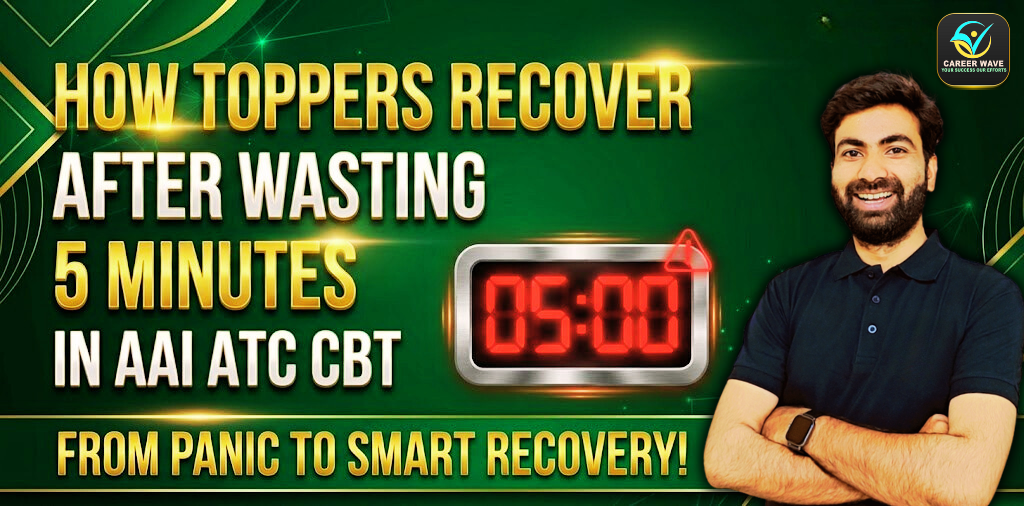
How Toppers Recover After Wasting 5 Minutes on One Question
(AAI ATC CBT – Real-Time Damage Control Strategy)
In AAI ATC CBT, 5 minutes on one question can silently destroy your rank.
The exam is not just about knowledge. It is about time intelligence.
Many serious aspirants make this mistake:
“Let me just solve this question… then I’ll pick up the speed.”
But toppers think differently.
They understand one harsh truth:
The exam doesn’t punish you for leaving one question.
It punishes you for losing control.
Let’s break down how toppers recover instantly after wasting 5 minutes — and how you can train the same mindset.
🚨 Step 1: Immediate Emotional Reset (Within 5–10 Seconds)
The biggest danger after wasting time is not the lost 5 minutes.
It is:
• Frustration
• Ego hurt
• Panic
• Speed breakdown
Average student reaction:
• “5 minutes got wasted.”
• “Now what will happen to my score?”
• Starts rushing next questions.
• Makes 2–3 silly mistakes.
Topper reaction:
• Accepts loss immediately.
• No emotional drama.
• Mentally says:
“Done. Move. Next.”
They don’t negotiate with the past.
👉 Recovery starts with emotional discipline.
🧠 Step 2: Strategic Cut Loss Decision
Toppers follow a simple internal rule:
If:
• No clear method in 60–90 seconds
• Calculation getting lengthy
• Concept doubtful
• Options not narrowing
➡ They mark for review and move.
But suppose they accidentally got stuck for 5 minutes.
What next?
They DO NOT:
• Try to justify time spent.
• Try to “recover” by solving it at any cost.
• Force answer due to ego.
Instead they:
• Leave it marked.
• Reset section strategy.
• Shift to easier scoring zone.
This is called damage containment.
⏳ Step 3: Micro Time Recalibration
Let’s say total time is 120 minutes.
You lost 5 minutes.
Topper thinking:
• Remaining time?
• Remaining questions?
• Adjust average time per question.
Example:
Before:
120 mins / 120 questions = 1 min per question
After wasting 5 mins:
115 mins / 119 questions ≈ 58 seconds per question
Topper shifts into:
• Fast recognition mode
• High ROI questions
• Avoid medium traps temporarily
They convert panic into math.
⚡ Step 4: 3-Minute Speed Recovery Burst
After a time loss, toppers do a controlled speed burst:
For next 3–5 questions:
• Attempt only direct questions.
• Avoid calculation-heavy.
• Skip instantly if not clear.
This builds:
• Momentum
• Confidence
• Flow restoration
They don’t rush randomly.
They accelerate strategically.
🧩 Step 5: Protect Accuracy at All Costs
The biggest mistake after time loss:
Speed increases. Accuracy collapses.
In AAI ATC, negative marking hurts more than slow attempts.
Toppers remember:
• One wrong = more damage than one unattempted.
• Calm 58 seconds > panicked 30 seconds.
They protect:
• Logical reasoning accuracy
• Numerical precision
• Option elimination clarity
Recovery means balance, not blind speed.
🛑 Why Most Students Collapse After One Time Trap
Here’s what usually happens:
1. Time wasted
2. Emotional disturbance
3. Rushed next 3 questions
4. 2 wrong answers
5 Confidence crash
6. Section rhythm gone
The actual loss becomes:
• 5 minutes
• 3 wrong answers
• 10-minute mental disturbance
That’s 15–20 minutes damage from one question.
Toppers stop the chain reaction at Step 1.
🎯 The Topper Formula (Golden Rule)
Inside CBT:
“No single question is bigger than my overall score.”
They treat every question like a stock trader treats trades:
• If profit → good.
• If loss → exit fast.
• Capital protection first.
🏆 Career Wave Recovery Framework
At Career Wave, we train aspirants on:
✅ 1. 60-Second Decision Rule
Never allow a question to cross 60–90 seconds without progress clarity.
✅ 2. Mock-Based Time Conditioning
We simulate:
• Time pressure traps
• Deliberate tough question placements
• Section switching drills
✅ 3. Emotional Neutrality Training
Students practice:
• Controlled skipping
• Review marking discipline
• Zero-ego solving
✅ 4. 15-Minute Endgame Planning
If time loss happens:
• Recovery mapping
• Attempt restructuring
• Safe accuracy prioritization
Because real exam success is:
Mental stamina + Tactical decisions.
📊 Psychological Insight: Why Ego Causes Time Loss
Intelligent students often think:
• “I know this concept.”
• “I’ve solved harder in mocks.”
• “It’s just a small calculation mistake.”
But exam pressure reduces working memory.
You are not solving from classroom mode.
You are solving under:
• Timer
• Stress
• Score comparison fear
Toppers detach from ego.
They solve from probability mindset.
🔥 Practical Recovery Drill (You Should Practice)
During mocks:
Intentionally:
• Pick one tough question.
• Spend 2–3 extra minutes.
• Then practice recovery mode.
Observe:
• Heart rate
• Emotional shift
• Accuracy in next 5 questions
Train your brain to recover, not react.
FAQs
1️ Should I attempt a question if I already spent 4–5 minutes on it?
No. Time already spent is sunk cost.
If clarity is missing, leave it. Protect remaining time.
2️ How do toppers decide instantly to skip?
They check:
• Is method clear?
• Is calculation manageable?
• Is answer path visible?
If not → mark and move.
3️ What if the question was actually easy but I panicked?
Happens. That’s why review marking exists.
Come back in final round with fresh mind.
4️ Can 5 minutes really change selection?
Yes.
AAI ATC cutoffs are tight.
One:
• Wrong answer
• Missed easy question
• Panic chain
Can drop rank significantly.
5️ How can I build recovery ability?
Through:
• Structured mocks
• Time discipline training
• Emotional control practice
• Guided analysis (not just score checking)
Career Wave focuses heavily on this aspect.
Final Reality
In AAI ATC CBT:
You will waste time on at least one question.
The difference between:
• Selected candidate
• Non-selected candidate
Is not perfection.
It is recovery ability.
Toppers don’t avoid mistakes.
They recover faster.
And in a competitive exam,
speed of recovery decides rank.
If you want structured training on:
• Time discipline
• Section strategy
• Mock analysis
• Psychological control
Career Wave helps aspirants think like toppers — not just study like them.
Because selection is not about solving everything.
It’s about controlling the exam.
Smart decisions.
Stable mindset.
High scores.
Related bolg-