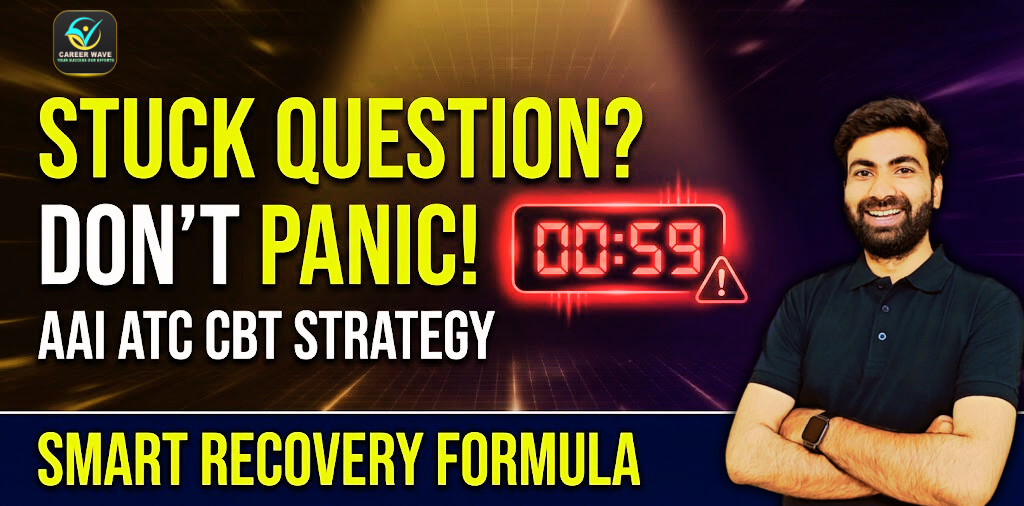
How to Handle the ‘Stuck Question’ Without Panicking
(Advanced CBT Psychology Guide for AAI ATC – By Career Wave)
Every serious AAI ATC aspirant experiences this moment inside the exam hall:
You read a question.
You understand the topic.
You start solving confidently…
And suddenly — progress stops.
The clock is ticking.
Your brain feels blocked.
Confidence starts shaking.
That single moment can decide whether your score stays stable — or collapses.
At Career Wave, after analyzing thousands of mock attempts and real CBT experiences, we’ve identified one powerful truth:
The difference between selection and rejection is not knowledge —
it is how you react when you get stuck.
Let’s go deeper.
What Actually Happens in Your Brain When You Get Stuck
When you cannot solve a question:
• The brain shifts from logical mode to stress mode
• Cortisol (stress response) slightly increases
• Working memory reduces
• Decision-making becomes rigid
This causes:
• Tunnel vision
• Re-reading the same line repeatedly
• Ignoring easier questions waiting ahead
In AAI ATC CBT, this psychological drop is extremely dangerous because:
⏳ You don’t have buffer time.
📊 It’s a relative competition.
⚡ Speed matters as much as accuracy.
Career Wave calls this the Micro Panic Loop.
The Micro Panic Loop (Danger Zone)
1. You get stuck.
2. You feel uncomfortable.
3. You try harder.
4. You waste 3–5 minutes.
5. You rush next questions.
6. You make 2–3 silly mistakes.
7. Confidence drops further.
This entire cycle can cost 8–15 marks.
The topper breaks the loop in step 2.
The 60-Second Decision Framework
Top performers follow a strict mental clock.
First 20 Seconds:
Understand the concept and approach.
Next 20 Seconds:
Check if calculation is manageable.
Last 20 Seconds:
If no clear path → exit.
No emotional debate. No ego.
📌 Career Wave Rule:
If clarity doesn’t appear fast, it won’t magically appear under pressure.
Why Students Refuse to Leave Stuck Questions
Let’s expose the real psychological reasons.
1. Ego Attachment
“I have studied this chapter. I must solve it.”
2. Fear of Missing Marks
“What if this is easy for others?”
3. Sunk Cost Fallacy
“I already spent 2 minutes. Let me try 2 more.”
4. Perfectionism
“I can’t leave questions.”
In AAI ATC, perfectionism is a trap.
Selection comes from efficiency, not completeness.
Advanced Recovery Strategy (Career Wave Exam Model)
When you detect you are stuck, apply this 5-step reset:
Step 1: Stop Writing Immediately
Don’t continue blind calculation.
Step 2: Ask One Logical Question
“Do I see the method clearly?”
If answer is no → exit.
Step 3: Mark for Review
No hesitation.
Step 4: Take One Deep Breath
Physiology controls psychology.
Step 5: Solve One Easy Question Immediately
This restores rhythm and confidence.
Momentum is everything in CBT exams.
The Rhythm Principle in AAI ATC
Your performance depends on flow.
Once you break flow:
• Speed drops.
• Error rate increases.
• Anxiety rises.
Top scorers protect their rhythm aggressively.
Career Wave trains students to think like this:
“I don’t fight difficult questions.
I collect easy marks first.”
When You Revisit the Stuck Question
Never return randomly.
Return only when:
✔ Easy questions are done
✔ You have regained confidence
✔ 15–20 minutes remain
Now re-read the question as if you are seeing it for the first time.
Many times:
• The trick becomes visible.
• You notice a missed detail.
• A shortcut appears.
Your brain needed distance.
Time Distribution Strategy (Very Important)
In AAI ATC CBT (120 minutes):
• First 40 minutes → Easy + Direct
• Next 50 minutes → Moderate
• Final 30 minutes → Difficult + Review
Stuck questions should enter the third phase — not the first.
Career Wave mock analytics show:
Students who delay tough questions improve score stability significantly.
What Makes Toppers Emotionally Different?
They:
✔ Accept uncertainty
✔ Detach from individual questions
✔ Think in total score, not single problem
✔ Stay objective
They don’t panic because they understand:
Every candidate is facing similar traps.
Real Example Scenario
Suppose you get stuck in Calculus at minute 35.
Wrong reaction:
• Spend 5 minutes forcing it.
• Enter minute 40 already frustrated.
• Miss easy Probability question next.
Correct reaction:
• Leave in 1 minute.
• Solve 6 easier questions in next 8 minutes.
• Return later with fresh brain.
Difference?
Nearly 10–12 marks swing.
Mental Conditioning Practice (Before Exam)
You must train this behavior before exam day.
In mocks:
• Force yourself to leave after 60 seconds.
• Practice deliberate skipping.
• Analyze time wasted per question.
At Career Wave, mock reviews focus more on decision mistakes than concept mistakes.
Because decision errors cost more marks.
Emotional Script You Must Remember in CBT
When stuck, say internally:
“Not now. I’ll come back.”
This one line prevents panic.
Important: When NOT to Leave Immediately
Leave only when:
• You see no direction.
• Calculation seems long.
• Question looks trap-based.
But if:
• You are 70% close to answer.
• Only small step left.
Then complete it.
Judgment improves with mock practice.
The Long-Term Benefit
Learning to handle stuck questions calmly:
✔ Improves real exam performance
✔ Builds emotional maturity
✔ Enhances decision timing
✔ Reduces burnout
AAI ATC selection is not just academic filtering.
It is psychological filtering.
Frequently Asked Questions (FAQs)
Q1. Is it normal to get stuck in AAI ATC CBT?
Yes. Even toppers get stuck. The difference is recovery speed.
Q2. How many questions should I leave initially?
Leave any question that crosses 60 seconds without direction.
Q3. Does skipping reduce attempt count?
Temporarily yes — but it increases final accuracy and total score.
Q4. What if many questions feel difficult?
Stay calm. Paper difficulty is uniform for everyone. Focus on what you can solve.
Q5. Can stuck moments reduce medical performance confidence later?
Yes. Repeated panic builds self-doubt. That’s why emotional control training is crucial.
Q6. How can Career Wave help with this?
We provide:
• Structured CBT simulation
• Time-behavior analysis
• Decision-making feedback
• Mock review focused on psychology
Because clearing AAI ATC requires more than concepts.
Final Words from Career Wave
A stuck question is not the enemy.
Your reaction is.
In AAI ATC CBT:
✔ Calmness beats intelligence
✔ Decisions beat emotions
✔ Recovery beats perfection
The exam does not test how much you know.
It tests how stable you remain under pressure.
If you want to master CBT decision psychology —
🚀 Prepare strategically with Career Wave — where strategy meets selection.
Related blog-
How Toppers Recover After Wasting 5 Minutes on One Question
Question Scanning vs Question Solving