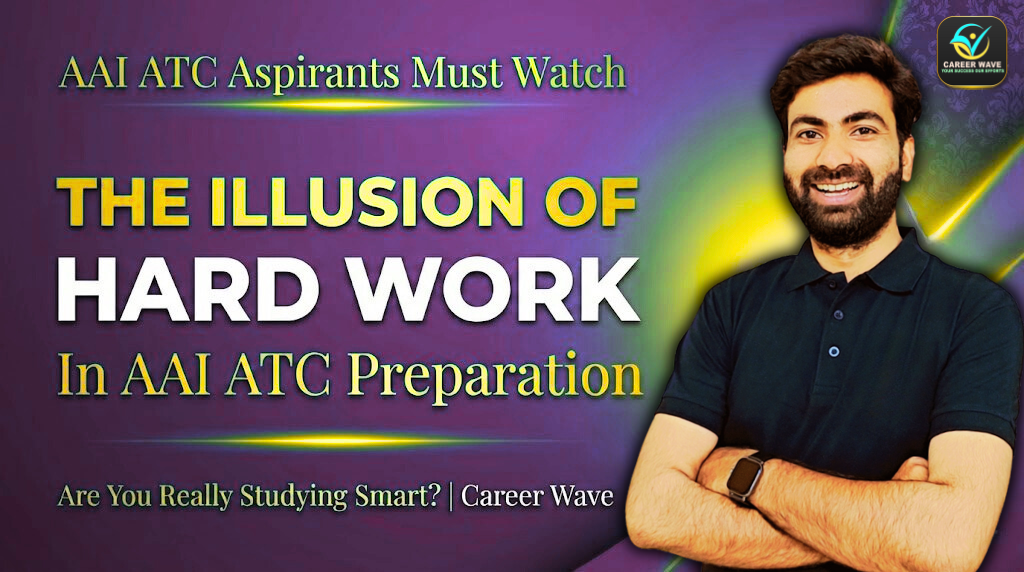
The Illusion of Hard Work in AAI ATC Preparation
Why Most Serious Aspirants Still Fail
Every year thousands of students prepare seriously for AAI ATC.
They wake up early.
They sit for long hours.
They sacrifice social life.
Yet many of them don’t clear the cutoff.
Why?
Because they are trapped in the illusion of hard work.
At Career Wave, we have analyzed hundreds of aspirants and found one common pattern:
Students are working hard — but not working strategically.
Let’s break this illusion in detail.
1) The Psychology Behind the Illusion of Hard Work
Human brain loves visible effort.
• Sitting for 8 hours feels productive
• Watching 5 lectures feels productive
• Completing a thick notebook feels productive
But exams reward:
• Speed
• Accuracy
• Pattern recognition
• Decision-making under pressure
You can study all day and still not improve your exam performance.
That’s the illusion.
2) Why AAI ATC Is Not a “Hard Work” Exam
AAI ATC is a performance exam, not a theoretical knowledge exam.
It tests:
• Fast calculations
• Quick elimination
• Logical clarity
• Mental stamina
• Smart question selection
If you:
• Spend 3 minutes on one quant question
• Get stuck emotionally
• Try to solve everything
You lose the game.
Hard work without strategy = Time loss.
3) The Most Common Illusions in AAI ATC Preparation
❌ Illusion #1: “More Hours = More Selection Chances”
Truth:
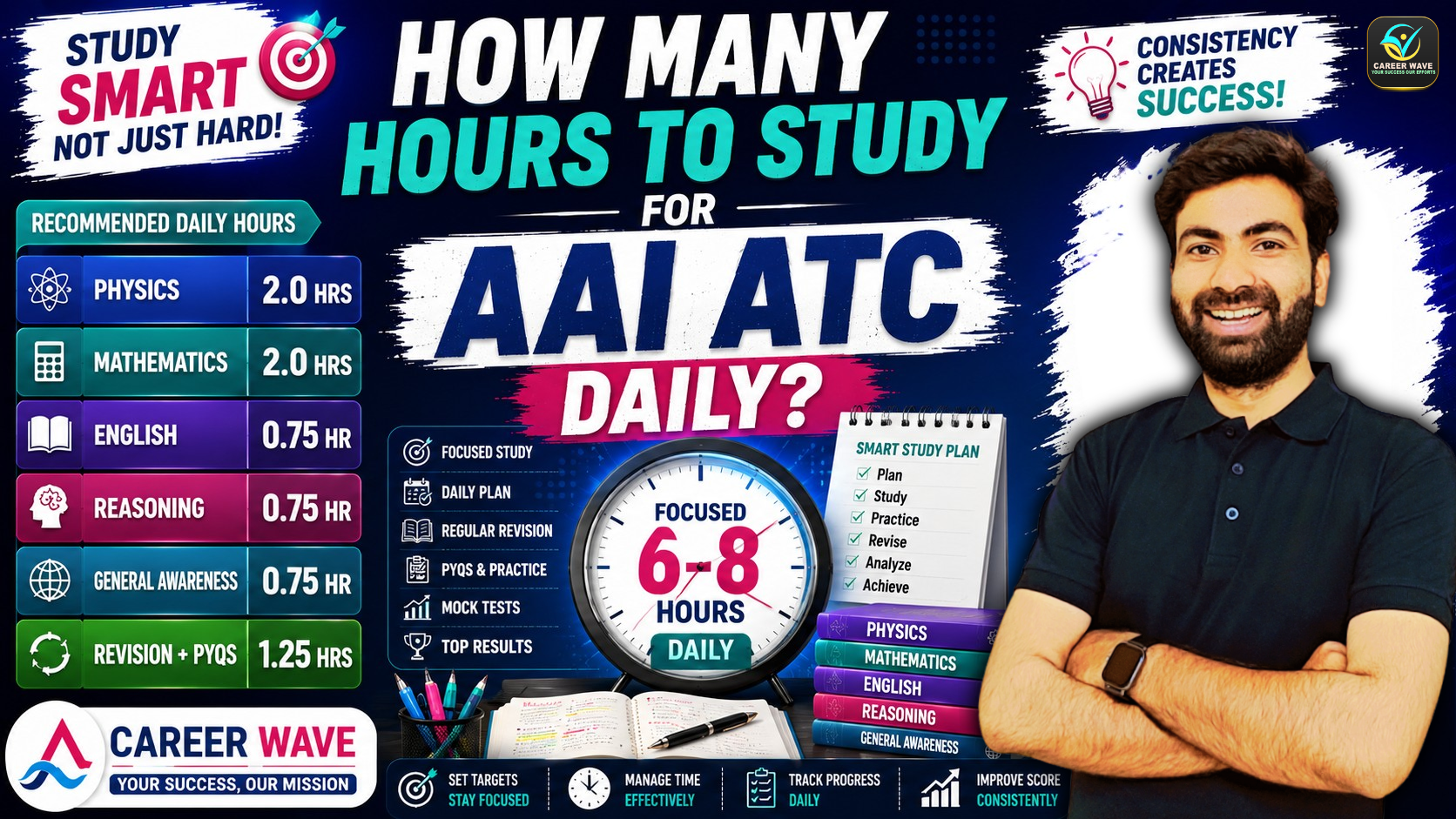
Focused 4–6 hours > 10 distracted hours
At Career Wave, we teach students to track:
• Accuracy percentage
• Average time per question
• Mock improvement rate
Not study hours.
❌ Illusion #2: “Syllabus Complete Karna = Preparation Complete”
Completing syllabus is step 1.
Selection depends on:
• Revision cycles
• PYQ mastery
• Mock test performance
• Error reduction
Many students’ complete syllabus once and move on.
AAI ATC requires 3–4 revisions minimum.
❌ Illusion #3: Avoiding Weak Topics
Students say:
“This topic is difficult, we'll do it later.”
Under “later” never case.
Smart strategy:
• Fix high-weightage weak areas first
• Leave low-weightage complex topics
That’s what we implement at Career Wave.
❌ Illusion #4: Watching Too Many Teachers
Switching batches, switching YouTube channels, switching notes.
Result:
• Confusion
• Overlap
• Zero depth
Golden Rule:
One source. Multiple revisions.
4) The Reality: What Actually Brings Selection in AAI ATC
✅ 1. PYQ-Based Preparation
Past Year Questions reveal:
• Question pattern
• Difficulty level
• Topic weightage
• Repeated concepts
At Career Wave, we follow PYQ-first strategy.
Because exam repeats pattern — not random theory.
✅ 2. Mock Test Intelligence
Mock test is not about score.
It is about:
• Question selection
• Time allocation
• Emotional control
• Pressure handling
After every mock, ask:
• Which section wasted my time?
• Where did I panic?
• Which topics need reinforcement?
Mock analysis > Mock score.
✅ 3. Time Per Question Discipline
AAI ATC demands:
45–60 seconds per question average.
If one question crosses 90 seconds:
Skip it.
Smart aspirants know:
Selection is about total score, not ego solving.
✅ 4. Accuracy Over Attempts
Many aspirants try to increase attempts.
But:
80 attempts with 90% accuracy >
95 attempts with 75% accuracy
Cutoff race rewards precision.
5) The Burnout Trap
Hard work without structure leads to:
• Mental fatigue
• Confidence drop
• Motivation crash
• Comparison anxiety
Students start doubting themselves.
But problem is not capability.
Problem is direction.
At Career Wave, structured preparation avoids burnout through:
• Weekly revision plans
• Sectional tests
• Strategy sessions
• Performance tracking
6) Hard Work vs Smart Work (Deep Comparison)
Hard Work Mindset | Smart Work Mindset |
“I will attempt the entire paper.” | “I will attempt selectively.” |
“I know this question, so I will solve it.” | “This is wasting time, I will skip it.” |
“The syllabus is complete.” | “Has my performance become stable?” |
Emotional attachment to questions | Strategic detachment |
Focus on quantity | Focus on efficiency |
Selection requires emotional maturity.
7) How to Break the Illusion Today
Step 1: Stop counting hours
Track performance metrics instead.
Step 2: Start giving mocks early
Even if syllabus incomplete.
Step 3: Analyze mistakes deeply
Maintain error notebook.
Step 4: Follow one structured program
Avoid random preparation.
Step 5: Improve decision-making
Practice skipping.
8) Career Wave’s AAI ATC Smart Framework
Our preparation model focuses on:
🔹 Concept clarity
🔹 PYQ mastery
🔹 Time-bound practice
🔹 Weekly mock analysis
🔹 Strategy correction
🔹 Mental conditioning
We don’t just teach subjects.
We train selection mindset.
Final Reality Check
Hard work feels satisfying.
Smart work feels uncomfortable.
Because smart work forces you to:
• Face weaknesses
• Analyze mistakes
• Accept flaws
• Improve discipline
But that discomfort leads to selection.
If you are serious about AAI ATC 2026:
Don’t chase exhaustion.
Chase efficiency.
Prepare smart.
Prepare strategically.
Prepare with Career Wave.
FAQs
Q1. Is 8–10 hours daily study wrong for AAI ATC?
Not wrong — but only effective if structured, timed, and revision-based. Random long hours are ineffective.
Q2. When should I start giving full-length mocks?
Within 40–50% syllabus completion. Waiting for 100% completion delays performance training.
Q3. How important are PYQs in AAI ATC?
Extremely important. They reveal pattern repetition and real exam difficulty.
Q4. What is the ideal accuracy target?
Minimum 85–90% accuracy in mocks before exam.
Q5. Why do hardworking students fail?
Because effort without exam strategy leads to poor time management and emotional mistakes.
Q6. How does Career Wave prevent the illusion of hard work?
By focusing on performance metrics, structured mock cycles, and strategic preparation rather than just long study hours.
Related blogs-
Maths Topics That Look Easy but Waste Maximum Time (AAI ATC & Competitive Exams)
Why Some Numericals Should Never Be Attempted