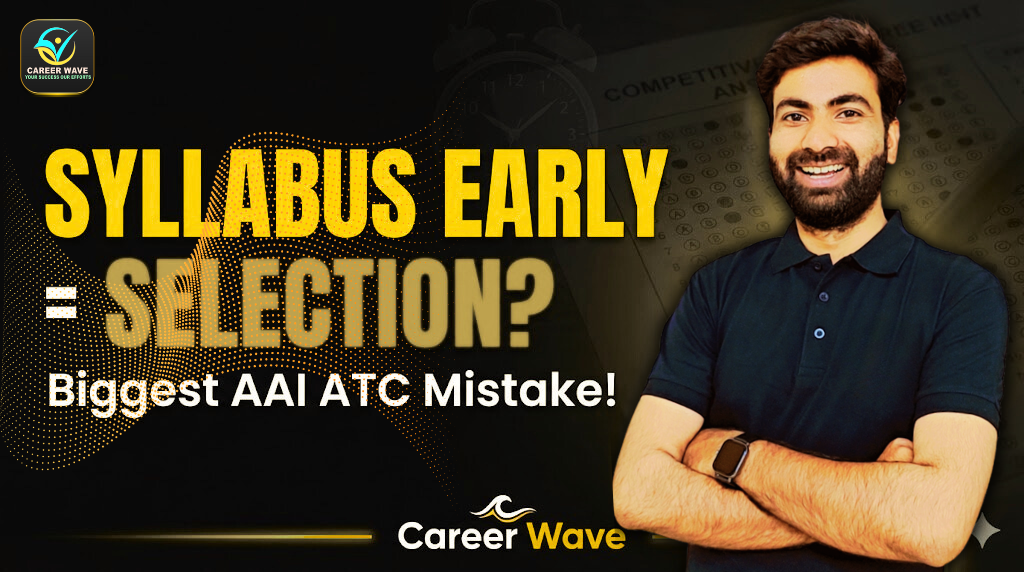
Why Completing Syllabus Early Doesn’t Guarantee Selection
In competitive exams like AAI ATC and other technical government exams, one belief dominates most aspirants’ mindset:
“If I complete the syllabus early, I will definitely get selected.”
On the surface, it sounds logical. Finish early → revise more → stay ahead.
But reality is very different.
At Career Wave, after mentoring hundreds of aspirants, we have observed something surprising:
Many students who complete the syllabus early fail.
And many who complete slightly later — but strategically — clear the exam.
Why?
Because selection is not a syllabus race. It is a performance competition.
Let’s break this down scientifically and practically.
1) The Psychological Trap of Early Completion
When you complete the syllabus early, three psychological effects happen:
🔹 1. Artificial Confidence
You feel prepared because “everything is done.”
But your brain mistakes familiarity for mastery.
Reading something once makes it feel known — but that doesn’t mean you can apply it under exam pressure.
🔹 2. Reduced Urgency
You may slow down:
• “I have time.”
• “Revision later.”
• “Mocks after finishing everything perfectly.”
This comfort zone reduces competitive sharpness.
🔹 3. Social Comparison Trap
Seeing others still completing syllabus boosts ego:
“I’m ahead.”
But the exam doesn’t test who finished first.
It tests who performs best for 2 hours.
2) Completion ≠ Retention
Memory science clearly shows:
Without revision:
• 50% of information fades within days
• 70% fades within weeks
If you complete syllabus in January and exam is in June:
Without systematic revision cycles, most of your early preparation becomes weak.
At Career Wave, we focus on:
• Active recall techniques
• Spaced repetition
• Formula drills
• Rapid revision frameworks
Because retention wins exams — not early reading.
3) Real Exam Demands Application Under Pressure
AAI ATC exams are not theory-based memory tests. They test:
✔ Fast numerical solving
✔ Concept switching between subjects
✔ Time management
✔ Accuracy under stress
Students who rush syllabus often:
• Don’t practice mixed questions
• Avoid difficult problem sets
• Focus on comfort topics
• Delay full-length mocks
So, when the real exam presents unpredictable question patterns, they struggle.
4) The “Mock Test Delay” Mistake
This is one of the biggest issues.
Many aspirants say:
“Let me complete syllabus fully, then I will start mocks.”
This delays real performance training.
Mock tests help you:
• Understand exam temperament
• Learn question selection strategy
• Improve time allocation
• Identify weak zones early
Students who start mocks early (even with incomplete syllabus) improve faster than those who wait for perfection.
At Career Wave, we recommend:
• Sectional mocks early
• Full-length mocks gradually
• Deep analysis after each test
Because analysis is where real growth happens.
5) Early Completion Without Depth = Surface Preparation
There are two types of preparation:
Type A: Fast Coverage
• Watch lectures quickly
• Make short notes
• Solve few basic questions
• Move to next topic
Type B: Layered Mastery
• Concept understanding
• Standard questions
• Advanced variations
• Previous year analysis
• Mixed application
Type A students finish syllabus early.
Type B students finish slightly later — but dominate in the exam.
Guess who gets selected?
6) The Rank Deciding Factors (What Actually Matters)
Selection depends on:
🔥 1. Accuracy Rate
Even 5–6 wrong questions can push you out of the safe zone.
🔥 2. Speed Optimization
Can you solve 25 questions in 20 minutes without panic?
🔥 3. Weak Area Control
Most aspirants avoid weak topics.
Selected candidates convert weak areas into stable zones.
🔥 4. Exam Psychology
• Handling pressure
• Staying calm
• Recovering after difficult section
• Avoiding over-attempting
These skills develop only through mock exposure — not syllabus completion.
7) The Illusion of “Done Once is Enough”
Many students think:
“I studied this once. I know it.”
But competitive exams require:
• Instant recall
• Pattern recognition
• Quick elimination
• Multi-step numerical speed
This comes from:
🔁 Repetition
🧠 Concept interlinking
📊 Continuous testing
At Career Wave, we train aspirants for performance consistency, not one-time learning.
8) The Strategic Preparation Model (What Actually Works)
Here is the model we recommend:
Phase 1: Concept + Practice Parallelly
Don’t just watch lectures.
Solve questions the same day.
Phase 2: 60–70% Completion → Start Mocks
Don’t wait for perfection.
Start sectional tests early.
Phase 3: Performance Tracking
Maintain:
• Accuracy log
• Weak topic tracker
• Time management analysis sheet
Phase 4: Revision Cycles
Minimum 3 strong revisions:
1️ Concept revision
2️ Speed revision
3️ Final polishing revision
Phase 5: Pressure Simulation
Attempt mocks in:
• Strict time
• Exam-like environment
• No distraction
9) What Makes Career Wave Different?
At Career Wave, our preparation system focuses on:
✔ Structured timetable planning
✔ Weekly performance review
✔ Mock test analysis sessions
✔ Strategy-based preparation
✔ Practical exam temperament training
We don’t promote “finish fast” culture.
We promote “perform better” culture.
10) Final Reality Check
Early completion gives mental comfort.
But competitive exams reward:
• Precision
• Smart execution Strategic consistency
• Psychological stability
Remember this:
Syllabus completion is preparation.
Mock performance is selection.
11) Frequently Asked Questions
Question 1. Does completing syllabus early give an advantage?
Yes — but only if you:
• Revise multiple times
• Start mocks early
Maintain consistency
Otherwise, advantage disappears.
Question 2. What percentage of syllabus should be completed before starting mocks?
Around 60–70% is enough to start sectional mocks.
You don’t need 100% completion.
Question 3. Why do some early finishers still fail?
Because:
• They lack exam pressure exposure
• They don’t analyze mistakes
• They overestimate preparation
• They ignore weak areas
Question 4. How many mock tests are ideal before exam?
Quality matters more than number.
20–30 well-analyzed mocks are better than 60 blindly attempted tests.
Related blogs-
The Illusion of Hard Work in AAI ATC Preparation
Maths Topics That Look Easy but Waste Maximum Time (AAI ATC & Competitive Exams)