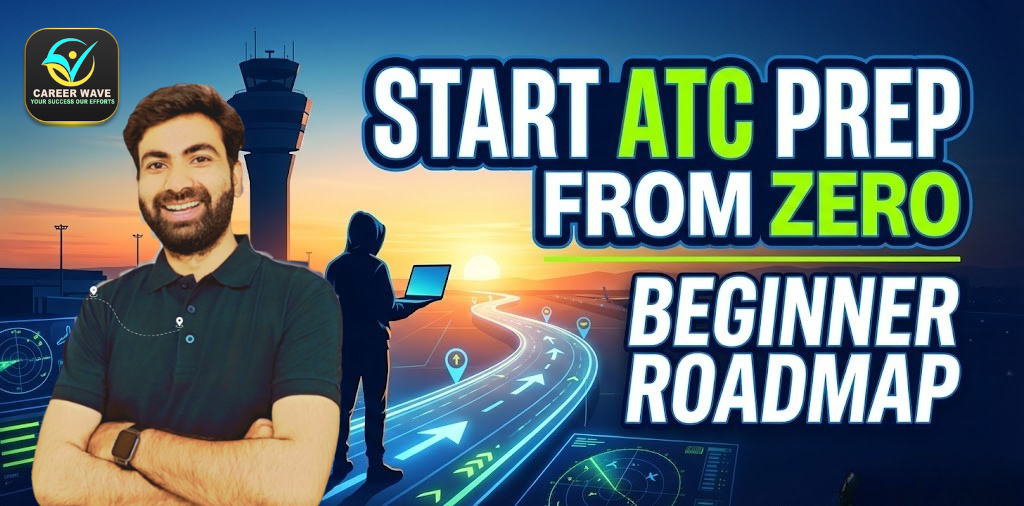
How to Start ATC Preparation from Zero (Beginner Roadmap)
Starting your AAI JE (ATC) preparation from zero can feel overwhelming. New aspirants often think the syllabus is vast, the competition is huge, and they don’t know where to begin. The truth is: ATC is one of the most structured exams in India, and with the right roadmap, any beginner can reach selection-level performance within months.
This guide gives you a step-by-step roadmap, complete syllabus breakdown, 30-day plan, NCERT strategy, PYQ pattern, common mistakes, and a final checklist.
1. Understanding the ATC Exam (Beginner-Friendly)
AAI ATC (Air Traffic Controller) exam is conducted to recruit JE (Junior Executive – ATC). The job role involves managing aircraft movement, ensuring safety, maintaining air traffic flow, and communicating with pilots.
Exam Structure
· Stage 1 – CBT (120 Questions, 2 hours, No Negative Marking)
• Technical: Physics + Maths (60 Q)
• Non-Tech: English + Reasoning + Quant + GK (60 Q)
· Stage 2 – Voice Test
· Stage 3 – Document Verification
· Stage 4 – Medical (CAT-III B)
Why beginners can crack this easily:
· The syllabus is predictable.
· PYQs repeat conceptually.
· No negative marking means scores can shoot high.
· Physics and Maths rely heavily on Class 11–12 fundamentals.
2. Complete Syllabus Breakdown (Tech + Non-Tech) – Complete Syllabus
3. Beginner’s 30-Day Starter Plan (Day 1 to Day 30)
This plan builds fundamentals quickly and avoids overwhelm.
Week 1: Foundation Setup
· Read NCERT Physics 11 (Units/Kinematics/NLM)
· Learn Calculus basics (Limits + Derivatives)
· Start English: 10 vocab/day
· Reasoning: Blood Relations + Direction sense
· GA: Start Static GK (Indian Polity basics)
Week 2: Moderate Concepts
· NCERT Physics 11: WEP, COM, Rotational, Gravitation
· Maths: Application of Derivatives + Integrals
· English: Reading comprehension
· Quant: Percentages + Ratio
· Reasoning: Coding-Decoding + Series
Week 3: Class 12 Physics + Strong Maths
· NCERT Physics 12: Electrostatics + Capacitance + Current
· Maths: Matrices, Determinants, Probability
· Quant: TSD + Time–Work
· English: Para jumbles + Cloze test
· Reasoning: Syllogism + Analogy
Week 4: High-Weight Topics
· Physics 12: EMI + AC + Optics + Semiconductors
· Maths: 3D, Vectors, DE
· Quant: DI
· English + GA revision
· Start 1 Full Mock Test
By the end of 30 days:
You will have covered 60–70% of concepts needed for strong ATC preparation.
4. NCERT Usage Guide for ATC
NCERTs are your base textbook for Physics. Here's how to use them:
o Class 11 NCERT
· Focus more on conceptual chapters:
Kinematics, NLM, WEP, Fluids, Thermodynamics, Oscillations
· Solve all in-text & exercise conceptual questions.
o Class 12 NCERT
This is 80% of the Physics section.
· Read theory + examples in:
Electrostatics, Capacitance, Current, Magnetism, EMI, AC
· Pay special attention:
Ray Optics + Semiconductors
· Make formula sheet for each chapter.
Important Note
NCERT alone is not enough; combine NCERT with PYQs to identify ATC-specific patterns.
(Career Wave’s Super-50 batch follows exactly this NCERT-PYQ-Concept-Test pattern
5. PYQ Pattern Analysis (Tech + Non-Tech)
o Technical (Physics + Maths)
Trends (2021–2023):
· Physics dominates with ~36–40 questions.
· Most repeated areas:
Electrostatics → Current → Optics →Semiconductor → Waves → Thermodynamics.
· Maths contributes: Calculus, Matrices, Probability, Vectors.
o Non-Tech
· English and Reasoning are generally easy.
· Quant is moderate but limited to basic arithmetic.
· GK stays mostly static + simple current.
Overall: PYQs show repeatability. Conceptual questions appear in similar formats every year.
6. Starting Your Preparation – Step-by-Step Roadmap
Step 1: Understand syllabus deeply
Print the syllabus and keep it on your study table.
Step 2: Build NCERT foundation
Read Class 11 + 12 Physics sequentially.
Step 3: Solve PYQs from Day 10
Don’t wait to finish the syllabus.
Step 4: Make formula sheets
One formula sheet for Physics, one for Maths.
Step 5: Give weekly mock
Mock → Analysis → Correction
Step 6: Learn non-tech as a “score booster”
Non-tech can give 50+ marks easily.
Step 7: Use structured courses
A guided module helps a beginner avoid confusion.
(Career Wave's Super-50 and Scorer follow step-wise ATC-specific sequencing.)
7. Common Mistakes Beginners Make
· Starting with YouTube random videos instead of NCERT.
· Studying without completing PYQs.
· Ignoring Maths initially and focusing only on Physics.
· Not practicing Non-Tech, losing easy marks.
· Not taking mocks early.
· Over-highlighting NCERT without understanding.
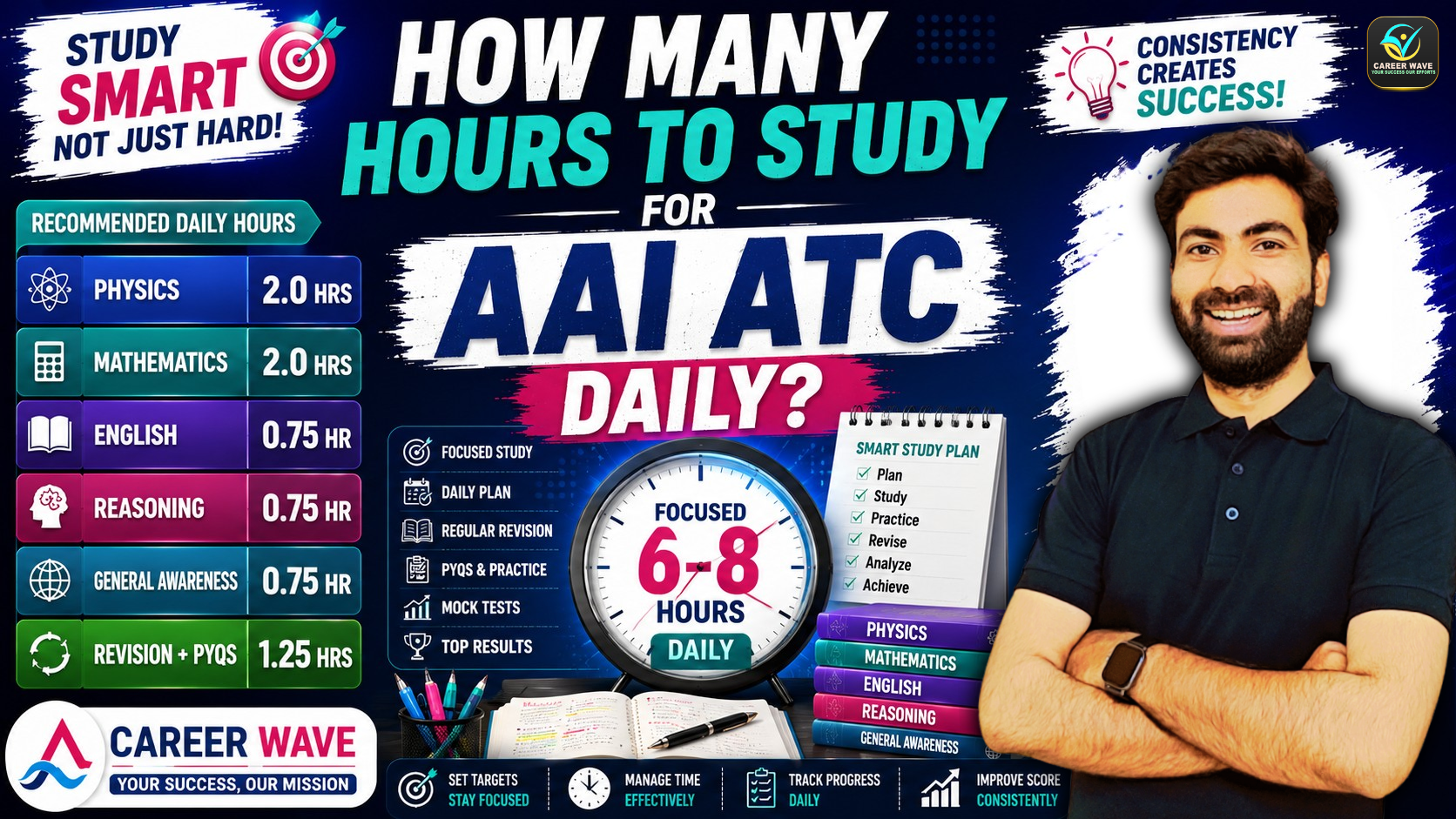
· No fixed daily 3–4 hour study plan.
· Depending on multiple coaching channels, creating confusion.
8. Subtle Career Wave Recommendation (No Hard Sell)
If you are starting from zero and want a guided, structured path, Career Wave’s ATC programs follow a predictable sequence:
üSUPER-50 (Tech+Non-Tech) – Bilingual & English
üSCORER (Tech only)
üIncludes: NCERT → PYQs → Practice Sets → Weekly mocks → Mentorship
Course link (for reference):
https://careerwave.org/new-courses
The structure is designed specifically for ATC beginners.
9. Final Beginner Checklist
Before starting:
· Print syllabus
· Download NCERT 11 + 12 PDFs
· Create two notebooks (Physics + Maths)
Weekly tasks:
· Study 4–5 Physics chapters
· Solve 50 PYQs
· Give one mock test
· Complete 1 GA weekly capsule
Concept mastery checks:
· Can you solve NCERT exemplar basics?
· Can you solve 70% PYQs without struggle?
· Do you revise formulas every week?
Final aim:
Build strong fundamentals → practice PYQs → score high in mock → repeat.