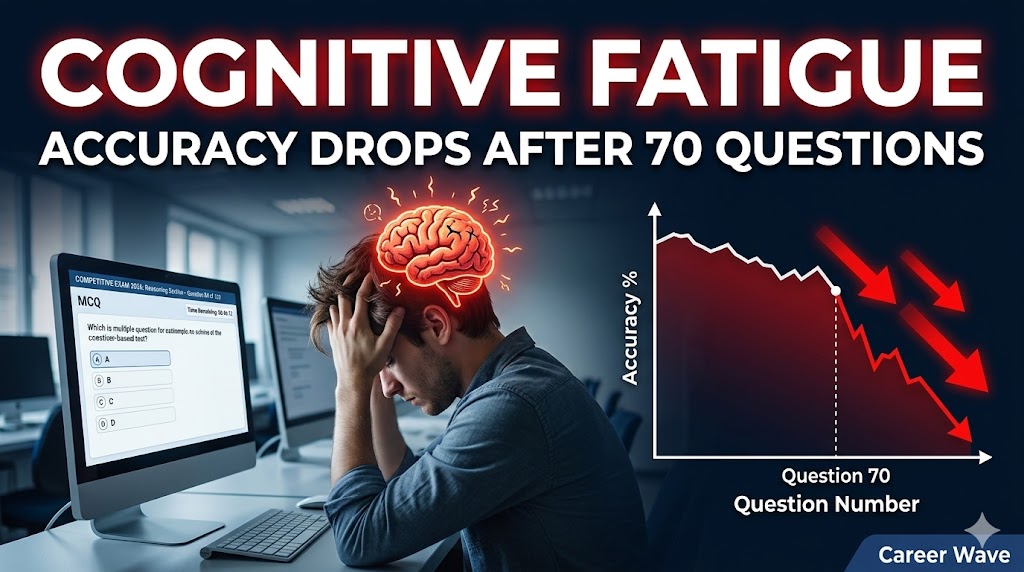
Cognitive Fatigue in Competitive Exams: Why Accuracy Drops After 70 Questions
Preparing for competitive exams requires months of focused study, concept clarity, and continuous practice. However, many aspirants experience a common problem during mock tests or real exams — their accuracy suddenly starts dropping after attempting around 60–70 questions. Even when they know the concepts well, mistakes increase and their solving speed decreases.
This phenomenon is called cognitive fatigue, a psychological and neurological condition where the brain becomes mentally exhausted after prolonged concentration and decision-making. In high-pressure exams like the Air Traffic Controller exam conducted by the Airports Authority of India, cognitive fatigue can significantly affect performance if candidates are not trained to manage it properly.
At Career Wave, mentors often emphasize that competitive exams are not just about knowledge or syllabus completion. They are also tests of mental endurance, focus, and decision-making under pressure.
1) What Is Cognitive Fatigue?
Cognitive fatigue refers to the gradual decline in mental performance after long periods of intense thinking. During competitive exams, the brain performs several demanding tasks simultaneously:
• Reading and interpreting questions
• Recalling formulas and concepts
• Performing calculations
• Comparing answer choices
• Making quick decisions under time pressure
Initially, the brain performs these tasks efficiently. But as the exam progresses, mental resources become depleted, and the brain struggles to maintain the same level of attention and accuracy.

2) This is why students often experience problems such as:
• Small calculation errors
• Misreading questions
• Selecting incorrect options despite knowing the concept
• Reduced solving speed
Even top-performing students face cognitive fatigue during long exams.
3) Why Accuracy Often Drops After 70 Questions
Through mock test analysis, educators have observed that many students start making more mistakes after attempting a large number of questions. Several psychological and biological factors contribute to this pattern.
3.1 Mental Energy Depletion
The brain consumes a large amount of energy during intense thinking and problem-solving. Every question requires focus, reasoning, and memory recall.
After solving dozens of questions continuously, the brain's available energy reduces. As a result, concentration becomes weaker and the chances of mistakes increase.
This is one of the main reasons why accuracy begins to decline during the later stages of an exam.
3.2 Decision Fatigue
Competitive exams require constant decision-making. Students must repeatedly decide:
• Whether to attempt or skip a question
• Which formula or method to apply
• Whether the calculation is correct
• Which option is the best answer
Making hundreds of decisions in a short period leads to decision fatigue, which reduces the quality of later decisions.
At Career Wave, students are trained to develop structured decision strategies so they do not waste mental energy analyzing every question from scratch.
3.3 Reduced Attention Span
After long periods of intense concentration, the brain’s ability to maintain focus decreases. Students may begin to overlook small details in questions.
Common attention mistakes include:
• Ignoring negative signs
• Misreading units
• Missing key words like not, least, or incorrect
• Selecting the wrong option accidentally
These small mistakes can significantly reduce exam scores.
3.4 Stress and Time Pressure
As the exam progresses, students start worrying about the remaining time and the number of unanswered questions. This pressure increases stress levels and disrupts logical thinking.
Stress can lead to rushed decisions and careless mistakes, especially toward the end of the exam.
3.5 Information Overload
The brain can only process a limited amount of information at a time. When students continuously process complex questions, formulas, and calculations, the brain becomes overloaded.
This overload makes it harder to focus on new questions, which contributes to declining accuracy.
4) Signs That Cognitive Fatigue Has Started
Many students do not realize when cognitive fatigue begins during the exam. Some common warning signs include:
• Reading the same question repeatedly
• Feeling mentally slow or confused
• Making simple calculation mistakes
• Feeling frustrated or impatient
• Guessing answers randomly
Recognizing these signs early allows students to adjust their strategy and regain control.
5) How Toppers Manage Cognitive Fatigue
Top-performing candidates understand that competitive exams are mental endurance tests. They use several strategies to maintain accuracy throughout the exam.
6) Balanced Question Attempt Strategy
Instead of attempting questions randomly, toppers select questions strategically. They prioritize questions that can be solved quickly and accurately, conserving mental energy for later sections.
7) Controlled Solving Pace
Many average students start solving questions very quickly in the beginning and exhaust themselves mentally. Toppers maintain a steady and controlled pace to preserve energy throughout the exam.
8) Smart Skipping
When a question appears lengthy or confusing, toppers skip it immediately and return later if time allows. This prevents unnecessary mental exhaustion.
9) Micro Mental Breaks
Sometimes taking a 5–10 second pause, stretching fingers, or taking a deep breath can help the brain reset and restore focus.
These small mental breaks help maintain clarity during long exams.
10) Training the Brain to Resist Cognitive Fatigue
Cognitive endurance can be improved with the right training methods.
11) Full-Length Mock Tests
Regular mock tests simulate real exam pressure and train the brain to maintain concentration for longer durations.
12) Sectional Practice
Practicing sections separately helps students build confidence and improve speed before attempting full-length tests.
13) Pattern Recognition
The more questions a student practices, the faster the brain recognizes patterns. This reduces mental effort and improves solving efficiency.
14) Revision Cycles
Frequent revision helps convert concepts into long-term memory. When concepts are easily recalled, the brain spends less energy solving questions.
15) How Career Wave Helps Students Overcome Cognitive Fatigue
At Career Wave, preparation focuses not only on syllabus completion but also on building exam intelligence and mental endurance.
The training system includes:
• Full-length CBT mock tests that replicate real exam conditions
• Detailed mock analysis to identify accuracy drop patterns
• Training in question selection strategies
• Guidance on time management and mental energy control
These methods help students maintain strong accuracy even in the later stages of competitive exams.
16) Final Thoughts
Cognitive fatigue is a natural challenge in long competitive exams. Even well-prepared students can experience it if they are not mentally trained for exam endurance.
Understanding why accuracy drops after many questions allows aspirants to develop smarter exam strategies. With consistent practice, controlled pacing, and proper mock test analysis, students can maintain high accuracy throughout the exam.
Institutes like Career Wave emphasize that cracking competitive exams requires not only knowledge but also mental discipline, focus, and effective decision-making.
By training the brain along with the syllabus, aspirants can significantly improve their performance and confidence during the exam.
17) Frequently Asked Questions
What is cognitive fatigue in competitive exams?
Cognitive fatigue is mental exhaustion that occurs after prolonged concentration and problem-solving during exams.
Why does accuracy drop after many questions?
Accuracy drops because the brain becomes tired after continuous thinking, leading to reduced focus and decision fatigue.
How can students prevent cognitive fatigue during exams?
Students can reduce cognitive fatigue by practicing mock tests, maintaining a steady pace, skipping difficult questions, and taking short mental pauses.
Do toppers also experience cognitive fatigue?
Yes, but toppers manage it effectively through better time management, question selection, and mental endurance training.
How does Career Wave help students improve exam endurance?
Career Wave provides structured preparation, full-length CBT mock tests, and exam strategy training to help students maintain focus and accuracy throughout competitive exams.
Related Blogs-
Why Completing Syllabus Early Doesn’t Guarantee Selection
How Much Time One Question Is Actually Worth in AAI ATC?